Cria Cuervos

cria cuervos
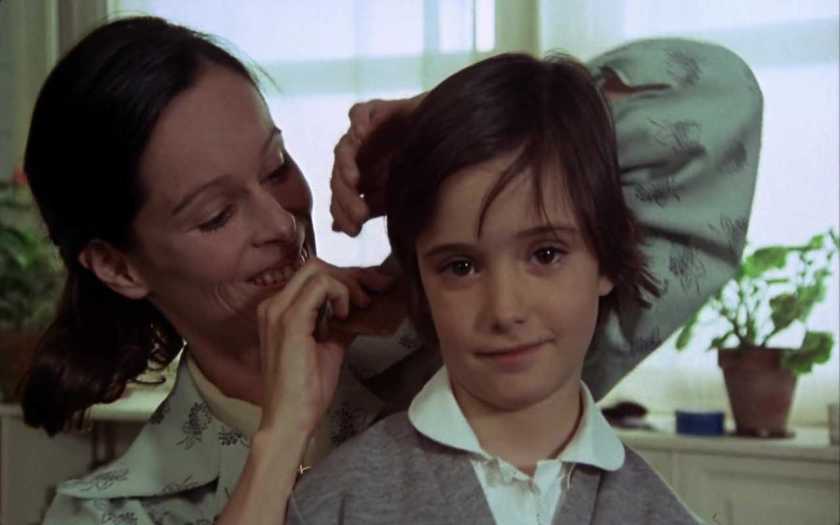
Ana (Ana Torrent) is convinced she poisoned her own father and keeps getting strange visits from the ghost of her mom (Geraldine Chaplin). She holds her father responsible for the illness and painful death of her mother. Her aunt arrives to take care of the girls, but unlike her sisters, Ana doesn’t subscribe to her aunt’s disciplinarian ways and begins to imagine her death as well. The all-female household is completed by the children’s grandmother, mute and unmoving in a wheelchair, and the weird housekeeper Rosa. As Cria Cuervos’s uneventful narrative unfolds, the dead parents continue to appear unpredictably in the present. Raised under their aunt Paulina, Ana, and her sisters retreat into make-believe, dressing up as soldiers and lovers, and dancing to a song called past Porque te vas. The film is all about children and their loss of innocence by being corrupted by the adults around them, yet it is also about how their innocence causes them to not understand the concepts such as infidelity or death. Ana does not understand the difference between death and mere absence. She attempts to murder her aunt. She washes her father’s glass of poison (or at least what she believes is poison) without a hint of remorse.

As an allegorical drama, Cría Cuervos serves as a chilling yet beautiful counter to the repressive Franco regime, which director Carlos Saura was in opposition to. The Franco regime had implemented strict censors on anything that would cause Spain to be seen in a bad light. The only way these expressions would be able to get Franco’s censorship was through the use of careful metaphors and symbols.
La isla mínima(Marshland)

Marshland

Set in 1980, it follows two cops, Juan (Javier Gutiérrez) and Pedro (Raúl Arévalo), investigating the disappearance of teenage girls in a remote part of rural Andalusia. While investigating the death and mutilation of two girls found in a swamp, they find out that they are dealing with a serial killer.  Two other girls were murdered in similar ways, on almost the same dates, in both 1978 and 1979.  Juan and Pedro, who have never met until now , don’t like each other.  Pedro has disdain for the older Juan’s boozing, womanizing ways. However, their differences make each encounter with suspects interesting, as we see how each man handles certain situations.  Directed by Alberto Rodriguez, the film was intentionally set in 1980, when the country was reeling from the end of Franco’s undemocratic rule and learning to adapt to a more liberal society. Pedro is more methodical and observant, while Juan is impulsive and prone to using his fists to get answers while questioning the witnesses. Pedro despises Franco’s regime and its legacy, while Juan didn’t seem to care much about that. 

There are a couple of symbol-heavy scenes that include Juan and a bird seemingly staring at each other, one might claim that the bird represents a new era for the country, while Juan is a man tormented by a dark past he can’t escape. The political climate of the region is what separates this film from many murder mystery films. Also worth mentioning is the sublime photography.  The top-down aerial photography is most prevalent during the starting credits of the film. Good performances from Javier Gutiérrez as a tough, arrogant cop abusing the suspects’ civil rights and Raul Arevalo as an ethical Inspector who displays his worried look to everybody. Support cast is pretty good such as Antonio De la Torre , Nerea Barros. The setting is well-structured, as the cars, haircuts and mustaches certainly point to the late 70’s.  This thriller is gripping, well-structured and entertaining throughout.

http://www.imdb.com/title/tt3253930/