Pitfall (Otoshiana )

PITFALL.jpg

Pitfall is set against the background of labor relations in the Japanese mining industry.  It’s the first collaboration between Teshigahara, writer Kodo Abe.  A miner and his son travel the countryside searching for work.  Stalked by an unnerving, immaculately suited assassin he is killed brutally and left for dead.  It is also a ghost story, as miner rises from the dead and wanders the camp looking for answers to his murder. The child hides and avoids contact with the human beings around him.  Tesigahara builds a fascinating film by using a number of different tools-cinematography, numerous themes and a range of genre and stylistic conventions.  The film is not only an unsettling ghost story but also a murder mystery, a tragic tale of human desperation.  Meanwhile, the music is creepily effective in making you very aware of the characters’ every move and keeping you on edge.  Teshigahara’s visual flair, evident in his sculptural use of wastelands and remarkable superimpositions, is matched by  Takemitsu’s unorthodox score.
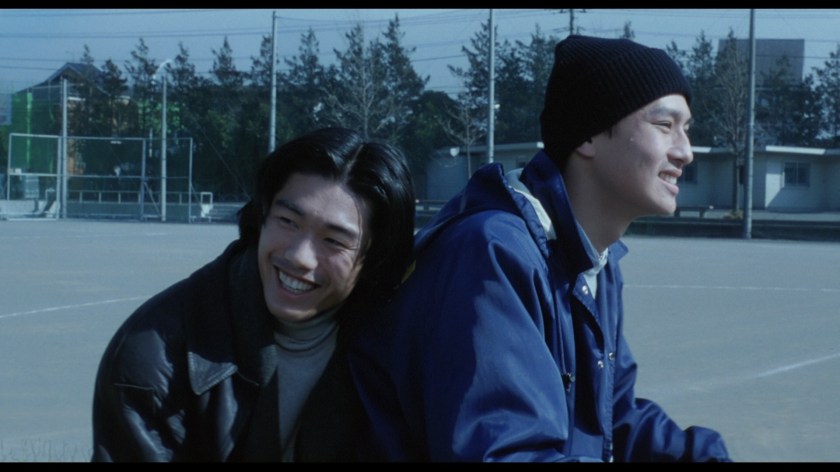
Kids Return

kids-return

Kids Return is a 1996 Japanese film written, edited and directed by Takeshi Kitano. The film was made directly after Kitano recovered from a motorcycle accident that left one side of his body paralyzed. After extensive surgery and physical therapy he quickly went on making Kids Return. The film focuses on a group of high school students as they prepare to enter into the adult world. The two lead characters are Shinji and Masaru, delinquent losers who are looked down upon by their teachers, and feared by their classmates. After they’re thrown out of school, they fall into amateur boxing and go into different paths. Unfortunately, Shinji is the only one who shows any talent for boxing. Masura, on the other hand, gives up and joins a menacing Yazuka gang. The relationship between the two friends really works. We see their dynamic and when they drift apart, you believe it. You also grow to like the characters, and kinda root for one. Kids Return’ is seen as  Kitano’s most autobiographical work, set in the part of Tokyo where he grew up and featuring events and job roles that he himself experienced while growing up. The two friends, Masaru and Shinji drift through school, seen as the ultimate prodigal sons by their teachers. Even at it’s darkest, Kids Return remains optimistic for Shinji and Masaru’s future. For Kitano, life is not an unbroken journey towards an inevitable conclusion, but a series of moments, each significant in their own right. Kitano interweaves different narrative levels combining flash backs with snippets of the past and present and placing high demands on the audience.

Confessions

confessions-2010


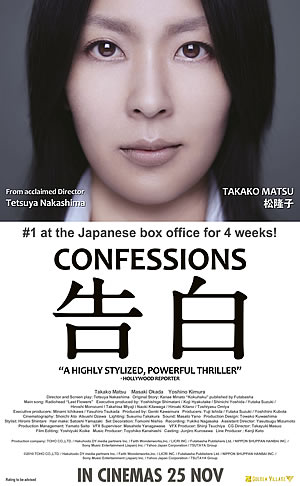
Confessions is a 2010 Japanese revenge drama directed by Tetsuya Nakashima, based on housewife-turned-author Kanae Minato’s 2008 mystery novel. High school teacher Moriguchi (Takato Matsu) announces in her class that she will resign shortly. Her young daughter was murdered by students identified in her class. She not only reveals the murderers’ identity but also explains how she plans to take revenge on those students. This leads to serious repercussions for some of the pupils. Twists and turns in the story then unfold for the viewer as we are retold further confessions to piece it all together. The story is told through confessions of various characters in the film, sometimes repeating the same event from different perspectives. Everyone expresses their own hopes and despair,sadness and hatred. The fast narratives combined with hauntingly beautiful slow motion imagery and mesmerizing background music gave this film an eerie atmosphere. The “blue” look and the ominous, monotonous soundtrack just adds to the film’s darkness.  Matsu Takako gave a superb performance in the lead role. Her control of emotion was perfect in the first half as a ruthless teacher who suffers from tremendous pain. In the second half, her character breaks down a couple of times. Confessions is a dark revenge drama that works quite well because of how the director structures the story. The film does falter slightly, though, from some overdone and contorted scenes drawing dangerously close to being gimmicky.

Charisma (Karisuma)

charisma

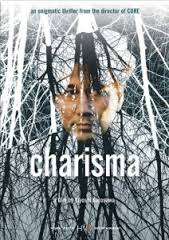
The screenplay for Charisma was originally written in the early 90s. It earned Kiyoshi Kurosawa a scholarship from the Sundance Institute, which allowed him  to study filmmaking in the U.S. Being a devoted fan of American genre cinema, he accepted the opportunity with relish.

Yabuike (Koji yakusho) is a Tokyo detective who is called in for the difficult cases.  He attends an incident where an Mp is being held at gunpoint.  The captor’s note reads “Restore the rules of the world”.  Reading this demand  ,he gives up any hope of resolution and as he leaves ,the entire hostage situation goes to hell.  He is suspended from duty.  Yabuike is so shocked by this incident that all he can do is to be asked to be driven somewhere, anywhere and eventually he gets himself lost in a dying forest .  Yabuike’s real adventure into lunacy begins , where he will soon learn that the laws of nature governing the forest are far more stark than anything he has encountered in Tokyo.  He meets a variety of personalities living within the forest.  They are in dispute over an unique tree named “Charisma”  growing in a clearing in the forest.  Botanist Jinko believes the plant is toxic and it will eventually kill the whole forest.   A former  sanatorium patient wants to protect the tree even if that leads to the death of the rest of the forest.  Some other people want to take the tree away for a collector.

Charisma emerges to be a highly metaphoric , thematically rich piece of cinema.  It raises questions about the role of individual in modern-day Japanese society (as represented by the unique tree). The various supporting characters  represent the ideological struggles between reactionary and revolutionary forces over  this debate of individuality.

Cure (1997)

cure 2

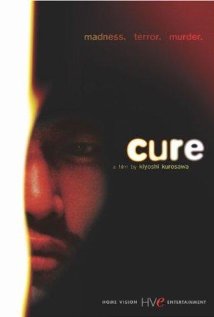
The story concerns a number of murders in which all the victims have died from a very peculiar knife wound: a large x has been carved into their flesh, across the throat and chest.  Each of the murders is committed by a different person and all of them are found near the scene of the crime and most interestingly-none of them knows why they committed crime.  “It seemed like the most normal thing to do,” is their answer. Police inspector Takabe (the always brilliant Koji Yakusho) starts investigating the cases and he gets a strange link. He learns that each of the unwitting killers came into contact with a young drifter just before the crime took place. His name is Mamiya, a formal medical student who is suffering from amnesia. Takabe’s questions meet with more questions, and he begins to lose control. Takabe firstly is not the most stable guy, to begin with- he suffers hallucinations, such as seeing his wife hanging from a noose in their kitchen.

Cure is an unnerving and unsettling film. Director Kiyoshi Kurosawa proves to be an absolute master at creating a bleak atmosphere that chills the viewer to the very bone. Cure is more than just a thriller though-the normal urban settings look mysterious throughout. In other words-its the very normality that Kurosawa questions.

A Wife Confesses

Image

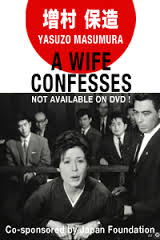
Young widow Ayako Takigawa (Ayako Wakao) goes on trial for the murder of her husband in a mountaineering accident. She stands to gain five million yen from his life insurance—that is, if she is cleared of the charge. Did Ayako cut the rope to get rid of her husband or this was her only way to survive? Is this young man who was with them at the time really her lover?Tied to a mountain between her  spouse and her secret lover, disaster strikes. To prevent all three from  their deaths, the woman is forced to choose between cutting her husband’s rope or that of her lover.  Masumura masterfully moves through the ambiguity of human behaviour , along the thin line that separates rational justification from subconscious motivation.  Ayako Wakao,  portrayed simultaneously a sympathetic victim and one of the most sophisticated femme fatales ever  in cinema. 

Red angel

Image
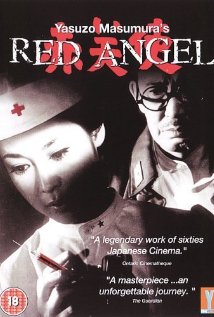
Yasuzo Masumura’s no-bullshit antiwar film tells of an army nurse who falls in love with a drug-addicted surgeon. Sakura Nishi is a Japanese nurse in China during the Sino-Japanese war. One evening after entering the ward she is overpowered by her patients and raped. Then she is sent to field hospital and there she falls in love with doctor Okabe. There she surprisingly comes into contact with the soldier who raped her before. Instead of seeking revenge . she pleads with Okabe to do their best to save him. Shot in hauntingly beautiful black and white, Red Angel has an episodic structure and uses Nishi’s encounters with different patients to explore how the war affects the men and society as a whole in different ways.  One of the film’s strongest assets and statements is showing the unflinching carnage that war creates via its scenes of battle wounded soldiers . 

Black Sun

Image

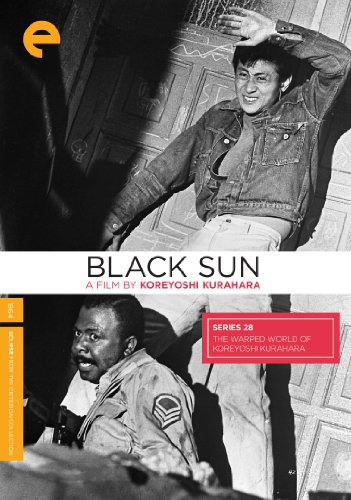
A young jazz-obsessed Japanese drifter and a black American bcome friends in a strange manner. Our main protagonist loves jazz and blues , those done by blacks. It is a Japan still recovering from WWII, with bombed out buildings. Black Sun‘s bizarre character interactions take place within the context of the USA’s ongoing military presence in Japan some twenty years after Emperor Hirohito sent his emissaries to sign the documents of surrender that drew the Second World War to a close. The two outsiders become outlaws, and Koreyoshi Kurahara depicts their growing bond as an alternately absurd and tragic culture clash. It features music by American jazz drummer Max Roach.

Double Suicide

                                                                              double suicide

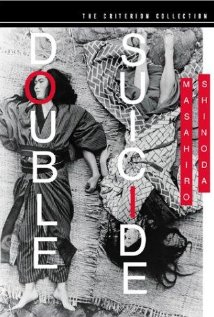
Masahiro Shinoda directs this brilliant modernist reworking of a famous 1720 bunraku (puppet theatre ) play written by Chikamatsu Monzaemon. Set in Osaka , the film centers on the doomed romance between Jihei , a down and out married paper merchant passionately in love with courtesan Koharu whome he cannot afford to buy out of servitude. Their love is further hampered by Tahei , a rich ,obnoxious merchant who flaunts his ability to buy Koharu. Suicide is the only way for the two to be together. Shinoda begins the film in a modern day theater with puppeteers preparing for the show. When the story itself begins , Shinoda replaces the puppets with real actors but puppeteers’ presence remains. Figures dressed entirely in black move among the characters, helping to position them and manipulating the story. When the actual story begins, Shinoda constantly reminds the audience that they are watching a theatrical story with a predetermined outcome. Shinoda’s interiors are abstract and theatrical to the point of absurdity. Shinoda also cast his real-life wife Shima Iwashita as both the courtesan and the paper merchant’s wife. No matter where he turned ,he was stuck with the same woman. Double Suicide effectively combines the best of both worlds – the technical prowess of a master cinematician with a touching and tragic love story.

Audition

                                                                        Audition

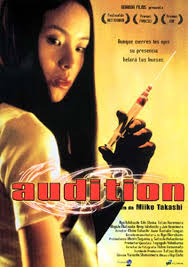
Audition is a 1999 Japanese psychological horror film , directed by Takashi Mike.  Tv producer Aoyama is a widower and his teenage son wants his father to remarry.  His friend devises a way to let Aoyama pick someone. They will put out a fake audition for a script and put out a casting call for the lead female character.  Aoyama is attracted towards Asami Yamazaki.  His friend has a bad feeling about Asami as he cannot reach any of the references on her resume.  However Aoyama is so attracted towards her that he pursues her anyway. Mike never paints their romance as truely whimsical, and many of their sequences together are silent uncomfortable experiences that make us aware of what’s ahead. But the double-edged sword of this film is the last ten or fifteen minutes. Mike preserves the slow moving first-half of the story, which makes violence of the final scenes all the more shocking and severe.  Aoyama, though flawed, is so thoroughly likable that audience cannot help but cringe at his doomed relationship with Yamazaki.
Audition is a modern classic , and is a film that will surely influence and entertain for generations to come.