Martin Eden

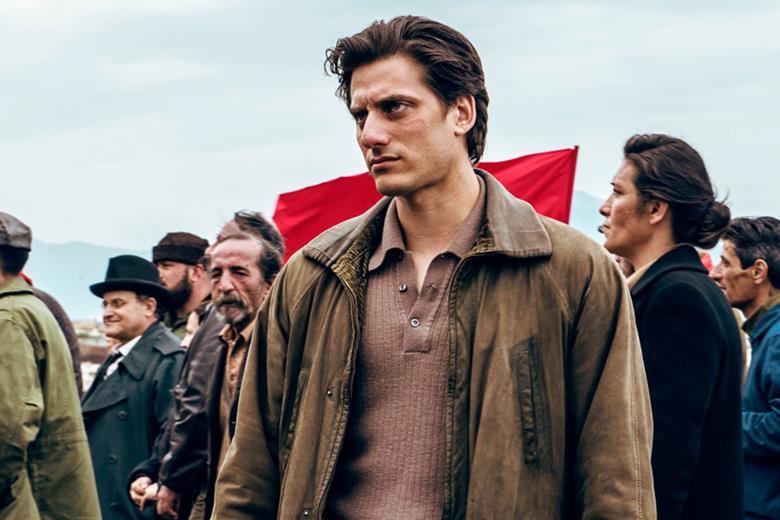
Director: Pietro Marcello
Stars:  Luca MarinelliJessica Cressy

Ever since I saw the picture, I have been thinking that I have to write something about it. But I could not understand how to write that. But the picture is not that incomprehensible. Martin Eden is the lead character of this film. He falls in love with the daughter of a rich man. Martin’s education is meagre. For his love’s sake, he goes to school again. After going to school, he decides that he wants to be a writer. The more Martin studies, the more the distance between him and his lover increases. He started writing from a rented house in the village. Most of his writings are sad, and very few people like them. But fortunately, a magazine agreed to print his novel. Gradually he started to become famous. Meanwhile, he gets involved in some political issues. He was skeptical about the role of the individual in socialism. As he grew older, he became cynical in nature. When he was younger, some of his ideas were clear. But with age, he became more complicated.
It is not clear what period the story belongs to. The clothes look like 1920, but some houses look like 1940-1950. The newsreel of the silent Age is shown at the beginning of the movie. The director wanted to make it clear that duration is not important here.
Marinelli is a force of nature in every scene and doesn’t play Eden so much as inhabit him.


link:- https://www.imdb.com/title/tt4516162/
Dogman

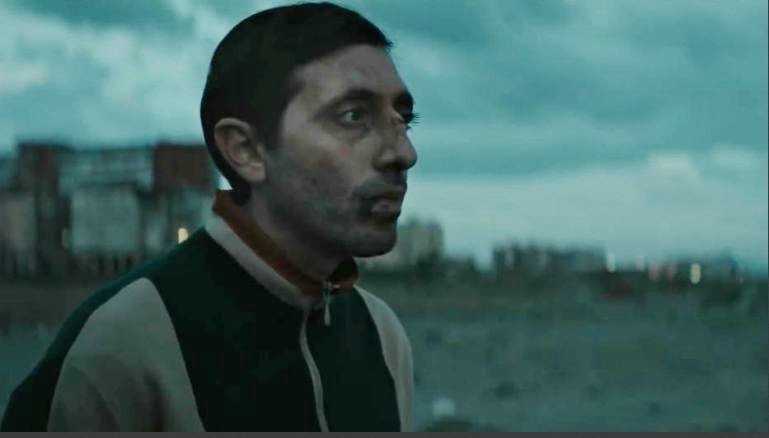
“Dogman” is what the leading hero calls the little dog-grooming parlor he owns in a small town in Italy.  His name is Marcello (Marcello Fonte) and he seems to be gentle and loving before anything else.   His daughter lives with his ex-wife. At times, he takes his daughter scuba-diving.  But Marcello is also a minor-league drug dealer, who sells cocaine to an annoying, troublesome customer named Simone.  Simone is a bully who terrorizes the town like a mad dog on the loose.  The connection between these two unlikely people forms the film’s core.  One day, Simone forces him to take part in a robbery.  The police come the next day and take Marcello away. They know that Simone is behind this mess, and they tell Marcello to sign a paper accusing Simone. If he does that, he’ll go free, otherwise he will have to spend a year in jail.  Surprisingly, Marcello decides to spend a year in jail. When he returns to his home, he notices that he has become an outsider in his own community. 

The cinematography by Nicolai Bruel reflects the film’s bitter tone.   The saturated colors over each scene enhance the uncanny qualities of this film.  It presents a doomed world where no one is quite clean or blameless.  Director and co-writer Matteo Garrone presents us with a grim world. Marcello Fonte delivers a solid performance in the leading role. We are not quite sure why he likes to get dominated by Simone.   Is it his lust for power? Or fear? Fonte’s performance keeps us guessing about it till the end.   Dogman is actually a character study that digs deep into the human dilemmas of the violence hidden inside each one of us.

IL Divo

il divo

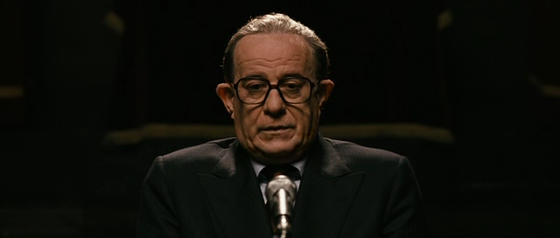
Paolo Sorrentino’s terrific Il Divo presents an extraordinarily sinister portrait of Giulio Andreotti, Italy’s most significant politician of the post-war era.  Between 1972 and 1992, he faced numerous trials on conspiracy and corruption charges and always escaped.   It begins as a collection of arresting images and concludes two hours later in the same fashion.  Throughout the film, the camera loops, and dances.  There is pop music on the soundtrack, low-impact electronica, and opera, too.  The film focuses squarely on the ending of his government service in the 1990s, during and after the seventh term as prime minister.  The trial surrounded his alleged involvement in the murder of Mino Pecorelli, a journalist who accused him of Mafia ties and to the kidnapping of Prime Minister Aldo Moro.  Toni Servillo gives an intricate portrayal of the man. Assisted by magnificent makeup work, he embodies the bent-eared, hunchback former Prime Minister.  His upper body seems to move as a single unit.
In the film, Andreotti is most haunted by the Red Brigades’ murder of the kidnapped of Aldo Moro, which he might have prevented.   Sorrentino tags Andreotti as the ultimate power-hungry; in one scene, he explains that the reason he confides in a priest instead of praying directly to God is because priests vote.   Il Divo tarnishes his legacy but not clearly, which is probably appropriate for a politician renowned for his opacity.

Sciuscià( Shoeshine)

shoeshine
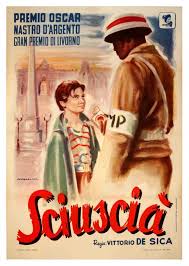
Vittorio de Sica’s 1948 drama Ladri di biciclette (The Bicycle Thief) is regarded by critics as one of the great masterpieces of the Italian neo-realist cinema. Two years earlier, he directed Sciuscià (Shoeshine), which focuses on the disintegration of a friendship between two Italian youths who fall victim to the state’s juvenile detention system. Shoeshine deals with a pair of children living on the street, best friends who shine shoes for a living and whose greatest dream is to buy a horse. Pasquale, the older boy, and Giuseppe, the younger, are drawn into a situation they don’t quite understand the weight of. One day Giuseppe’s older brother, Attilio, visits the two boys while they are shining shoes. Attilio tells Pasquale that Panza (a fence) has some work for them.
Panza gives them two fine American blankets to sell to an old lady. Attilio and Panza would come up later passing as cops to steal the poor woman. Given enough money to buy the horse, the kids live the happiest moments of their lives. Later the kids get arrested for stealing blankets. Surprisingly, despite their age and how non-serious their crime appeared to be, the two are dealt with very harshly and are sent to a juvenile prison.

shoeshine2

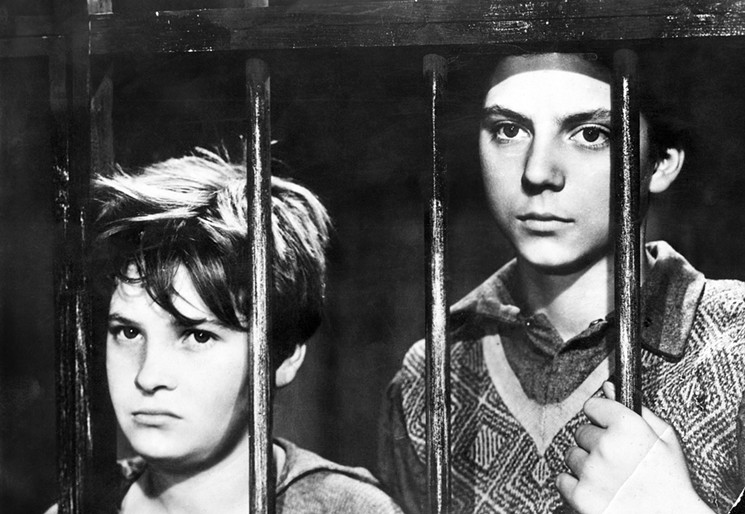
The bulk of Shoeshine takes place behind bars, where the boys have their friendship tested.  De Sica shows the juvenile detention system as a rough social order. The cells are overcrowded, five kids to a room, with each sphere becoming its own little gang. The film is considered one of the first Italian neorealist works which would leave a lasting mark on Italian cinema. The form contends with economic hardship and moral deprecation as a canvas.  Many times they would shoot in and around the streets of Italian cities and even hire non-professional actors to intensify the realism. With location shooting, long takes, fast black and white film stock, Desica demonstrates that Italian society and its social institutions—have no interest in the “common man.” As Orson Welles said “The camera disappeared, the screen disappeared, it was just life.” 


I Vitelloni

Image


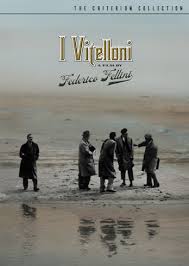
Federico Fellini’s first international success, this 1953 film, based on memories of his youth in Rimini, focuses on five youths in a sleepy seaside town during the winter offseason. The director has said that much of the film is autobiographical and captures those he knew in Rimini.
The film opens with a party, where Sandra Rubini (Leonora Ruffo) is elected Miss Siren of 1953. This is because she is pregnant, via Fausto Moretti (Franco Fabrizi), whose father forces him to marry her, to save the family honor. Throughout the film, we see him flirting with all kinds of women-a married girl at a film theater, his boss’s wife, a girl he picks up at a café and so on. Riccardo (Riccardo Fellini- Federico’s brother) is given the least screen time. He’s a wannabe actor and singer who basically support for the others. Leopoldo (Leopoldo Trieste), is a poet and intellectual who revels in melodrama and clichés. Alberto (Alberto Sordi) lives with his mother and sister, Olga (Claude Farell), who sleeps with married men. And then there is Moraldo (Franco Interlenghi), the most philosophical of their group, is actually aware of their lives as insulated and circumscribed, the only one finally agitated enough to take action.  Moraldo is definitely the consciousness of the film. Martin Scorsese named this film as a huge inspiration for his film “Mean Streets” .I Vitelloni is also an insightful and accurate representation of Italy in the immediate postwar period, full of references to the massive social changes underway.

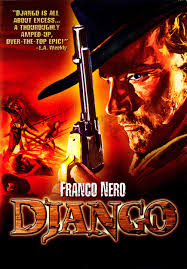
Django

                                                                   django

 Django is a 1966 Italian western film directed by Sergio Corbucci and starring Franco Nero in lead role. A mysterious man named Django (Franco Nero) arrives in a mysterious small town dragging a small coffin .  He rescues a young woman , Maria and finds himself in the middle of a conflict between Mexican gangsters and Yankee Thugs. In its time, Django raised the bar for graphic film violence , with the result that it was banned for decades in several countries.  The bad guys get slaughtered by the dozen in a good old-fashioned gunslinger way. The script manages to make Django a classic antihero mainly because of Franco Nero’s portrayal. Django is a modern myth, a cool comic figure. There are rumored to be over a hundred unofficial sequels ,though only thirty one have been counted.