Kasba

Kasba

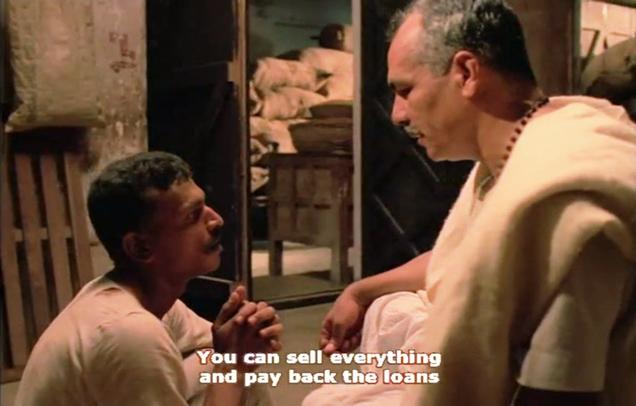
Kasba is a 1991 Indian drama film written and directed by Kumar Shahani. It is based on the short story  “In the Ravine” by the famous Russian Writer Anton Chekov.  Maniram (Manohar Singh) an entrepreneur, makes huge profits by cheating people. His business is run by his daughter-in-law Tejo (Mita vasisht), who is married to Maniram’s mentally challenged younger son (Raghuvir Yadav).  When Maniram’s elder son Dhani (Shatrughan Sinha) comes back into town to get married, things start changing. He runs away from his wife next day and later ends up being arrested in Delhi. The police starts cracking down on Maniram’s corrupt business while Tejo takes control of the power. Kasba was shot in the Kangra Valley- a tourist spot that is framed by the snow capped Himalayan mountains. One of the most impressive aesthetic elements of Kasba is the positioning of the camera, moving only to parallel the psychological and emotional mood of the characters. Shahani’s observation of life in the Kangra Valley is measured in the vivid use of natural sounds to which the ambitious and ruthless Tejo becomes impenetrable.  The naturalism of the soundtrack that is used in opposition to the destruction of the family and Tejo’s desire to inherit the family wealth including the land leads to the excluding of Tara (sister in law) and the death of her child. Thematically, Shahani’s interest is with the passing of a feudal system in which patriarchy is represented as inadequate to deal with and respond to modernity. Shahani carefully distances the spectator from raw human emotions s by introducing allusions to miniature art found in the Kangra Valley. The film shows Shahani’s complete mastery of the narrative mode and goes into the depths of human nature and its worst impulses – ambition and greed.
Damul

damul

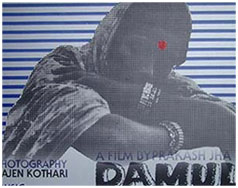
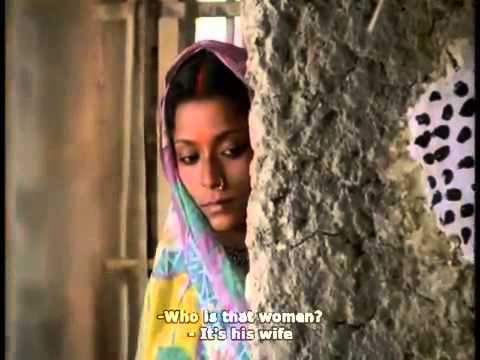
Damul is a 1985 Hindi film directed by Prakash Jha, based on the story Kaalsootra by Shaiwal, a native of Gaya district of Bihar. The story is about a bonded labourer Sanjeevan (Annu Kapoor) who is forced to steal for his  landlord Madho (Manohar Singh), to whom he is bonded until death. In a parallel development the landlord’s younger brother kills his labourers who try to flee from his construction site due to low wages.  Finally, the landlord’s mistress Mahatmain (Deepti Naval) decides to come out and make a statement before the authorities.  Madho keeps the debt-ridden and illiterate lower castes in eternal bondage, using their labour to win elections.  There is rivalry between Madho Pande and Bachcha Singh (Pyare Mohan Sahay), a Rajput, who is waiting for an opportunity to settle scores with the former. 

damul 1   damul 2

Damul makes links between caste, politics, the rural economy and migration. Rajen Kothari’s textured cinematography and mobile camera create just the right setting for a timeless tale of modern-day slavery. Through the unfolding of Damul, the viewer is almost continuously exposed to a series of audiovisual shocks. There is murder in cold blood, there are mass killings of defenseless people, sexual blackmail of a helpless young widow of high caste. The camera captures the subtle nuances of the facial expressions in close-up. The light in the Harijan basti is muted and natural- a glow here, a soft light there, the fiery flames heightening the credibility of the event or scene. The editing is slick without any jerks and jars that the violence could have justified. Manohar Singh is outstanding as Madho Pande. Annu Kapoor as Sanjeevan is very impressive while Sreela Majumder as his wife attracts notice. Deepti Naval’s brief stint as Mahatmain is adequately enacted. Damul remains Prakash Jha’s best film till date. 


Ek Ghar

Ek Ghar

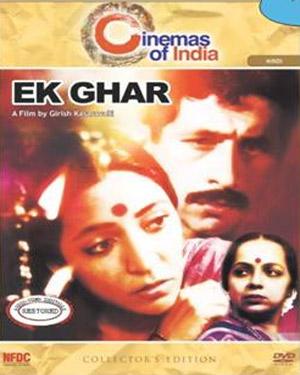
Ek Ghar (The House) is a 1991 hindi psychological drama directed by Girish Kasaravalli. Rajanna (Naseeruddin Shah) and Geeta (Deepti Naval) arrive in the city in the fond hope of building a little home.  He works as a supervisor in a MNC which manufactures bulldozers. Rajanna finally manages to find a house. However, when a workshop opens up next door, they are troubled by the noise and find ways to attain peace.  He has been helped in securing the house with the influence of his aunt (Rohini Hattagandi). She is old,attractive and has been deserted by her husband long ago. Rajanna uses her but wants his wife to stay away from her as she may be a bad influence. The contradictions are clear both within Rajanna and in the city. Nothing is what it appears to be. In 1991, India was on the point of an economic and consequently a social revolution which must have made most men and women anxious. The film is carefully constructed and crafted.  It follows a dual colour pattern of mostly blue intersected with yellow. When he and his wife decide to take a walk, it is at night and trees appear more like concrete pillars, lit by street light. The background score by L. Vaidyanathan mixed with the noise of the city creates a perfect mood of peace lost forever.Naseeruddin Shah is convincing as the confused, disoriented immigrant while Deepti Naval and Rohini Hattagandi stole the show by their power-packed performances.

Tarpan

Tarpan-film

Tarpan was a 1994 hindi dramatic film written and directed by K.Bikram.Singh. Joravar (Ravi Jhankal) and his wife (Mita Vasisht) live together in a small village of Rajasthan. Their first daughter inexplicably passed away , and both of them take special care of their second one.  Unfortunately, she too starts suffering inexplicably. The couple set out to speak to a village elder by the name of  Jasso (Om Puri). He guides them to Sukku baba (Veerendra Saxena) -a fakir who knows the cure. He tells them to travel to another village, and cleanse the well that the upper-caste thakurs used to draw their water from years ago. A village where no girl child survives beyond the age of seven. The well would have to be cleaned by the community as a whole, before its waters can be used. Nobody seems to know about the well. The village headman (Manohar Singh) and an old woman (Dina Pathak) help them to discover the well . An old well from which ghosts of the past emerge. A woman (Revathy) fighting for the rights of her child and taking revenge of her husband’s (Pavan Malhotra) murder even after her own death. A community confessing its crimes long forgotten. The film presents a series of inter-related events in the form of four stories, which initially appears as individual disputes between members of different communities. The four stories merge into the theme of caste conflict. The interesting film wonderfully depicts the reality of caste-ridden India, where humans are discriminated against on the basis of their birth. 

New Delhi Times

New Delhi Times

New Delhi Times is 1986 Hindi film directed by Ramesh Sharma and written by Gulzar. The editor of the newspaper New Delhi Times, Vikas Pande (Shashi Kapoor) has to confront the politician Ajay Singh (Om Puri) who is associated with a powerful lobby of illegal liquor manufacturers.  Meanwhile, there is a power struggle going on between the existing chief minister Chaturvedi (Ram Gopal Bajaj) and the ambitious MLA Ajay Singh for the post of chief minister. On the other hand Vikas’s wife Nisha (Sharmila Tagore), who is a lawyer, is approached by an old man whose daughter is missing from her in-laws place.  Shashi Kapoor’s Pande is a man of the world, who nevertheless has not developed a cynical attitude despite the surrounding environment. Shashi has played the role with dignity and poise. Sharmila Tagore plays Pande’s supportive wife and though she does not get to do much in the film, her practical attitude comes across as a breath of fresh air after Pande’s burning idealism. The film also stars Om Puri, who is impeccable as ever,who becomes the focus of Vikas Pande’s investigations. Mk Raina, Kulbushan Kharbanda , Manohar Singh were convincing in their roles as well.

It is also one of the few movies made in India that looks at the difficulty and paradox inherent in a crime-journalist’s profession. New Delhi Times takes an in-depth look at the politically corrupt system that pervades the lives of ordinary people, who in many ways are unable to deal with it. But the film ran into all kinds of trouble. There was a lawsuit filed against it by someone who took offence to a dialogue where Vikas tells Nisha that all lawyers are liars; someone else tried to get the film banned for depicting a politician instigating communal riots. When New Delhi Times was scheduled to play on Doordarshan, it was pulled out at the last minute because of the legal battles that confronted it.  Over the years, New Delhi Times has gone on to receive largely positive reviews.

Naya Daur

Naya daur


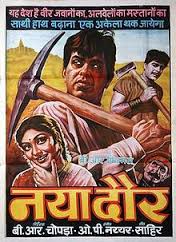
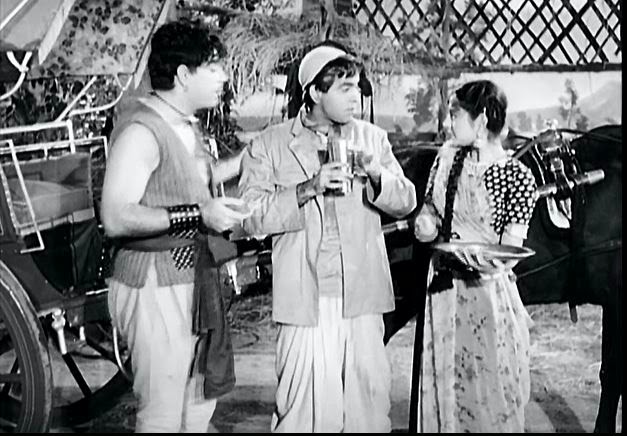
Naya Daur ( English: New Era) is a 1957 Indian drama film starring Dilip Kumar, Vyjayanthimala, Ajit and Jeevan. The film is set in post-independence India, where industrialization is slowly creeping in.  ‘Naya Daur’ literally meaning a New Road – is a fine story of a young village man Shankar (Dilip Kumar) who wants to challenge onslaught of machines in his daily life by building a new road in his village. Shankar (Dilip Kumar) and Kisna (Ajit) are the best of friends, village boys who grew up together. Shankar makes his living as a tonga driver. Kisna chops lumber for the local mill owner (Nazir Hussain), who treats his workers with tremendous compassion. The owner leaves for a pilgrimage, and his son Kundan (Jeevan), who takes over operations, doesn’t see things the same way – he brings in machines and fires all the woodworkers. Meanwhile, the bond of friendship between Shankar and Kisna is threatened when both fall in love with Rajni (Vijayantimala). The workers start to move to the cities leaving their homes behind. Frustrated with the dramatic change Shankar challenges the owner’s son & accepts Bus Vs. Tanga race. Thankfully, director B R Chopra takes pains to point out in his film that his characters are not anti progress. This was one of Dilip Kumar’s finest roles, and the irony lies in that he may never have done the film at all. When BR Chopra first came to him, Dilip Kumar refused because of date issues. It was then offered to Ashok Kumar, who felt he was too urban to fit into a rural character.


naya daur 1
He liked the story, though, and convinced Dilip Kumar to at least hear it. Dilip slipped into the character of Shankar very believably. He was the sociable, cheeky taangewala to life, without falling into the trap of being annoyingly cheerful. Similarly, in his dramatic scenes with Ajit, or even the scene where he breaks off his sister’s engagement, you see a principled man, and a honest one. As the parallel lead, Ajit not only had almost-equal screen time as the ‘hero’, but he also had a very nuanced character arc – from the faithful friend to the man who seeks vengeance because he has been betrayed, or so he thinks, by his dearest friend. Vyjayanthimala’s  Rajni is strong, self-respecting, and knows her own mind. She has no qualms in admitting to Shankar that she loves him. This was OP Nayyar’s year – both Tumsa Nahin Dekha and Naya Daur released in 1957, cementing his place in the ranks of successful music directors. Naya Daur’s message is neither a derogation of modernity, nor a plea for consensus. I think what BR Chopra (and Akhtar Mirza his screenplay writer) was conscious of the particular reality of India in the 1950s: a country where Independence under Nehru meant development, power and influence, but at the same time where the human and rural dimension was still very much a key factor.

Parineeta

PARINEETA

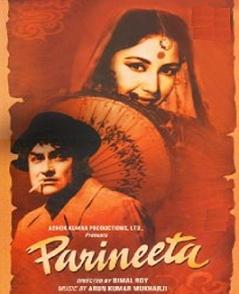
Parineeta is a 1953 Hindi film starring Ashok Kumar and Meena Kumari, based upon the 1914 Bengali novel of the same name by Sharat Chandra Chattopadhyay. The film was directed by Bimal Roy.  Shekhar (Ashok Kumar), the son of a wealthy Brahmin family, discovers that he’s fallen in love with Lalita (Meena Kumari).  Shekhar has known Lalita since she was eight years old and came to live with her uncle Gurucharan and his wife after the death of her parents. The two families live in connecting houses, and Lalita spends as much time in Shekhar’s household as in her own. Shekhar’r father Navin (Badriprasad) has other plans for Shekhar.  He wants to arrange his marriage with the daughter of Choudhary,  another wealthy Brahmin who has promised Navin a huge amount of dowry. The relation between the two families gets affected when Gurucharan is forced to repay his debt and he decides to marry off  Lalita to Girin Babu (Asit Baran).  Meena Kumari and Ashok Kumar are wonderful together.  Ashok’s character is indulged and a bit spoiled, yet he never comes across as impolite. Ashok’s Shekhar is just sheltered from real-life consequences and has an idealistic view of things. A very young and lovely Meena Kumari plays Lalita.  Lalita’s part in the story involves much silent despair. The other characters – Lalita’s uncle played by Nazir Hussain, the rich guest who drops in enacted by Bengal’s Ashit Baran,  Lalita’s cousin – gave solid support to the principal characters.
The most striking element of Bimal Roy’s films, including Parineeta, was his ability to project the Bengali family in a language like Hindi, without losing out on the essence and spirit of the ethnic moods the story and the characters belong to. Lighting has always been an extremely important element in Bimal Roy’s works. Whenever the narration grows nostalgic or reasonates with inner crisis, whether in anguish or in ecstasy, the mood is captured most ably in delicate shadowy patterns of black, grey and dove white by cinematographer Kamal Bose.

Anubhav

anubhav 1971

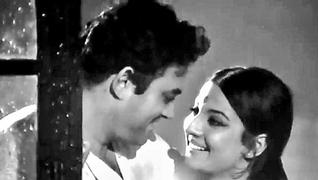
Anubhav is a 1971 hindi film directed by Basu Bhattacharya, which stars Sanjeev Kumar , Tanuja and Dinesh Thakur as leads. The film was the first part of Basu Battacharya’s introspective trilogy on marital discord in an urban setting, which included Avishkaar (1973) and Griha Pravesh (1979); and went on to win the 1972 National Film Award for Second Best Feature Film . The film centres on the relationship between Amar (played by Sanjeev Kumar) and Mita (Tanuja), a well-to-do Mumbai couple, who, after six years together, find themselves in a dry and sexless track. “Anubhav” is about Meeta, who leads a lonely life in a mansion. Her husband Amar Sen (Sanjeev Kumar) pursues a career of an ambitious editor, a workaholic who is dedicated to his profession at the cost of ignoring his responsibilities at home. Her craving to start a family is conveyed in the opening frames through a child left to fend for itself in a party that strictly involves grown-ups. Meeta’s concern for the weeping child, begging attention, rouses the mother within her to the fore. It is her journey to rediscover herself that makes this a well-crafted film.

tanuja_sanjeev
Kumar and Tanuja make a great couple with a believable and nuanced on-screen rapport. This film is about Tanuja despite the presence of the gigantic Sanjeev Kumar.  Anubhav” was marked by some exceptional songs from Geeta Dutt (“Meri Jaan Na Kaho Meri Jaan” and “Koi Chupke Se Aake) and a soulful solo by Manna Dey (“Phir Kahin Koi Phool Khila”). Music was secondary to the narrative that grows on you in a matured style that was Bhattacharya’s forte. The urban landscape of Bombay is captured stunningly in black and white, the slums and skyscrapers co-existing.   For Meeta, however, the world revolves around the servants at home, her husband leaving home in a rush and returning in an amble, tired from the demands of the office. . Bhattacharya uses simple props as a symbol (e.g. the ticking clock, the radio). Moreover he stays focused on the main story.  

Ganga Jamuna

Ganga Jamuna

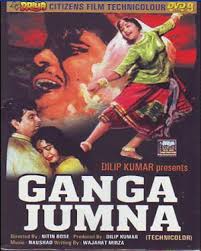
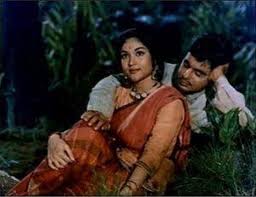
Ganga Jamuna released in 1961 was one of the first films to popularize the theme of two brothers on opposite side of law . It was produced by Dilip Kumar and directed by Nitin Bose.  A religious, principled widow (Leela Chitnis) struggles to raise her two sons Ganga and Jamuna. Devastated when she is framed for a theft, the frail woman passes away. Ganga pledges himself to support his younger brother as they grow to adulthood. He enjoys the endless squabbles with his childhood friend Dhanno (Vyjayanthimala). The sombre Jamuna (Nasir Khan), is in love with the zamindar’s daughter (Azra). Meanwhile, the zamindar’s brother-in-law (Anwar Hussain) has his eyes on Dhanno.  Ganga saves her from the zamindar’s lecherous assault. The zamindar (Anwar Hussain) gets his revenge by upstaging a robbery charge against Ganga. The supreme irony is that his best intentions for his loved ones are ill-fated. Ganga gets an empty jewel box home probably for his beloved mother but this gets her framed. 

Ganga jamuna 1

The money he steals doesn’t reach Jamuna. Of all the human relationships that Ganga Jamuna explores, the most affecting is the one between Ganga and Dhanno- an outstanding love story between two ordinary people handled with great care. Dilip kumar is too good and plays the role of Ganga very convincingly. Vyjayanthimala is a revelation as Dhanno.  Nasir Khan (real life brother of Dilip Kumar) manages to lend a quiet dignity to his role. Directed by New Theatres old-timer Nitin Bose, Ganga Jamuna is a well-structured and briskly paced film and was notable of the use of Bhojpuri dialect. This former cinematographer also frames some excellent shots even while keeping a tight check on the narrative.

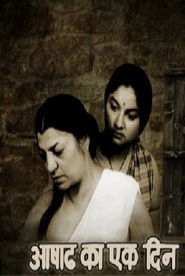
Ashadh Ka Ek Din

ashadh ka ek din

Mani Kaul’s Hindi film is based on play of the same name by Mohan Rakesh.  The title    of  the play derives from the second verse of Kalidasa’s play Meghaduta.  It literally means “one day during the monsoon”.  It depicts the love of Mallika and Kalidasa, the famous    Sanskrit poet and dramatist. Kalidasa lives in Himalayan village and is romantically linked with Mallika.   However he is invited to king Chandragupta’s court in far-off Ujjaini. Mallika sacrifices her love and encourages him to go to ujjaini. Vilom, a friend of Kalidasa and interested in Mallika, is a passive onlooker mostly.  One-day passing through his village with his queen ,he ignores mallika. Mallika makes her life complete without him.

 The characters’ lines were pre-recorded and played back during shooting thereby freeing the actors from any kind of theatrical conventions.  The sparse realism of ‘ Uski Roti’ is replaced by  Mahajan’s sensuously shot landscapes and relaxed camera movements , minutely registering light changes within the frame.