Namkeen

namkeen 1


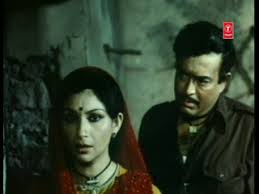
Perhaps my most favourite Gulzar film is Namkeen. It is a very simple story actually. A mother and her three sisters are caught in the simple troubles of life. These are poor people and their daily concern is winning bread. The oldest daughter Nimki (Sharmila Tagore) takes care of the most household activities . Voiceless Mitthu (Shabana Azmi) expresses her words in poetry while their mother Jyoti (Waheeda Rehman) is at work all day. Gerulal (Sanjeev Kumar) brings a pleasant change to their lives. Or does he? It has a lyrical feel to it and the landscape (Darjeeling of 80s) is breathtaking. The way Gulzar uses nature to depict the complexities of relationships is extraordinary. The story is simple yet the nature of relationships are not. Gerulal loved Nimki while Mitthu loved Gerulal yet there is no sibling rivalry between them to get their desired man. Well, the film is not without it’s flaws. They were missing a male figure in their family.  Gerulal fulfilled that position. In a way,it is implied that women need a better male figure in their lives. However the positive aspects (nuances of relationships,psychology of female characters) overshadow the flaws. And if one pays more attention, there is a spiritual angle as well. Sanjeev Kumar never needed to act. He just became the characters he played. Namkeen is no exception either. Even in a female-dominated film ,his performance scores over others. Sharmila always did well in Gulzar’s films. As expected, Waheeda and Shabana don’t disappoint in their roles. But most importantly, it is the touch of Gulzar which makes this film so special to me. The song “Phir se aiyo badra bidesi” where Mithu romances the mists of  Darjeeling  is so dreamlike and misty it moves us into a world where pain, anger, frustration and bitterness take a backseat.  The song  “Raah Pe Rahte Hai” aptly captures the pain and anguish of the lead character Gerulal when he leaves the village.
Dance Of The Wind

dance of the wind 1

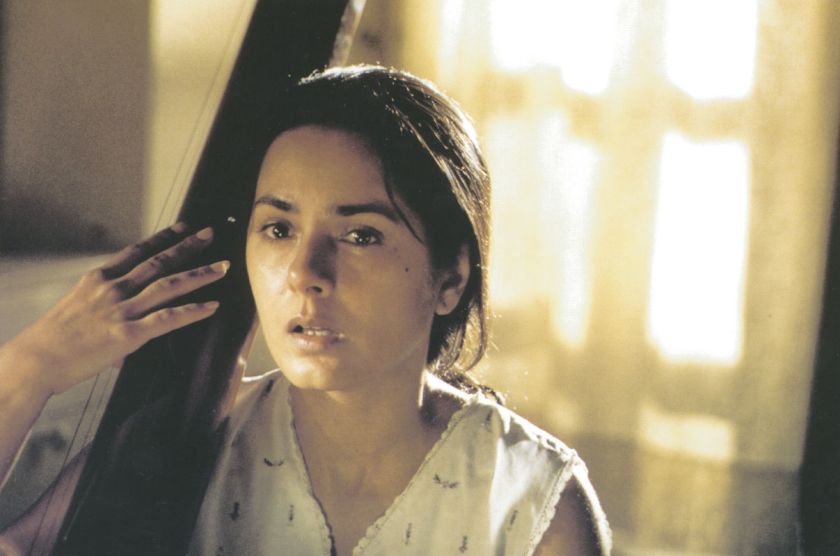
Pallavi (Kitu Gidwani) , a successful classical singer trains with her mother to carry forward the Hindustani musical tradition. She is good but not as much skilled as her mother is.  Her mother Karuna took training from an old man. He never performed on stage but used to give lessons to his students. When Karuna started to perform on stage , he cut off all contacts with her.  He detested glamour world. The trauma of Karuna’s death, announced by the appearance of the old man and a little girl, causes  Pallavi’s voice to disappear. Slowly her relationship with her husband (Bhaveen Gosain) becomes strained.  She slowly loses her students and her career takes a backseat.  Retreating into solitude, she finds the little girl Tara (Roshan Bano) again. Much of the music was composed by Shubha Mudgal, a classical singer who studied in the guru-disciple tradition.  Director Rajan Khosa used music in crucial points to capture the essence and mood of the film. The film is spiritual but it is extremely honest in it’s approach. In other words,it located in Indian culture.  Khosa didn’t opt for any dishonest trick to make it global.
Yet, it has an universal appeal. He is aided by fine technical work all around,  from Piyush Shah’s soft-hued lensing to Amardeep Behl’s quietly refined production design. I always liked to watch KItu Gidwani.  She has been an extremely talented actress. Instinct affects her acting more than anything else.  Bhaveen Gosain is known in theatre circuits. He just did this film only.  Here, he gives a very convincing performance as a caring husband.  Vinod Nagpal shines in a very short role.

Debshishu

debsishu

In the 70s and 80s, plenty of Indian directors made socially-realistic films. Some of the notable directors were Shyam Benegal, Govind Nihalani, Nabyendu Chatterjee and Utpalendu Chakraborty.  Utpalendu Chakrabarty made very few films in his career. His last film was 25 years ago.  Even then, not all of his films are available. But if one watches Chokh and Debshishu, he/she will be convinced of his great skills and mastery over the medium. In the opening scene, we see a middle-aged guy announcing the arrival of a debshishu (child god) in a remote village.  The child god fulfills the wishes of people. A couple, Raghubir and Seeta (Sadhu Meher and Smita Patil), arrive in the village with their only child. They have lost everything in the flood. Seeta came to stay at her brother’s house for a few days. However, the brother’s wife (Rohini Hattagandi) turns out to be very cruel and insensitive towards them. Still, they manage to get a room in their house.  Raghubir realizes that he can’t stay here for long. Soon, he has to find a job and a house of his own. One day, while going to the market, he hears about debshishu (child-god). He visits there hoping that his wishes will be fulfilled. There he sees a magician (Om Puri). He remembers him showing magic in his village. When Raghubir and Seeta’s deformed baby was born, he went to his house to ask for help. The villagers warn Raghubir that if his baby is not killed, they will force them to leave the village. According to them, the baby would bring bad luck to the village. The magician told him to sell the baby to them, and he would compensate for that by giving him good money in return.  Raghubir follows his orders.  Raghubir realizes that the child god is his deformed baby. 

Let me tell you, this film is much different in content and form than other good social-realist films belonging to that particular period. The cast system, poverty, religion are all mixed here in a bizarre (important word) way. While I do like most social-realist films of that period, very few of them did display the complexity of oppression. It isn’t just limited to homeowners or wealthy, powerful people oppressing others. The reality is bizarre and that is what this film is. The film highlighted how gods are born and how poor people are forced to believe in their existence more. Sadhu Meher has been exceptional. Smita Patil and Om Puri are dependable.  Utpalendu was a gem of a director and to me one of the most important ones, along with Shyam Benegal and Govind Nihalani. He used two flashbacks in the film. One of them was done in black and white to capture the image of the rain more realistically. Another one was in color when Sadhu Meher visited Om Puri’s house.


Footpath (1953)

footpath


Nashu (Dilip Kumar) is an idealist young man who works for a small newspaper run by Ghosh babu. He lives with his brother Bani (Romesh Thapar) and sister-in-law Meena (Achla Sachdev). Nashu loves Mala (Meena Kumari) who lives nearby his house.   Times change and slowly it becomes difficult for Nashu to sustain his living by working in that small newspaper. Though his brother Bani cares for him, his sister-in-law does not. In the home, he had to bear a lot of humiliation from her.  Out of desperation, he enters the world of black-marketing. From here, the story takes a dramatic twist. He becomes the most trusted associate of Ram Babu (Anwar Hussain). Being aware of this, Mala maintains a safe distance from him. At the same time, his elder brother suffers from poverty. His comfort-loving wife Meena deserts him. The entire film looks into the psyche of a man who failed to earn money by honest means.

The problem with the film is that it does make the point by repeating it often. On the positive side, the film gives a glimpse of the black-market world. Also, the mood of the film is extremely dark. This mood wasn’t common in Hindi films back then. Director Zia Sarhadi showed a lot of promise and eye for detail. The sequences shot indoors as well as in the black-marketing den shot in natural light by N. Raiaram are really convincing. However, keeping with the trend during that period, the villains look unconvincing. On the whole, the music score of the film leaves a lot more to be desired, considering that the film carries the Khayyam stamp. However, the film boasts of one of the most memorable Talat Mehmood songs “Shaam-e-Gham Ki Kasam”.It is clear that Zia Sarhadi was heavily influenced by neo-realism. Dilip Kumar does well in the lead role. Low pitched modulated dialogue delivery and great use of right arm were his acting hallmarks. However, at times, his low pitched delivery looks unconvincing. He did well but this is not among his best works.  Meena kumari gives a very restrained performance. In this film, she is shown taking a bath. Such a scene was uncommon back then.


Newton

Newton

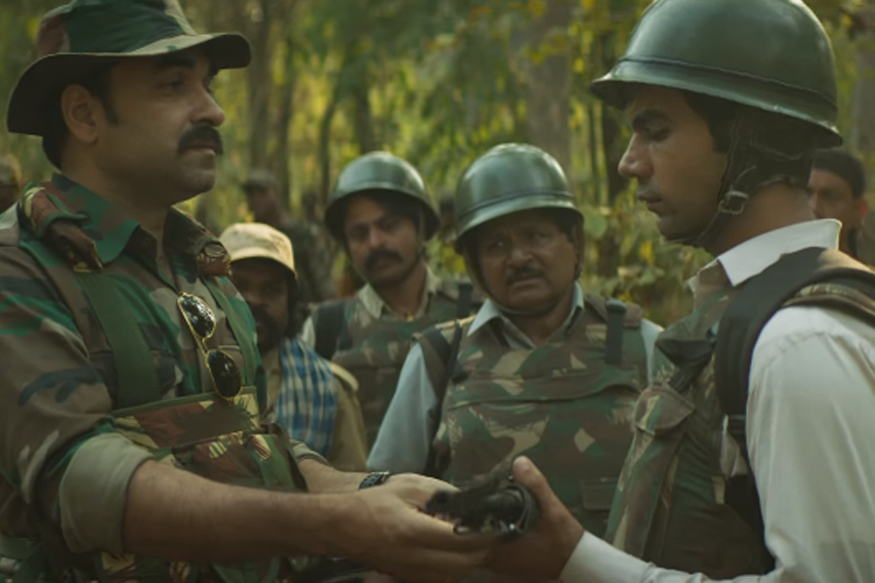
Newton (Rajkummar Rao) is sent off for election duty in a Naxal- heavy area. He is an honest and idealist person. But his idealism is his limitations as well. In Dandakaranya, he meets a sharp but little ill-tempered commander Aatma Singh (Pankaj Tripathi). From the moment, Newton and his fellow officers Loknath (Raghubir Yadav) and Shamboo land in the location, there is friction. A local booth-level officer Malko (Anjali Patil) joins them there. Newton is honest and he wants a fair election. But how does it matter when things won’t change? how does it matter when the locals don’t have a clear idea about the candidates?

When Newton tries to tell an officer how the entire day of voting didn’t make sense, Officer asks him “was there any instance of fake voting”? U will end up feeling for the character Newton but he is also guilty of such a situation. He is at-the-end ” by-the-book-idealist”. And here lies the brilliance of the script.  In one scene, Malko (Anjali Patil) tells Newton ” The history of the jungle is older than the history of democracy”.  Loknath (Raghubir Yadav) is an adjusting ever-practical public. He is also a writer. Aatma Singh (Pankaj Tripathi) tells Newton that no one cares about the election. He is only concerned about finishing the voting process early. I did like the slow-paced narrative in the first half.  U will wait for something to happen but ultimately nothing happens.  This isn’t a radical film as such. It makes a mockery of democracy, state, and the lead character but it refuses to take any stand.  I did like the melodramatic approach at the ending.  It was needed to make Newton look ridiculous. Rajkummar Rao is brilliant as the main protagonist of this film. It was good to see Raghubir Yadav getting a good role after a long time. I have always been his fan. He is such a natural actor. Anjali Patil was brilliant in the role of a local officer. But the best performer in the film is Pankaj Tripathi. Tripathi is such a brilliant actor that his mere presence brings a character alive on screen.

Hamraaz (1967)

Hamraaz

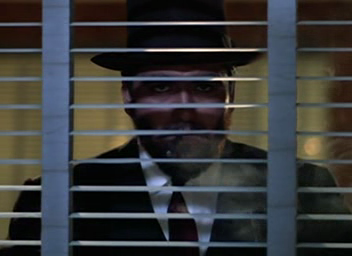
Hamraaz is a BR Films production and a fine example of the high entertainment value that characterizes BR Chopra’s films. Meena (Vimi) married a military officer Rajesh (Raj Kumar). Rajesh is sent to the China border and is declared killed.  In the meantime, Meena’s father (Manmohan Krishnan) discovers that her daughter is pregnant. Fate is at play. Popular stage actor Kumar (Sunil Dutt) from Bombay visits Darjeeling. Kumar and Meena fall in love, get married and move to Bombay. After four years, Meena’s past returns to haunt her. Kumar gets suspicious as she begins to avoid him. During the turn of events, Meena gets killed and inspector Ashok (Balraj Sahni) suspects Kumar’s involvement. Saahir Ludhianvi has written five songs for this film and Ravi has composed music for them. I loved two songs, one of them is- “Tum Agar Saath Dene Ka Vaada Karo, Main Yun Hi Mast Naghme Lutaata Rahoon ” and the other one is “Na Munh Chhupa Ke Jiyo Aur Na Sar Jhuka Ke Jiyo”. All these five songs are over within the first hour of the film and immediately thereafter we find ourselves enveloped in a suspense thriller lasting till the end.
The white-shoes of the mysterious person whose identity is revealed just before the climax is something unforgettable for the viewers. The style is heavily influenced by classic Hollywood films but for a Hollywood lover like me, it’s a great experience. Here is a thriller where songs don’t impede the growth of suspense as the songs take the narrative forward, a quality we miss these days. I consider Sunil Dutt an average actor at best. But in this film, he gets most screen-time and he does justice to it. He was persuasive as an insecure husband. I guess male actors are capable of depicting insecure lovers more often than not. Raj Kumar’s stylized acting fits in this film. Balraj Sahni was excellent as inspector Ashok. Unfortunately, Vimi was the weakest link in that film.  If u love thrillers with a touch of melodrama, u will enjoy it.

Pakeezah

pakeezah 1

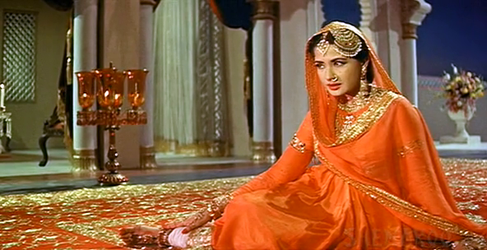
Some films want to buy classic status with massive budgets and crumple under the pressure of their own spectacle. Pakeezah is lavish in its treatment of a courtesan’s turbulent story, but its splendor fills the eye, stirs the senses.  The story begins with the elopement of a tawaif,  Nargis (Meena Kumari)  with her lover,  the Nawab Shahabuddin (Ashok Kumar).  Shahabuddin takes Nargis to his household,  where she is rejected by his honorable family.  Nargis flees to a graveyard, where she spends the next 10 months of her life, giving birth to a daughter in the interim.   Nargis dies in the graveyard, and her older sister Nawabjaan (Veena), on receiving this news, reaches there and takes the baby away. 17 years later Sahabuddin has received a letter written by Nargis on her deathbed. He comes to know about his daughter through this letter.  Shahabuddin rushes to Nawabjaan’s Kotha and asks for his daughter Sahibjaan (Meena Kumari). A furious Nawabjaan tells him to come tomorrow morning.  Nawabjaan takes her to some other place.  They travel overnight by train and while both of them are asleep in their compartment, a fellow passenger climbs into their compartment by mistake. He is Salim (Raj Kumar).  Enchanted by her feet, he leaves a note “Aap ke paon dekhe, bahut haseen hai. Inhe zameen par mat utariyega — maile ho jayenge”.

There is grandeur in Amrohi’s filmmaking – an epic magnitude of treatment.  The evocative songs and the background music create the right period mood and Amrohi’s eye for details brings great depth to the lavish sets.  The film’s main merit in spite of its flaws, its at times disjointed flow, its stock situations and an overextended plot,  lies in its euphoric romanticism. Pakeezah is filled with symbols.  There is, for instance, the oft-used symbol of the bird in a cage.  Trains themselves form an important motif throughout the film.   A train is where Sahibjaan’s and Salim’s paths first cross, and ever after, trains continue to haunt  Sahibjaan.   Kamal Amrohi uses actions, expressions, little details to convey far more than dialogues do, and often in much less time.  The script is memorable in the hands of Meena, Ashok, Raaj Kumar, Veena etc to name a few.  Personally, I was most impressed by the regal-looking Kamal Kapoor. Meena Kumari lives the tragedy of Nargis and Sahib Jaan like her own. Coupled, with a captivating screenplay is a beautiful musical score, enhanced by the protagonist displaying notable command of classical Indian dance  (kathak).

Aar Paar

Aar Paar

I noticed that I had not reviewed a single film of Guru Dutt on my blog. In order to make amends, I decided to review one of his films. Kalu (Guru Dutt), a taxi driver who was sentenced to prison for speeding, is released two months before his term for good conduct. Wandering the streets, Kalu helps a young woman Nikki (Shyama) to fix her car.  He gets a job at Nikki’s father’s garage and love blossoms between Nikki and him.  When her father finds out, he kicks Kalu out.  An encounter with the mysterious Captain results in a brand new job for Kalu. Captain is planning a Bank robbery and thinks Kalu would be useful in driving the car.  Kalu joins with the captain’s gang which includes a dancer (Shakila) and a guy named Rustom (Johnny Walker).  In Aar Paar, Guru Dutt took his talent for song picturization to several notches above the commonplace.  Songs in his films often take place in locations occupied by the characters in his films. A fine example here is the romantic duet Sun Sun Sun Sun Zalima. The song is set in the stark and unromantic atmosphere of a garage with a car providing the center-piece but the way two lovers circle around each other within this space is a brilliant piece of choreography.

The other song whose picturisation deserves a special mention is- “babuji dheere chalna pyaar mein zara sambhalna” (Shakila’s great entry).  Aar Paar was a significant turning point in the life of composer OP Nayyar who went on to become an extremely successful music director.  Songs like Babuji Dheere Chalna, Yeh lo Main Hari Piya, Mohabbat Karlo, Ja Ja Ja Ja Bewafa, all sung brilliantly by Geeta Dutt, are remembered and hummed to this day. The plot of Aar Paar may now seem formulaic but scores in its treatment.  The narrative flow is pacy and engaging, merging the elements of thrills, romance, action, and comedy rightly. Aar Paar is a noir film that is infused with humor. Dutt’s friend and collaborator, VK Murthy, was behind the camera as usual, and the Dutt-Murthy combination’s play with light and shade was nothing short of magical. Guru Dutt plays his part of the streetsmart driver with ease.  Shyama was ok.  Shakila is excellent as a femme fatale.

Raman Raghav 2.0

raman-raghav-2-0

Raman Raghav was a psychopathic serial killer who operated in the city of Mumbai in the mid 1960s. His real name was Sindhi Dalwai. All the murders took place at night and were committed using a hard object. He also raped his sister before killing her.  This film is not about him. The electrifying atmosphere at the night club that follows instantly takes the audiences in the trance for a gut wrenching, dark, intense thriller about a killer and a policeman that brings in different shades of evil and inhumanity.  Nawaz, who plays the notorious serial-killer Raman, is inspired by the real-life serial-killer, Raman Raghav. The screenplay follows his exploits as he steers the bylanes, slums, and rundown apartments of Mumbai, piling on the bodies and indulging his dark fantasies.  Vicky Kaushal (Raghav) plays the DCP of the Mumbai Police Force . Kaushal is as emotionally bare as Nawaz, with the only difference being that they emotional voids are targeted at the opposite spectrums of the law. He’s an addict to the core, and has no apologies about being one just like Nawaz has none about his murderous wrongdoings.

Raman calls himself Sindhi Dalwai and finds a partner in Raghav. Through eight chapters- Locked Man, The Sister, The Policeman, The Hunter, The Hunted, The Son, The Fallen and Soulmates – Kashyap builds his characters to a tall dark shadow that scares us out of our wits.  Nowhere does the camera focus on a smashed, bloodied head yet the way with which Nawaz carries out each murder is gory and makes you want shut your eyes. The camera work is also crisp as  it travels to murky bylanes of Mumbai with as much ease as it captures the city’s impressive skyline at night. Siddiqiui is appropriately creepy as Raman, a long scar running down his forehead, an unmistakable glitter in his eyes. While not as spine-chilling as his more counterpart, Kaushal holds up his end impressively.  Both Ramanna and Raghav are also creatures bred and brought up in patriarchy, are victims of it ( Raghav’s submissive equation with his dad for instance) yet preserving its deep misogyny. Some sequences stand out. Ramanna holding his sister’s family hostage brings out his sick mind in an anxious  way possible. Raman Raghav 2.0 is a taut thriller, full of energy and overflowing with tension.

Gumrah

Gumrah

Gumrah is a 1963 Hindi film produced and directed by B.R.Chopra. Meena (Mala Sinha) and Kamla (Nirupa Roy) are two daughters of a wealthy Nainital resident. Meena is in love with artist-singer Rajendra (Sunil Dutt). Things take a turn when Kamla and her two kids come to visit them from Bombay.  Meena’s father (Nana Palsikar) suggests Meena marry her sister’s husband Barrister Ashok (Ashok Kumar) since a new woman might not take to the kids. Meena ultimately agrees to marry Ashok and then moves down with him to Bombay. All this happens without her even informing Rajendra.  After some time, she meets Rajendra again, and this brings to a renewed relationship. Gumrah was one of the earliest hindi films which tackle the issue of extra-marital affair. B.R. Chopra’s Gumrah must have been perceived then as a bold and forward film of the times. But then again,some aspects of this film can be regarded as sexist. The film makes the point of the woman being the moral centre point of the family. It treats extra-marital affair as crime especially when it is done by women.  Beside that ,the film is well-made. The music was composed by Ravi while the lyrics were by Sahir Ludhianvi.  All the songs are hauntingly beautiful, ‘chalo ek baar phir se’, the beautiful arrangements and melodies in ‘aap aaye’ the haunting ‘aa bhi ja’ wonderful kiddies song ‘Ek thi Ladki and my favourite one ‘tujhko mera pyar pukare’ where we’re treated to lovely shots of Nainital. Gumrah is overall Mala Sinha’s show, and she is plain excellent in a demanding part which requires her to work a lot with her inner self.  Ashok Kumar is competent in the role of the happy-go-lucky husband who is far more sophisticated than it seems to be. Sunil Dutt was strictly average as tormented lover.  Gumrah is overall an enjoyable film. It could have been a great film if it was devoid of apparent sexism.