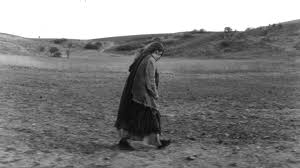
The Turin Horse

After making this film, Bela Tarr announced that he was retiring from making films. Though after 8 years, he is making a comeback with a documentary titled “Missing People”. Turin Horse begins with an unseen narrator telling us, that in 1889 Friedrich Nietzsche went suddenly insane after throwing his arms around an abused horse in Turin. After this incident, the philosopher remained in such a state until his death. Nobody knows what happened to the horse.  Next, we see a monochrome film about six chapters of life on a remote, impoverished farm occupied by an elderly man, his daughter, and their unfit horse. In one sequence, we get to know that the name of the old man is Ohlsdorfer.  Every day, the daughter goes to the well and brings the water. She dresses her father as his right arm is paralyzed. But each day things get worse. The wind doesn’t decline, the horse won’t drink or pull a cart. One day, a man comes to their house to get some amount of brandy.   He tells the old man humans and God are responsible for suffering in the world. The old man ignores his vision, saying that all of those are rubbish. There lies the point of the film. It is about the “heaviness of human existence”. The film is in black and white and consists of merely thirty long takes. As it is with Tarr’s films, he uses the environment as the main ‘characters’ – the buildings, the landscape. This gives a tremendous sense of grandeur to simple images. Mihaly Vig once again delivers an incredible score, a funereal song that shares the soundtrack with the endless howling wind.  Previously in Tarr’s films, we have seen that people do always suffer. But we have also found a glimmer of hope in Werckmeister Harmonies. There was a particular scene where a mob would attack the hospital, but they would stop vandalizing once they find a helpless person inside a bathroom. But in “Turin Horse”, it seems that he feels that there is only a horse to human suffering.
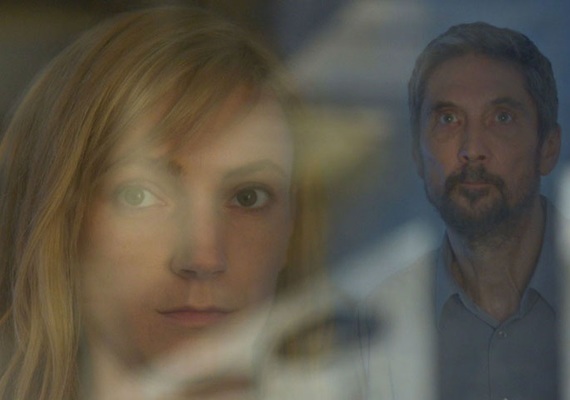
Teströl és lélekröl (On Body and Soul)

On Body and Soul

Ildikó Enyedi’s “On Body and Soul” opens on a buck and a doe going through snowy woods, in a fantasy that climaxes with the buck placing it’s head on the doe’s neck in a haunting gesture of relationship. Endre (Géza Morcsányi) and Maria (Alexandra Borbély) both see the same dream at night.  Both of them work in a slaughterhouse. Endre is the manager, a middle aged man with a disabled arm. Maria is the new hygiene inspector in the farm. She examines the slaughtered beasts for signs of disease or excess fat. She finds difficult to interact with human beings. In this film,we see some explicit shots of animals being chopped up. Such scenes might give an eerie feeling to the film throughout. Endre and Maria begin to fall in love. Both do share the same dream but when it comes to real life,both of them struggle to continue the relationship. Endre has a disabled arm while Maria finds it tough to communicate with him. Maria watches pornography to know about sex in details.  Both are lonely in their own lives. Just like the cows of the slaughterhouse, both of them are imprisoned in their worlds. Endre mostly talks to Jenö (Zoltán Schneider) but he is far from being his friend. One of the most interesting aspect of the film is the way window is used to separate them. At-times, Endre watches Maria through the windows of his office.
At canteen,he watches her through windows. They are so close yet so far. One day, both of them try to sleep in one room together. While doing so,they can’t sleep at all. The film is extremely well-shot. A lot of the imagery is splendidly unsettling. The music is hauntingly beautiful and Ildiko Enyedi’s direction is controlled and intelligent. She succeeds in connecting between human and animal behaviour and depiction of the alienation of modern human being.  Géza Morcsányi gives a stunning performance as Endre . He successfully conveys all the emotions with a bit of sophistication. Alexandra Borbély is even better than him. Some actresses perform so wonderfully that it stays in your mind forever. She is beautiful but in most part of the film she acts as if she suffers from inferiority complex. She hardly looks confident. The script is nuanced, poignant and thought-provoking, with some pertinent points made about the subjects it explores.