Deadlock

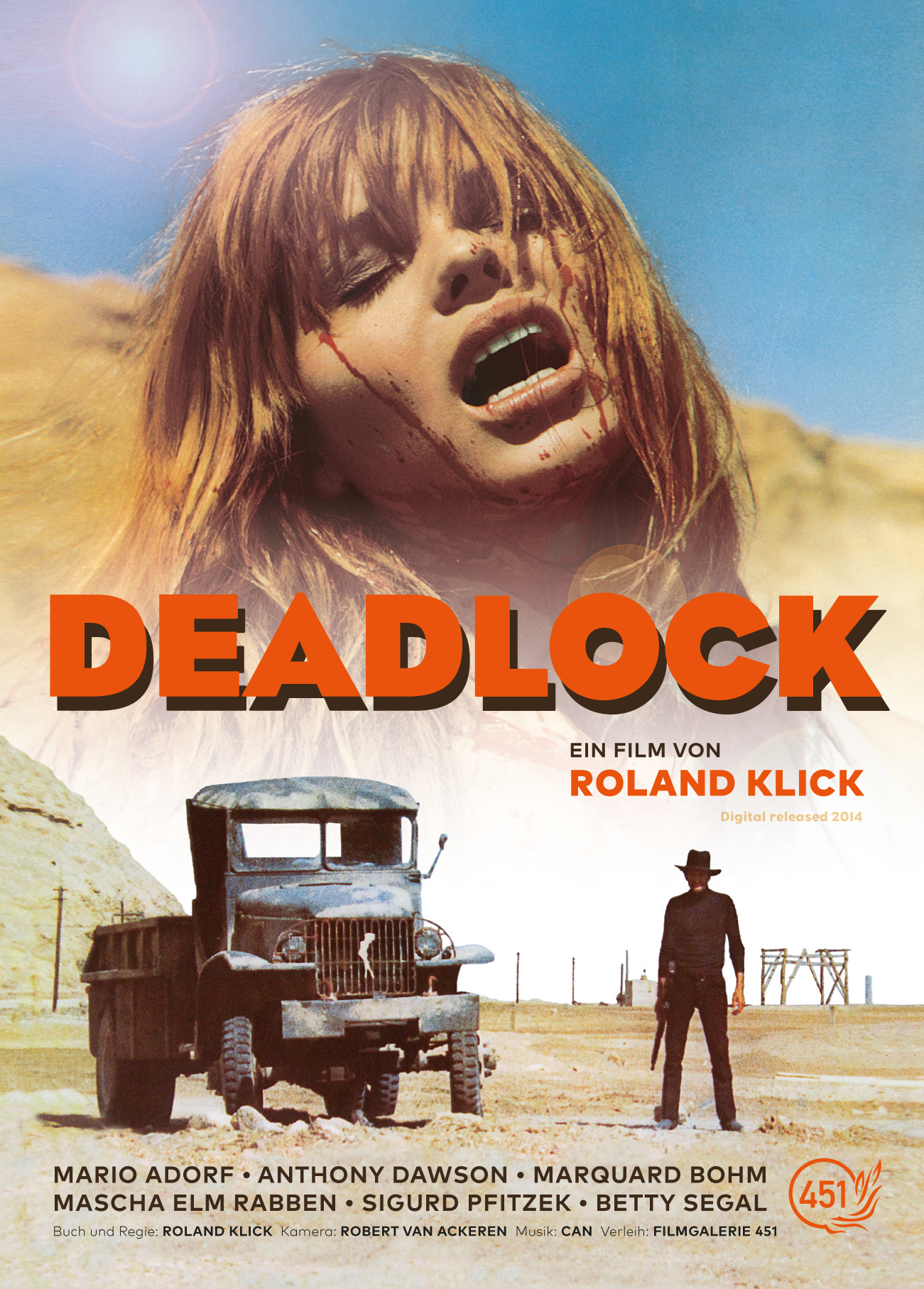
Roland Kluge tried to make a Spaghetti Western film in German. Spaghetti Western is quite difficult to do in the German landscape. The shooting of the film “Deadlock” was done in Negave desert. No one specifically mentioned the “location” of the story in the movie. The first scene shows a tired, devastated man carrying a suitcase. In the middle of the desert, he became unconscious. A man saw him and took him to his house. The place where his house is, is a deported mining town. Gradually, it became known that the man with the suitcase had robbed the bank. He is waiting for his partner. His partner will also come to the place with the rest of the loot, and they will share the loot. The man who brought that guy into a home is a driver. The story doesn’t say much but we can assume that he used to work in mines once. His life is not going anywhere. He is waiting for an opportunity so that he can improve his life. Seeing the suitcase full of the man he had brought home, the driver was hopeful.
For the most part, the film was slow (unlike most Spaghetti westerns). It was most interested in observing the characters but it would take a turn when the guy’s partner Sunshine would make an appearance. Although the film is set in the real world, it seems different in many places. At times, it goes beyond reality and it gives a feeling of absurdity. Germany band Can’s soundtrack gave that feel as well.
In the Fade (Aus dem Nichts )

In the Fade 1

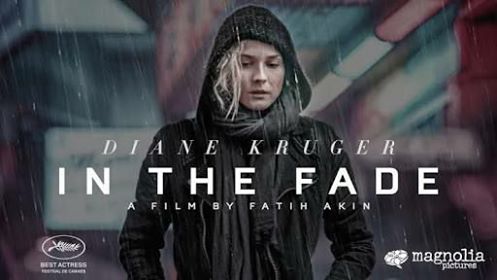
In a prologue, we see blonde Katja (Diane Kruger) marrying jailed drug dealer Nuri Şekerci (Numan Acar). After returning from jail, Nuri corrected himself and he did set up a business. They had a happy family with a son. One day, Katja goes to a spa with her friend. While returning, she finds police barricades and learns that a bomb killed her loved ones. She is devastated totally. She tries to get back to her normal life but she couldn’t.  From the investigation, it is learned that a neo-nazi group is involved in this murder. Since last few years, neo-nazi groups are creating terror in Germany. They are mostly violent towards Muslims. Katja’s friend Danilo Fava (Denis Moschitto) is prosecuting attorney, pitted against nasty defense lawyer Haberbeck (Johannes Krisch). Kruger convincingly conveys Katja’s anguish, fragility and fierce determination as a woman who has lost everything yet single-minded in a pursuit of justice that eventually turns to vengeance. The first half of the film deals with the tragedy of Katja. 2nd half deals with the court procedures. In the 3rd half, we witness the rage of a woman. The film just doesn’t focus on the terrorism issue. It also deals with the rage of a woman. Beside that, it deals with the grief of survivors. Court scenes were cleverly shot. We felt bored while watching that part. But that is how justice system works. The film cleverly used silence in crucial moments. One might hope for some action, but that is not going to happen.

Antikörper (Antibodies)

Antibodies


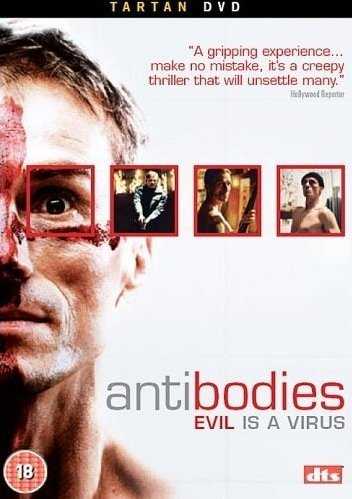
Written and directed by Christian Alvart, the film begins with two German police offers on a call in which a woman has been hearing screams from an upper floor of an apartment. Upon investigating, the two officers are caught off guard and blasted by an alleged serial killer Gabriel Engel (Andre Hennicke), the man who has killed and sexually assaulted 13 young boys.  Soon Engel is caught and taken into custody. But he keeps mum about what he has done. Meanwhile, in a small country village, local farmer and town constable Michael Martens (Wotan Wilke Mohring) has been trying to solve the brutal murder case of a local 12-year-old girl.  Hearing the news of Engel’s capture, the villagers believe that cops finally managed to catch the killer. But Michael is not convinced. Michael goes to the big city in hopes to find out the truth directly from the killer, himself. As he begins a deadly mind game with the madman, he gets more questions than answers. There have been a lot of comparisons between this film and Jonathan Demme’s Silence of the Lambs.  However, this film differs by directly referring to Silence of the Lambs in the very first meeting between Michael and serial killer Engel.
As the two meet for the first time, Engel says, “What did you expect? Hannibal Lecter? ” By doing this, the film is clearly able to take a stand different from Silence of the Lambs. Both the lead actors  (Hennicke and Mohring) do a superb job in their respective roles. Hennicke’s character is much more vicious than Hannibal Lecter.  Hennicke’s performance is incredibly effective and, in a way, much more terrifying than Hannibal Lecter. The cinematography of this film is stunning.  Hagen Bogdanski did an incredible job here. The grey and blue-tinted color is used to depict the big city while the warm picture gives the feel of the countryside. From the beginning, the film is imaginative, brave and unpredictable.