Juste Avant La Nuit

Juste avant la nuit

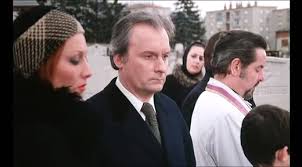
Just Before Nightfall is another Claude Chabrol film that focuses on infidelity and again it’s an intriguing thriller and an excellent exploration of the human condition. When a sadomasochistic game goes too far, Charles (Michel Bouquet), a married man, strangles his lover, the wife of his best friend, and then does battle with his guilty conscience. The murder happens right at the start of the film, so it’s not exactly a spoiler. Bouquet despises the games she likes to play, mostly because he sees that what she’s really getting off on is his own distaste. He’s not sure whether he wanted to murder her.  He’s married to an elegant woman (Stephane Audran, Chabrol’s wife) and has a couple of nice kids and an elegant house that was designed by the victim’s husband.
His characters are generally from the section of the French bourgeoisie. They’re respectable, they live in comfortable homes and work in well-paying professions, they present a facade of total respectability. But underneath there are dark passions and well-kept secrets and, at times, the ultimate embarrassment of murder. The actors reveal their inner dilemmas with gestures more than words. Deep intentions run across surface motives. And the final gesture of this compelling film casts all that went before into another, deeper level. All the main characters are developed well and believable. The main character, Charles, is certainly the most interesting; the way that guilt overtakes him provides a different take on the common murderer theme and makes for a very interesting watch. Guilt, forgiveness, revenge coexist and mutually triumph. Many of us assume these three moral stances are mutually irreconcilable. Chabrol balances them against each other and then fuses them together.

wolf

Director Christophe Gans has given us an exhilarating ride with this stylish period thriller. The story involves the Beast of Gevaudan, which in 1764, terrorized a remote district of France, killing more than 100 people and tearing out their hearts and vitals.
As the film opens, the king has dispatched eminent scientist Gregoire de Fronsac (played by Samuel le Bihan), along with a muscle-bound Iroquois blood brother named Mani ( Mark Dacascos), to investigate. The creature responsible is reportedly a monstrous wolf, but as the pair investigate, they discover that several of the locals may know more about the affair than they’re admitting.  Why is aristocrat Jean-Francois de Morangias ( Vincent Cassel) so indecisive towards the duo and is the prostitute Sylvia ( Monica Bellucci) just a little too savvy and sophisticated for someone who earns their living from dusk till dawn?  There’s also the small matter of Marianne (Dequenne), Jean-Francois’ virginal sister who fascinates Grégoire and then drives him into the arms of Sylvia.

Brotherhood of the Wolf encompasses every genre of film; martial arts, action, romance, thriller, horror, drama, everything.  There is the strikingly elegant and almost hypnotic courtesan Monica Bellucci, playing her role of seductress with ice-cold professionalism.  In complete contrast, there is the innocent, fragile, and astonishingly beautiful, Emilie Dequenne, younger sister to the protective Jean Francois.
The two leads are fantastic and share a chemistry reminiscent of the relationship between Butch and Sundance.  Then there is Vincent Cassel who is suitably creepy as the immoral ‘Morangias”.  Atmosphere and suspense are strong throughout, and definite care is taken with the sound editing, whether it be the ceaseless patter of the driving rainfall or the heaving atmosphere of a noisy brothel.  The horror or ‘attack’ sequences are artfully played out, quietly refusing to reveal the identity of the creature; but when at last it is shown, the special effects do not disappoint.

Elle

elle

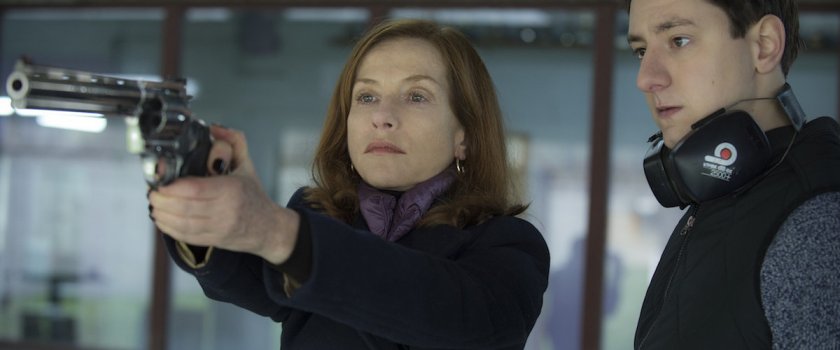
Michèle Leblanc (Isabelle Huppert) is raped in her home by an assailant in a mask, then promptly cleans up the mess and resumes her life. The only witness to the attack is a black cat, which sits watching silently. This is the first image, the cat’s stare, a touch that’s grotesque and mysterious, like everything that follows in this subversive black humor.  Later, at dinner with friends, she offhandedly remarks, “I suppose I was raped.”  Michèle is the CEO of a video game company.  Her ex-husband, Richard (Charles Berling), is an obscure novelist who is trying to pitch her an idea for a game about a post-apocalyptic revolt of cyborg dog slaves. Her mother lives with a gigolo. And there are the violent fantasies that Michèle initially entertains about getting back at her rapist, whose identity she discovers later.  Elle is at least three films at once: First, there’s the comedy of manners involving Michele’s adult son, mother, ex-husband and their respective other halves. At other moments, Elle plays like a sophisticated thriller. But it’s the third film, a complex psychological portrait of an unusual woman, that might be the most alluring (and these are the things u can never find in Indian cinema). As it progresses, Elle takes a deep dive into dangerous territory that could be misinterpreted as misogyny.  Huppert gives a performance of imperious fury, holding the audience at bay, almost provoking us to disown her. Paul Verhoeven’s long-awaited return to genre filmmaking pulls off a breathtaking film.

Ma nuit chez maud (My Night at Maud’s)

ma-nuit-chez-med

My night at maud’s is a 1969 French film directed by Eric Rohmer. It is the third film in his series of six moral tales. In this film, an introverted Catholic enginner (Jean-Louis Trintignant) is introduced by his Marxist friend Vidal (Antoine Vitez) to Maud (Francoise Fabian), a charming middle-aged woman and ends up staying the night in her apartment. They spend the evening talking about philosophy and religion, particularly about their different views on Pascal and his wager.  Pascal offered a pragmatic reason for believing in god : even under the assumption that god’s existence is unlikely, the benefits of believing are so vast as to make betting on theism rational. If god does exist, then our lives gain meaning and our reward is eternal. The three main characters are an interesting study in contrast. Vidal sees the wager as a logical tool for explaining everything, from religion to politics. For Jean-Louis, Pascal is too strict, a man who has sacrificed sensual pleasure.
Maud believes in the supremacy of love. After Vidal leaves, Maud tells Jean-Louis about her marriage, her ex-husband’s Catholic mistress, and the tragic end to her affair with the only man she loved. The girl that Jean-Louis is currently chasing is 22 year old Francoise ((Maire-Christine Barrault) a blonde,catholic girl that he has seen at church. They too fence with words as they try to mislead and reveal at the same time, and the audience is intrigued. Jean-louis is conflicted between his Catholic principles and his love of sensual pleasure.  He lives in a world centered on himself, involving in much philosophizing about choice but never choosing. Once Vidal leaves, Jean-Louis stays the night. Maud effortlessly engages Jean-Louis in a game of intellectual chess, provoking him with his own illusions about love. On the surface, the film appears very simple but underneath there is much complexity. Rohmer’s approach has often been called literary. He combines his intellectual interests with an intense examination of everyday life.

La Promesse

la promesse

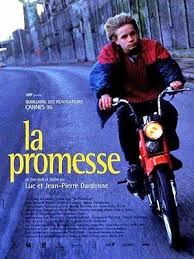
La Promesse, as the title suggests, is about the effort of keeping a promise, though it isn’t quite as simple as all that. At the age of fifteen, Igor has left school, works as an apprentice at a service station, and assists his father, Roger (Olivier Gourmet), in running an illegal immigrant smuggling, housing, and construction racket. They bring them back to a block of flats they live in and start charging them for money. One of the immigrants is Assita who has come to Belgium with her husband Amidou to find a better future for them and their baby. One day when immigrant-inspectors pay a visit, events start to have strange consequences. Igor leaves the service station in order to outrun the authorities and send the workers away.  In his haste, Amidou is critically injured when he falls from the arena, and, in his final words to Igor, asks the young man to look after his wife and child. Fearing prosecution, Roger ignores Igor’s pleas to take Amidou to the hospital for proper medical attention and instead, covers his body with canvas and leaves him to die. An important point of the film is the relationship between Igor and his father. The starting of the film presents a relationship between a father and his son that we could describe as complicity.  At this moment, the film becomes tinged with tenderness. But throughout this film, this complicity gradually turns into an open opposition and the consequences of Igor’s promise open his eyes on his father’s cruelty.

Jean-Pierre and Luc Dardenne create a scathing, poignant, and troubling  portrait of maturity, accountability, and sense of duty in La Promesse. Set in Liege, which is situated in Wallonia, a French-speaking portion of Belgium (where the Dardennes live), La Promesse is a study of native hustlers who exploit illegal West African immigrants, paying them little for hard labor. The sound scape is something that one should pay attention to. There’s no musical score at all only the voices the characters hear, the voices of an industrial town – ambiance. In the end the industrial voices just keep going on as the credits come on the screen.

Dobermann

Dobermann

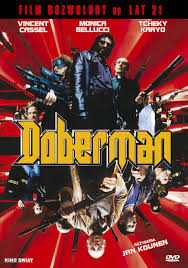
The charismatic criminal Dobermann (Vincent Cassel), who got his first gun when he was christened, leads a gang of brutal robbers with his deaf girlfriend Nat (Monica Bellucci). After a complex bank robbery, they are being hunted by the Paris police. The hunt is led by the sadistic cop Christini (Tchéky Karyo), who only has one goal: to catch Dobermann.  The cast is dominated by French superstars Cassel and Monica Bellucci (they married in 1999), playing the antihero and his ultra-loyal partner in crime, and they both manage to create a niche amidst the film’s visual excesses. But the film clearly belongs to Karyo as the deranged cop on Dobermann’s tail, an irredeemable psycho who’s prepared to break every rule – legal and moral – to bring his nemesis to book.  Dobermann not only set debut director Jan Kounen on the road to cinematic glory, it also helped to create an aggressive upsurge in ultra-commercial European cinema. This is 100 minutes of non-stop comic-book violence, a traditional cops and robbers scenario in which the police are no better than the crooks. All the thought behind this film was put into the style, and in that regard the film succeeds admirably for this is an incredibly stylish film made on a relatively small budget, the film was made for about 33 million Francs which is equivalent to about 5 million Euro’s. The directing was extremely fast paced and kinetic, full of stylish movements, rapid zooms to close ups and fast editing. The film consists of basically two sequences: a supposedly “genius” bank heist and a violent confrontation at a nightclub frequented by cross dressers.

Le scaphandre et le papillon (The Diving Bell and the Butterfly

The Diving Bell and The Butterfly

The Diving Bell and the Butterfly (French: Le scaphandre et le papillon) is a 2007 biographical drama film based on Jean-Dominique Bauby’s memoir of the same name. The film is based on a real man, and the book he somehow succeeded in writing although he could blink only his left eye. The man was Jean-Dominique Bauby (Mathieu Amalric), who was the editor of Elle, the French fashion magazine, when he had his paralyzing stroke.  A speech therapist (Marie-Josee Croze) suggests a mode of communication: They will arrange the alphabet in the order of most frequently used letters, and he will choose a letter by blinking. She passes the baton to Claude (Anne Consigny), who takes the dictation for his memoir. She makes the letters into sentences and paragraphs in a variety of different settings once Bauby is able to be moved around in a wheelchair.  The positive attitude of these women gives the patient the courage and confidence he needs to write his memoir. He also welcomes Laurent (Isaach de Bakole), a friend who reads books to him. He fondly remembers his last meeting with his forgetful father (Max Von Sydow), who loves him dearly. Later in a phone call, his dad breaks down when he realizes that he will never hear his son’s voice again. One of the most dramatic moments in the film occurs near the beginning when the first therapist thought Jean-Do communicates is that he wants to die.

the diving bell and the butterfly 1
Feeling rejected and angry, the therapist storms out of the room but apologizes and comes back shortly to resume the treatment. We do not actually see Jean-Do until about a third of the way through the film but we can hear his thoughts which are in turn angry, funny, and bitterly cynical. Much of the film vividly explores the editor’s imagination and the camera takes us on some wild rides that include images of Nijinsky, Empress Eugénie, Marlon Brando, and Jean-Do in his imagination skiing and surfing. Some of the most emotional moments occur when he greets his young children at the beach for the first time after his stroke, a telephone “conversation” with his 92-year old father (Max Von Sydow).  Mathieu Amalric has played the character of Jean with so authentication that it is hard to believe and separate his self from the real character. The most wonderful part that remains with you after the movie is the sense of humour with which Jean sees this world. He remains light hearted at times and thinks hilarious comments even in the most painful state of his being. I would also like to mention the two supporting characters who render Jean’s words on paper. Those roles are beautifully portrayed by two well known Canadian and French actresses – Marie Josee Croze (former writer) and Anne Consigny (latter writer) respectively. The Diving Bell and the Butterfly is a film of enormous power that shakes us and enables us to get in touch with the miracle of each moment.


La French

La French

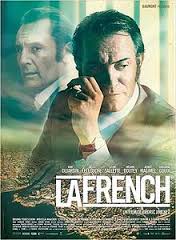
The Connection (French: La French) is a 2014 French-Belgian action crime thriller film directed by Cédric Jimenez and produced by Alain Goldman. The film was inspired by the events of the French Connection in the 1970s, starring Jean Dujardin as police magistrate Pierre Michel and Gilles Lellouche as “Tany” Zampa, a drug gang ringleader.  An energetic young magistrate Pierre Michel is given a tough job on the ins and outs of an out-of-control drug trade. Pierre’s wildly ambitious mission is to take on the French Connection, a highly organized operation that controls the city’s underground heroin act and is controlled by the notorious —and reputedly untouchable— Gaetan Zampa.  Michele is portrayed as a driven, obsessed man – it is implied that he had some gambling problems in the past – who seems to be actually trying to catch the ‘bad guys’. During the entirety of the film his determination is being shown as close to obsession as possible without too much cliché. Dujardin and Lellouche’s characters are more alike than they are different, with both being devoted family men and ultra-faithful husbands, and both having a close group of associates they treat like family.
Dujardin plays a full-on good guy, with his magistrate, Pierre Michel, being shown as one of the most incorruptible guys in France. It’s nice to see Dujardin play such virtuous part, which he does well. Lellouche’s Zampa is not your typical villain, in that he’s shown to have a compassionate streak, and is so anti-drug in his own life that when he discovers an associate of his is a drug-addict, he forces him to do a massive trail to try and teach him a potentially deadly lesson. Cédric Jimenez grew up himself in Marseille in the 1970s and says that the story of the Judge has run through his veins his whole life. He chose to shoot the whole film with a hand held camera, which gives the film it’s intimate and raw feeling. The opening scene showed a landscape filled with historical buildings, palm trees, straight roads and the sea that reflected blue from the sky. The vibrating and aggressive sound from the motorbike gave the picture a dramatic sound. To carry on, the visualisation had some glimpse shots, fast forwarding and an expression in chiaroscuro. The film looked like a production from the 1970s. Laurent Tangy as the cinematographer expressed the contrast between light and shade. There is some action here and there, but it’s neither flashy, nor heroic.

Le Beau Serge

                     Image
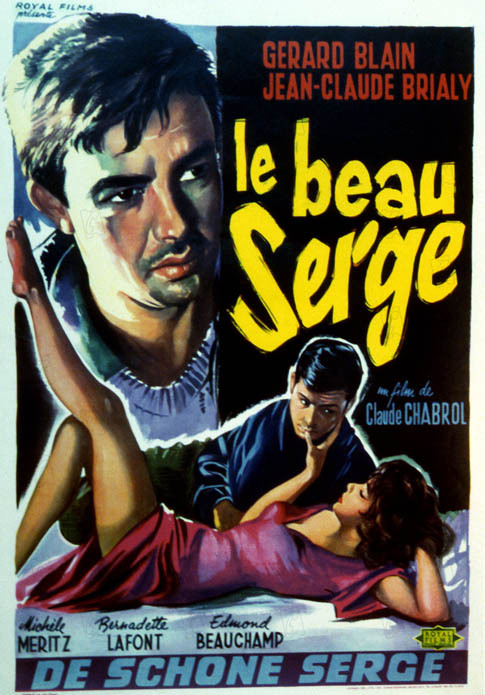
It is often considered the first product of the  “Nouvelle Vague” movement. It is about a young man Francois (Brialy) who returns to his native village and finds that his childhood friend (Blain) has become a hopeless drunk. It is Brialy’s efforts to rekindle the youthful promise once shown by his pal that form the bulk of the stark goings-on.  While much of the first half focuses on Francois’s attempts to solve the mystery of Le Beau Serge, the second half of the film increasingly comes to focus upon why it is that Francois is so obsessed with saving first Serge and then the entire village. Though Chabrol offers us no easy answers, the depth of Francois’s guilt is such that his attempt to protect Serge and his family eventually comes to seem insane. The remarkable and stark Le Beau Serge announced the arrival of a great who would go on to craft provocative, entertaining films for five decades.

Possession

                                                                  possession

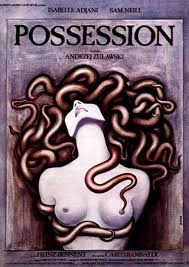
Possession is a 1981 French cult horror film directed by Andrez Zulawski and starring Isabelle Adjani in lead role.  Possession debuted at Cannes, where it was received with notable press.  The central couple, Anna and Mark, is introduced at what appears to be the beginning of an estrangement. Their marriage already is broken, neither party will allow the separation to be resolved without exerting some hardship upon the other. Mark and Anna are shouting each other by the opening five minutes.  After the opening ten, they are fighting in public. The level of frustration, rage, and insanity only continues to rise.  The first half of Possession is peculiar and the second half is bizarre.    Zulawski wrote it while going through breakups to recognize emotional rawness and irrational behavior. People go crazy when relationships go bad.  Murder, mutilation and literal monster breeding are the nightmarish faces of character assassination and financial destruction.

The tension and electricity of the performances is literally inhuman, and it becomes quickly obvious that we are not really watching “natural” or “method” acting but something far more extreme.