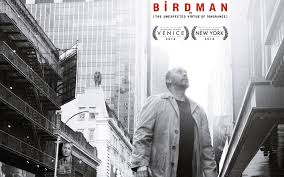
Birdman

Birdman

It is a 2014 American film directed by Alejandro G. Iñárritu. It was written by Iñárritu, Nicolás Giacobone, Alexander Dinelaris, Jr. and Armando Bo.   The film was shot in New York City during the spring of 2013 with a budget of $16.5 million jointly financed by Fox Searchlight Pictures, New Regency Pictures and Worldview Entertainment.

Keaton is Riggan Thomson , a former film star whose claim to fame is having played a superhero ,Birdman.  Riggan wants to make his big comeback , and bid for credibility by writing ,directing and starring in an adaptation of Raymond Carver stories on the Broadway stage.  The protagonist’s on screen and off screen struggles whirl around at a rapid pace as the camera follows him through the narrow shabby , sets , halls and rooftops of the theater. While the Birdman trailers have positioned this film of Inarritu as counter-programming to Marvel and DC’s burgeoning cinematic universes ,the actual story is focused on more personal matters : troubled relationships ,artistic integrity, Broadway versus Hollywood.  Birdman is about a father ,husband ,lover ,business partner and actor. Birdman is basically a shadowy figure from Thomson’s past- one that ,above all else ,haunts him (as a voice to his self-loathing).

Together Inarritu and cinematographer Lubezki make ambitious use of a Broadway theater stage-employing every inch of the building to give the impression that most of Birdman was filmed in one continuous take.  Emma Stone supports Keaton as his daughter Sam, a recovering addict who wants little to do with her dispassionate father , but has little choice , being stuck with him while her mother is unable to take her in.
She’s bold and combative in a way that doesn’t feel simplistic or overzealous. Keaton gave a great performance as the main protagonist -the fact that he’d starred in Batman and Batman Returns in past added a self-reflexive touch to the film.
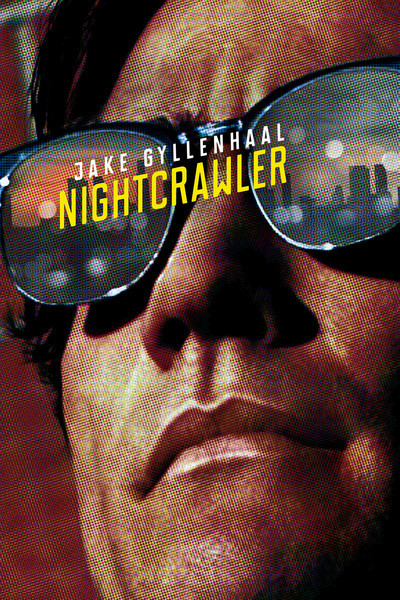


Nightcrawler

nightcrawler 2

Lou Bloom (Jake Gyllenhaal), a driven young man desperate for work, discovers the high-speed world of L.A. crime journalism. He’s first seen trying to cut through a chain-link fence to steal scrap that he can sell for pocket money.  While driving late at night, he happens upon cameramen filming a car wreck. He asks the lead cameraman (Bill Paxton) what TV station they work for, and learns that they’re freelancers who monitor police radios, chase down wrecks and fires and homicides, and sell their video footage to the highest bidder.  He develops a working relationship with Nina Romina (Rene Russo) , news director for a local LA TV station. As the quality of his video footage improves so does his remuneration and he hires Rick ,young and unemployed to work with him.

Robert Elswit’s cinematography is perfection ,depicting the lure of L.A. afterdark in all of its haves-and-have-nots glory.  “Nightcrawler,” which was written and directed by Dan Gilroy, provides ample cause for alarm. It was shot both digitally and on film, as was Michael Mann’s “Collateral,” another nervous nocturnal thriller, set in the same city. Only difference is that film was an ordinary one while Nightcrawler is nothing less than a classic.  The film is about a private ,ruthless loner who pursues his dream his way , always , and whose path through the world is marked by the bloodstains of the people he’s rolled over. Gilroy, a first-time feature director who has written or cowritten many movies, including “The Bourne Supremacy,” knows what he wants to say, and how to say it.

Then again, this is Jake Gyllenhaal at his absolute best. Louis Bloom lures you in with a soft, socially awkward demeanor that makes him seem like a wounded animal, but his eyes reveal something dark – something unsettling.

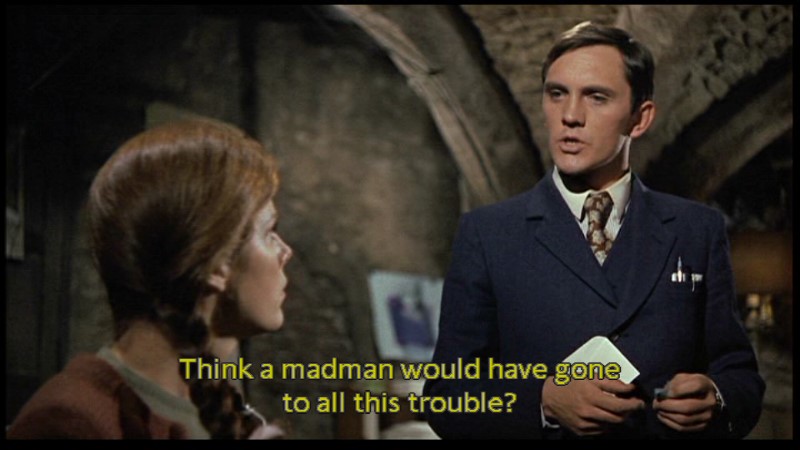
The Collector


a William Wyler The Collector DVD Review PDVD_013


Freddie Clegg (Terence Stamp) is a butterfly collector. One-day he kidnaps and chloroforms Miranda (Samantha Eggar). Wyler focuses the entire film on just the two characters and their psychological toyings with one another. The Collector focuses on the obsessions of a young man whose need for a woman’s affection leads him to desperate measures at the expense of his object of desire. Freddie is shy , poor and utterly obsessed with her.  When he wins a fortune in the football pools, he devises the perfect use for his newfound wealth. He buys a remote house and converts the basement into a comfortable prison for Miranda. Samantha strikes a deal with him, promising to stay a month. Freddie agrees, confident that she will soon love him. Samantha later realizes that there is no way of escaping as he “collected” her but Freddie never behaves like a monster. This intense creepy film features a superb performance from Terence Stamp in the title role as the “collector” of beauty. Stamp’s sociopathic brooding is fantastic, creating a vibe throughout the entire film that doesn’t waver in the slightest. This isn’t an exploitative, blatantly cruel film. It’s a disturbing love story, even if it’s a love that isn’t reciprocated.

Mystery Train

Image


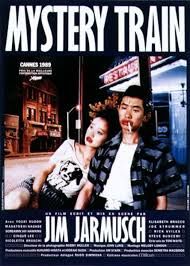
The film consists of three stories that take place on the same night in downtown Memphis. Youki Kudoh and Masatoshi Nagashe play two Japanese youth who have come from Yokohama to visit Sun studios and Graceland. They are completely different- she is outgoing, he’s quiet; she loves Elvis, he prefers Carl Perkins. The second story is about an Italian widow who is at the airport making arrangements to ship her husband’s body back to Rome. The final story introduces Johnny who is upset after losing his job and his girlfriend. The three stories are linked together by the Arcade hotel and Elvis. Cinematographer Robby Muller captures Memphis in such a manner that u will never forget the city.  John Lurie contributes a piercing Sun Studio-style guitar score and the cast makes a near-perfect ensemble. “Mystery Train” concerns the intertwining stories of foreigners in a quintessential American city. The main theme here is the tragic, drastic juxtaposition of Elvis’ magic spell, and the reality of what Memphis looks like years after his absence. It clings to his image , but seems incapable of moving forward, of producing any new commodities.

Pale Rider

Image

The film bears a striking similarity to the classic western Shane. In a small California town ,some independent miners have staked a claim to a promising lode.  The town is ruled by a cabal of evil men , revolving around Lahood and the marshal ,who is his hired gun. Suddenly a mysterious stranger (Clint Eastwood) arrives in the mining community. His presence compels the main characters to become united and helps them to fight against evil. He may indeed be the pale rider suggested in the title, whose name was death, but he may also be an avenging spirit, come back from the grave to take revenge. He is known as preacher. In this ,Eastwood becomes an avatar of divine punishment and holy retribution. The Marshal Stockburn confesses that he recognizes the preacher , but is confused because the man is supposed to be dead.
As the film’s director, Eastwood has done some interesting things with his vision of the West. The sources of light are almost all from the outside. Interiors are dark and gloomy, and the sun is blinding in its intensity. Clint Eastwood as both director and protagonist once again proves himself to be a master of stylized drama.

Inside Llewyn Davis

Image

Inside Llewyn Davis, Joel and his brother Ethan’s film about a turbulent period in the life of its title character, a fictional Village folkie, during 1961. The film was partly inspired by the autobiography of folk singer Dave Van Ronk
If we see technically ,then Davis isn’t Van Ronk. He had a gruff , commanding style that was 180 degrees removed from Oscar Isaac’s (the actor who played Davis) resonant balladeering. Yet the film has more than its share of nods to Van Ronk.
Isaac sings three Van Ronk-associated songs, which he learned from one of the late singer’s Village folk buddies. The cover of Davis’s album is a direct nod to Van Ronk’s 1963 LP Inside Dave Van Ronk. Llewyn is so poor he doesn’t even have a winter overcoat. His fellow folk singer Jean Berkey (a foul-mouthed Carey Mulligan), who goes out with his friend Jim (Justin Timberlake), is furious because she is pregnant and thinks he might be the father. “Everything you touch turns to shit, like King Midas’s idiot brother,” she screeches at him. He used to sing with a partner, Mike, who killed himself by jumping off the George Washington Bridge. He performs in a shadowy club, in the glare of a recording studio, at a dinner table, and in a vacant auditorium. And here lies the genius of Coen Brothers. The Coens could have made a film about a superlative talent , just waiting to be dug up like a diamond. 

Llewyn is very good, but he’s not great. The truth, in this instance, is uttered by Bud Grossman ( Superbly played by F. Murray Abraham -the actor from Amadeus) , the owner of the Gate of Horn, who asks Llewyn to play for him, one to one. He gives the verdict after listening to Davis’s song “I don’t see a lot of money here.” Llewyn accepts the verdict, as you should from any god, and leaves.  Oscar Issac gave a splendid performance in this film. The lead hero doesn’t look like lead and that’s exactly what it should be. Bud Grossman, again, gets it right, telling him, “You’re no front man.” There are many humorous moments but the tone is too bleak for this ever simply to seem like comedy. The Coens are dealing with suicide, abortion, and their lead character’s ongoing professional failure.  The film manages the unlikely feat of staying respectful toward the Greenwich Village folk scene of the early 1960s while being gently satirical about folk subculture in general.


The Friends of Eddie Coyle

                                                                                            The Friends of Eddie Coyle

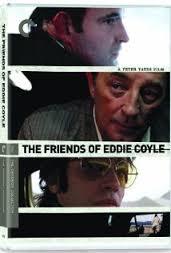
Eddie Coyle (Robert Mitchum) doesn’t want to serve a life sentence in prison, so he becomes an informant for both the police and the treasury department. The characters and dialogue are what drive this low key crime story. Eddie Coyle has no friends.
 The life of a criminal is hard. Eddie Coyle is tough but wearing out. He doesn’t want to leave his wife and kids and see them go on welfare. It’s impossible to not feel for Eddie (because of Mitchum’s understated performance), who comes across as a mostly harmless man who got caught up in the wrong game and could never figure out how to unravel himself. The film’s other characters like Dilon, a hard-eyed bartender who acts as a liaison for those who are truly in power and thus don’t need to dirty their hands directly and Jackie Brown, a young gun dealer. Brown is cocky and in no way naive, but he also represents a generation that Coyle doesn’t understand. There is not a lot of physical violence in the film, with only a few gunshots being fired. Directed with a sharp eye for its gritty locales and an open heart for its less-than-heroic characters, this is one of the suspenseful crime drama of 1970s Hollywood.

To live and die in LA

                                                                         to live and die in la

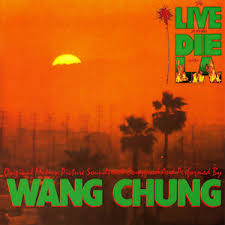
William Petersen stars as Richard Chance, a US secret agent who becomes obsessed with catching master counterfeiter Rick Masters  (William Dafoe) after Masters kills his partner. Chance gets closer to Masters by catching one of his mules Carl Cody ( John Turturo), but Cody won’t talk even after Masters hires goons to beat him in prison.   Chance and his partner Vukovich attempt to get information on Masters by putting one of his criminal associates Waxman under surveillance. Masters murders Waxman and the cops fail to catch him. Chance becomes increasingly reckless and unethical in his efforts to catch Masters. It all goes wrong when they decide to pull their own heist in order to secure the required funds to stay in hot pursuit.  William Friedkin plays it as brutal and cynical as he ever did with The French Connection, and this time the car chase takes place on a six-lane freeway going against the traffic. Friedkin creates a tense atmosphere of adrenaline and corruption and danger, enhanced by an effective techno soundtrack by Wang Chung and draws credible performances from his entire cast. The real star of the film is Robby Muller’s banished photography pf, Los Angeles.

Baby Face

                                                                       Baby Face

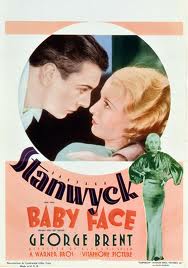
Lilly works as a barmaid in her father’s saloon where she learns to deal with the unwanted advance of male customers. When her father dies ,she moves to NewYork City with her maid Chico ,to become a ruthless gold digger.  She uses sex to advance her social and financial status.  Among the men used and abused are department store managers, bank presidents and government officers. This film led to the adoption of the production code in 1934.  The code virtually put an end to sexy films like this of “sleeping your way to the top”.  The men she goes through are pleasured thouroughly , and allowed to make themselves thought of as seducers. No one can do the innocent little girl act like Lilly , and each man is crushed when she moves onto the next man.

She doesn’t use the new men against each other , but simply blows off the former lover. If ever there was such a thing as a one-woman show, Baby Face is it.  Lilly knows right from the start that she is living in a man’s world. She also knows that men can be easily brought to their knees with the slightest hint of affection.  The interest thing about the film is that one Black character has a significant role in this film. The “pre-code” films made between about 1930 and 1934 can be quite shocking and delightful. 

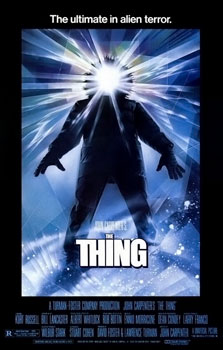
The Thing

                                                                              Thing

Strong premise as a group of American scientists and researchers posted at an isolated station in Antartica. Their days are busy but their nights are long and cold. One day, a half-dog/ half wolf appears with a Norwegian  chopper in hot pursuit.  During the night, the dog mutates and attacks other dogs in the cage and members of the team that investigate.  It turns out that dog is not the innocent victim of a lunatic hunting outing. It’s actually an alien that has the ability to digest and imitate creatures it comes onto contact with. No one knows who to trust because there could be an alien among them.  Dr Blair (Willford Brimley) calculates that after 27,000 hours from first contact with the civilized world, the entire planet earth will be infected by “the thing”. Macready (Kurt Russell) and others now must determine that who is a “thing” and who is a man. Creature effect artist Rob Bottin does an excellent job of turning what could have easily become a cheesy gore-fest into a frightening mess of blood and fear.

The Thing ,although never actually taking one specific form, is constantly seen in a morphing stage , and the effects are simply superb. John Carpenter manages to create a truely believable and incredible atmosphere. When watching this film, we truely get the sense of the dark,sinister,desolate surroundings. Kurt Russell does a good job as Mcready , nicely conveying the emotions of a man thrust into a situation of unimaginable horror. Morricone’s score is a wonderful eerie pulse beat that racks up the sense of doom and paranoia throughout the film.