Pit and the Pendulum

Pit and the Pendulum


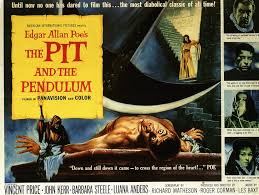
Following the sudden death of his sister, Francis Barnard (John Kerr) travels to Spain to question her husband, Don Nicholas Medina (Vincent Price), son of a notoriously barbaric Inquisitor. Medina openly mourns the death of his wife but Barnard is unconvinced by his story and is determined to discover the truth. “The Pit and the Pendulum” is the second of Roger Corman’s Edgar Allan Poe’s adaptations with a screenplay by Richard Matheson. Nicholas and his younger sister Catherine (Luana Anders) offer a vague explanation that Elizabeth died from a rare blood disorder six months earlier. During the dinner, the family’s friend Doctor Charles Leon (Antony Carbone) unexpectedly arrives and Francis discovers that his sister died of heart attack after visiting the torture chamber in the dungeons. Nicholas witnessed the murder of his uncle Bartolome (Charles Victor) and his adulterer mother Isabella (Mary Menzies) being tortured and killed by his father when he was a kid. Price himself is wonderful as usual as the tormented Don Medina. With ease he can go from melodrama to utter horror and his melancholic over-the-top melodrama was right at home in Poe’s adaptations. John Kerr makes a terrific counterpart and his performance is very believable. Steel’s aura of mystery suits perfectly the atmospheric horror of the film and Anders displays her talent for melodrama.
Pit and the Pendulum’ is a uniquely and profoundly visual experience. Richard Matheson’s screenplay is both intelligent and eloquent and Corman makes full use of what he is gifted here. The theme of being buried alive is something that appears to have fascinated Edgar Allen Poe as it appears in a number of his stories. It’s impossible to imagine the terror of being alone in an encircled space with nobody or nothing to help you escape and that’s what makes it so terrifying. Corman’s lavish, flavorful sets and unique use of color only add to the overall effect of the film.

Trumbo

TRUMBO

The film covers nearly three decades in the life of American screenwriter and noted Communist Dalton Trumbo (the 1940s-70s), with the title character played impeccably by Bryan Cranston. But three decades of such a richly lived life is a bigger bite than most 2-hour movies can chew.  Trumbo was one of the Hollywood Ten, artists (mostly writers) connected with the Communist Party in 1947 refused to betray other comrades during the hearings of the Committee on Un-American Activities led by Senator Joseph McCarthy so they had to purge several months in prison and were prevented from working in the industry.   Trumbo’s friend Edward G. Robinson (Michael Stuhlbarg), who supports the cause, sells the Portrait of Père Tanguy to raise money for their legal defense fund. The unexpected death of Justice Wiley Rutledge ruins Trumbo’s plan to appeal to the Supreme Court. In 1950, Trumbo serves 11 months in Texarkana prison, where he meets former HUAC chairman J. Parnell Thomas, who was convicted of tax evasion.
An old-school Hollywood screenwriter who did a fair amount of his best work in the bath, typing with a glass of Scotch in one hand and a lit cigarette in the other, Trumbo (Bryan Cranston) was what they call a “card-carrying member of the Communist Party,” unafraid about his political views — which had earned him acclaim in the literary world as the author of “Johnny Got His Gun.” Trumbo attracted the attention of Los Angeles Times columnist Hedda Hopper, whose idea of patriotism involved abolishing the threat of communism in the industry. On the personal front, there’s wife Cleo (Diane Lane) and three kids — the oldest of whom we watch grow into a confident young woman (Elle Fanning). Then, in the ’50s, we are privileged with scenes of Trumbo’s professional relationship with Frank (John Goodman) and Herman King (Stephen Root), producers of hilariously titled B-movies that provided Dalton with a living undercover. And there are even more characters who come and go, including some famous faces like David James Elliott‘s John Wayne and Christian Berkel‘s Otto Preminger, who are more caricatures than characters, but still undoubtedly memorable.
The film shows the screenwriter’s professional evolution, from blacklisted Hollywood writer and face of the notorious “Hollywood 10,” to a thankless life of writing under fictional names and winning Academy Awards on the couch. McNamara’s screenplay is filled with mighty one-liners, which everyone’s clearly having fun with. Gems like “I’m a screenwriter; if I couldn’t write shit, I’d starve,” or Louis C.K.’s one-of-a-kind delivery of beauts like, “he’s trying to sell his soul, but he can’t find it.” At times, it almost becomes too many good lines too fast (like in most every scene featuring Goodman), which halts the film’s rhythm and leaves little breathing room.  Director Jay Roach knows a thing or three about entertaining audiences. He’s directed “Meet The Parents,” and the “Austin Powers” movies, but “Trumbo” is probably his best film, by virtue of association to the strongest ensemble he’s worked with, and an impeccable script. The film becomes particularly good once we enter the blacklisted segment of Trumbo’s career, when theatricality starts to take a backseat to a deeper insight into the egocentrical and self-righteous side of this man. He’s no longer just a cartoonish figure, chain-smoking in his bathtub, but a father screaming at his daughter on her birthday, a friend ignorant to the pain of others around him, and a husband bullying his wife out of arguments.
 

Death Wish

Death Wish

Charles Bronson is Paul Kersey, a New York architect whose wife is killed by a group of muggers ransacking their apartment, an attack that also leaves his daughter unconscious. He takes a job working for a land developer in New Mexico to get his mind off his troubles, and while there his long fascination with guns is revived when his client Ames Jainchill (Stuart Margolin) shows off his personal collection and lets him crack some shots off.  He also witnesses a mock gunfight at Old Tucson, a reconstructed Western frontier town used as a movie set. Kersey soon arrives back in New York. But the streets are still filled with thugs, and Kersey knows that Manhattan is not the best place to be at night. He discovers that Jainchill has given him a .32 revolver as a present, and subsequently uses it to kill a man trying to mug him. He begins deliberately to tempt muggers, whether in an alley, on a subway train, or in a park and that he mechanically guns them down.
This made him the ‘avenging angel,’ a true phantom ‘one-man crusade.’ In the eyes of the public, Bronson became a national figure—the vigilante. “Death Wish” was a highly controversial film when initially released. At the time, major cities were facing a deadly crime epidemic, and this film tapped into the fears and unspoken desires of many viewers, giving them a chance to live out their secret fantasies. Yet, it is undeniably compelling; one of these movies that makes you wonder, “what if this happened to me?”  Bronson is highly effective here; while not one of the great actors, he has a very strong screen presence. Vincent Gardenia is effective as the police detective assigned to his case. He unwillingly admires Kersey’s resolve, although he is sworn to put a stop to the killings. Rather than Bronson’s performance Death Wish has its significant themes and screenplay components which were used at almost every action/crime movie later on, thus became clichés of their genre.

Play Misty For Me

PLay  Misty For me
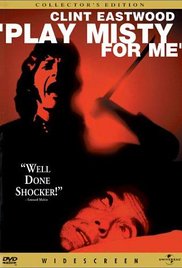
Play Misty for Me is a 1971 American psychological thriller film, directed by and starring Clint Eastwood, in his directorial debut with Jessica Walter and Donna Mills  as co-stars. The story-line was originally set in Los Angeles, but at Eastwood’s insistence, the film was shot in the more comfortable surroundings of the actual  Carmel-by-the-Sea, California.
The girl (Jessica Walter) calls up every night at about the same time and asks the disc jockey to play “Misty” for her. Some nights he does. He’s (Clint Eastwood) the all-night man on a small station in Carmel who plays records, reads poems, and hopes to make it someday in the big city. ” Later, he meets the woman at a bar he goes to often, and they go back to her house together and make love.   The next morning, he leaves, figuring it was just a one-night stand, but when he gets home, the woman, Evelyn Draper (Jessica Walter) shows up with groceries and starts to make herself at home. Dave decides to go with it, and later sees that his old girlfriend, Tobie Williams (Donna Mills), is back in town, and the two become close again. Evelyn begins stalking him through the middle part of the movie but don’t let that keep you away; she pops out when you least expect it. Even Eastwood’s friends and workers are not unsusceptible from her violence. Things get even worse when she damages his house and attacks his cleaning lady with a butcher’s knife. Evelyn’s admitted to a psychiatric hospital and this enables Dave to re-establish his relationship with Tobie Williams (Donna Mills). Tobie, who has recently returned to the Carmel area, is the woman he loves and their relationship develops well until further complications follow when Dave is told that Evelyn has been released from hospital. 


misty 2

 
The acting performances are consistently very good in this movie but Jessica Walter is outstanding in a role that requires her to be ultra scary. Her capacity to fly into a rage at the flick of a switch is astonishingly good and the way in which she portrays the manipulative side of Evelyn’s character also works well. Clint’s smooth, late-night D.J. is powerless in the face of Jessica Walter’s stalker, as she sets out to turn their one night stand into a lasting, meaningful relationship. Eastwood is quoted as saying that he was unsure of how his directing debut would be received. He disguised himself and went to a theatre showing Play Misty For Me, where he was pleased at the audience’s frightened reactions.  With this film, he began a pattern of bringing his pictures in under budget and ahead of schedule. Departing from tradition Eastwood opts out using a musical score in keeping with traditional suspense thrillers. Play Misty for Me’ may feel more dated than the 70’s fashion in some areas, markedly the violent sequences which seem amateur in this day and age, but the excellent foundations in plot, script and acting mean the film remains a good watch some 40 years on.

Holiday

Holiday 1938

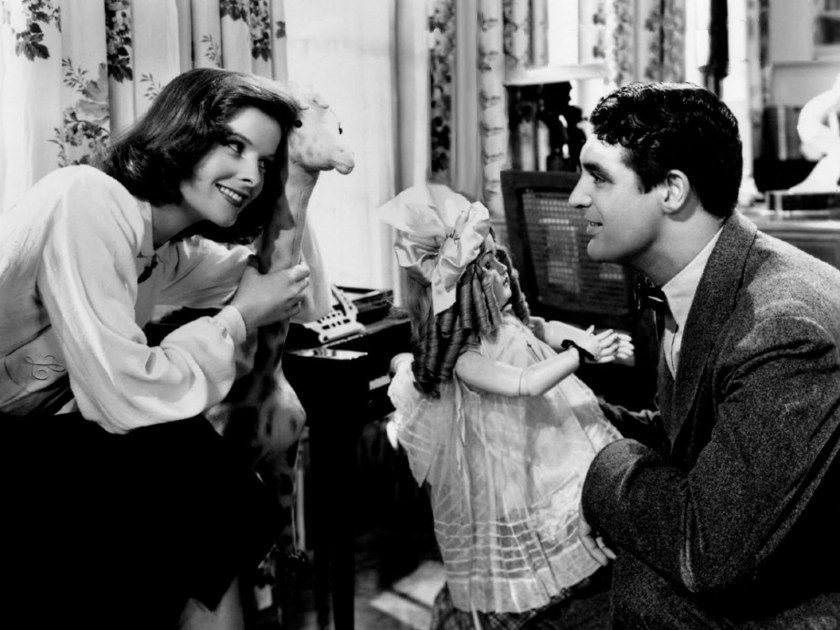
Holiday is a 1938 film directed by George Cukor, a remake of the 1930 film of the same name. Set in New York, it stars Cary Grant as Johnny Case, an emerging businessman who is more concerned about making a career out of something he wants to do, and not what he should do in order to make money.  While he takes a holiday, he meets Julia Seton ( Doris Nolan), the two fall in love and go back to New York to tell Julia’s father. What he doesn’t know is that Julia comes from an extremely rich family, and while he is shocked and amused by the fact, he finds himself taken with the other members of Julia’s family; Linda Seton (Hepburn), Julia’s free-thinking and dramatic sister, and brother Ned Seton (Ayres) a kind but stern alcoholic.   He has a plan: save up a little money then retire young, experience the world and then, when he’s run out of money and has an idea of what he wants to do with his life, come back and go to work doing what he wants to do. Now all he has to do is explain it all to Julia. And to her father. And all while trying to deny the fact that he’s attracted to Linda.  Cukor takes a lighthearted approach to this story, which keeps it cheerful and entertaining, and he laces it with warmth and  humor that’ll give you some laughs and put a smile on your face.


Holiday-3

But beyond all that, Cukor shows some real insight into human nature and the ways of the world. But what really makes this one special are the performances of Grant and Hepburn. Grant is as charming as ever, but just a bit looser and slightly less stylish than he is in most of his later roles. He bestows Johnny with youthful enthusiasm, good looks and personality, as well as a carefree yet responsible attitude that makes him someone you can’t help but like. And Hepburn fairly sparkles as Linda, a role she was born to play; this young woman filled with a zest for life and an indomitable spirit.
Like certain other comedies of its time, Holiday stands out due to its noteworthy serious streak in the midst of the comic funniness and silliness. The film’s underlying themes of rebelling against claustrophobic conformity and convention, the rejection of materialistic lifestyles and class struggles are particularly poignant in a current day context, as it becomes extremely clear how ahead of its time such messages and the film in general were.


When Willie Comes Marching Home

When Willie Comes marching home

When Willie Comes Marching Home is a 1950 World War II comedy film directed by John Ford and starring Dan Dailey and Corinne Calvet. The film begins in Punxsutawney, West Virginia.  Dan Dailey (William ‘Bill’ Kluggs) plays a brave guy who is the first in town to volunteer to go to war when WWII breaks out in America. The whole town sees him off. Willie tries to become a pilot but washes out. Although he proves to be so efficient at aerial gunnery that, he is made an instructor and assigned to a base near his hometown. While other boys go off to war, Kluggs becomes the local laughingstock. However, when a bomber pilot falls ill, Kluggs replaces him on a secret mission that will become his once-in-a-lifetime chance at a heroic destiny. Dailey is here at the top of his comic form. Mr. Dailey plays through this picture in a way that will make him everyone’s friend. Colleen Townsend and William Demarest are also good as his parents .Though it’s certainly a minor entry in the Ford oeuvre, it shows off his underestimated capacity for humor and warmth. During a fertile period of great westerns, John Ford also focused on war films, from a distance with dramatic comedy of manners.  It is this sub-genre in USA called “Small-Town Comedy. It mocks the stupid desire for heroism as assertiveness and social and family recognition in a small town.


The Ballad of Cable Hogue

The Ballad of Cable Hogue

Sam Peckinpah’s “The Ballad of Cable Hogue” is a splendid example of the New Western. The New Western is usually set at the moment when civilization reached the West. Largely ignored upon its release, The Ballad of Cable Hogue has been rediscovered in recent years and is often held by critics as an example of the breadth of Peckinpah’s talent.

Betrayed by his partners Bowen (Strother Martin) and Taggart (L.Q. Jones), Cable Hogue (Jason Robards) is left for dead in the desert. Miraculously, he finds water.
It turns out that the hole is 40 yards from the stage coach route between the towns of Deaddog and Lizard. Cable obtains claim to the land and convinces the stage-line to sign a contract with him to set up a way station for travellers. On his occasional trips to the closet town, he meets cheerful prostitute  Hildy (Stella Stevens), who joins him in his oasis. He meets Joshua (David Warner), a wandering preacher who applies a liberal interpretation of the bible to suit his own needs.  The old fellow’s project prospers; the sympathetic prostitute pays him a brief but fulfilling visit; he eventually gets revenge on one of the partners who left him to die. The cast are great, Jason Robards is wonderful in the title role, Stella Stevens as Hildy shows a fine actress at work.  David Warner is particularly fine as the raunchy priest and in his relationship to Jason Robards strike real sparks.

It contains an emotive score by the master Jerry Goldsmith, adding various sensitive country-western songs. The film is filled with scenes to cherish . Hildy takes a bath and Cable rubs her in one of the tenderest of moments, and the preacher conducts over one of the sincerest of funerals you can imagine. It’s a stunningly different and more positive film from the director of the nihilistic “Wild Bunch”. At the same time, it works as a reverse examination of his earlier film’s major themes. If “Bunch” is about damnation, “Cable Hogue” is about preservation, and redemption.  A twilight story ,¨Ballad of Cable Hogue¨ is a director Sam Peckinpah’s lovely effort, feeling look at the world of the Western.  


Imdb link :-   http://www.imdb.com/title/tt0065446/

The Beguiled

The Beguiled
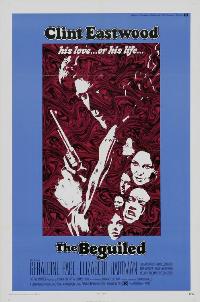
Directed by Don Siegel, with whom Eastwood collaborated on several films, it was made a year before Eastwood’s directorial debut with “Play Misty For Me”.  Eastwood and Siegel had to battle with Universal Pictures to keep the original ending, and they won out; and, the film was promoted as a standard Eastwood western, which it certainly is not. The Beguiled did poorly in its theatrical release.  Nobody was quite sure what to make of it, and some of its content raised a few eyebrows in 1971.  The film received major recognition in France and was proposed by Pierre Rissient to the Cannes Film Festival. “The Beguiled” is Mr. Siegel’s 26th film, as well as his most ambitious and elaborate. 

In the closing years of the American civil war, a severely injured Union soldier finds himself in the care of an all-girl boarding school. He is found by 12-year-old Amy, who takes him to the school run by Martha Farnsworth (Geraldine Page). Five other girls also attend the school, including the romantic and responsible Edwina (Elizabeth Hartman) and the desirous Carol (Jo Ann Harris).  The virginal teacher Edwins falls in love with him, and the sensual teen Carol wants to sleep with him.  Mcburney begins an erotic chess game, secretly telling each woman exactly what she wants to hear, hoping to gain a foothold of power in the house. Martha reveals herself to be a wounded, sexually confused character who has very personal reasons for not turning Mcburney over to the troops when she has the chance.  The Beguiled is entirely interested in what makes its characters tick. Sexual tension is visible in nearly every scene, even uncomfortably between Eastwood and 12-year old girls who share a kiss early on. The scene where Geraldine Page, armed with only a medical book as guide and brandy as anesthetic, removes Clint Eastwood’s leg with a hacksaw, is truly gruesome. The sexual politics are impenetrable. 

Mcburney is a hero whose stories of wartime heroics are a lie. Representing the union, he promises slave Halie (Mae Mercer) freedom before threatening to rape her. When his masculinity’s challenged he resorts to threats, threatening to loose Union soldiers on the school. If Mcburney’s a chauvinist pig, the women are stock archetypes. Martha’s rigid demeanor hides shameful secrets and unacknowledged longings. She falls for John after noticing his resemblance to her brother.  Geraldine Page (Miss Martha) was very convincing in her role; bringing lots of duality to it. Elizabeth Hartman (Edwina) was eerily convincing in her emotionally unbalanced part. Eastwood seems to be having a blast with the role until things turn really ugly, then he turns mean and ugly. it’s quite an impressive achievement overall and must be counted as one of Don Siegel’s finest films. The period details are richly, even obsessively designed and the acting is top-notch from everyone. The crisp cinematography by Bruce Surtees adds enormously to Siegel’s carefully wrought atmosphere of sexual repression.

Blue Collar

Blue Collar

Paul Schrader tells the story of three workers, who are all more or less in the same boat. Three leads- Keitel, Pryor and Yaphet Kotto- play laborers on the Checker cab assembly line in Detroit.  Richard Pryor, in easily his best performance, plays a man in trouble with the IRS. At work, he has a defective locker that continually cuts his hand when he fights with it.  Yaphet Kotto is in debt to a loan shark, Keitel works a second job to get by and finds himself unable to pay for the dental treatment that his daughter needs. Pryor, Keitel and Kotto hated each other during the making of the film, so much so that many of their scenes play out in long master shots only.  But when their money troubles pile up, they make a desperate plan to steal cash from their local union office. When they put their plans to work ,things eventually go from bad to worse. Richard Pryor shines in a performance that is both funny and heartbreaking. Harvey Keitel is in his usual magnetic self and Kotto is understated yet electric at the same time.

Schrader, who was at the time a renowned screenwriter for his work on Taxi Driver (1976), made his directorial debut with this film. The choice to go with a blue score is inspired in itself, as the nature of the music so perfectly captures what these characters are going through. There are several scenes that don’t feature any music at all, these being some of the most important scenes. Schrader made an impressive debut as director with this film. It is very rare to find an American film tackling issues like corruption in organised labour.


Sicario

Sicario

Written by Taylor Sheridan , the film is about an idealist FBI agent (Emily Blunt) who is enlisted by a government task force to bring down the leader of a powerful and brutal Mexican drug cartel.  While tracking leads in a kidnapping case , FBI agent Kate ( Emily Blunt) and her team make the shocking discovery of a mundane Arizona home that has been serving as a cartel graveyard.

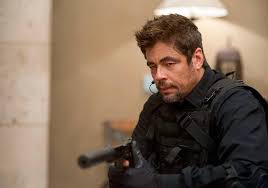
During the raid, a bomb goes off in the yard, killing two of the officers involved. Shortly after, she is recommended by her boss to join a special team headed by Matt Graver ( Josh Brolin), a team that would try to catch the men responsible. Kate is surprised to find out one of the members of the team is a Mexican, Alejandro (Benicio Del Toro) , which seems to be against the law.  They are going to Juarez; Mexico for their mission, another violation. They are successful, but not without incident.

The new film from director Dennis Villeneuve, Sicario captures the tension and horror of the modern war on drugs like few films before it have.  Graphic scenes are avoided by having them take place just off camera. The film’s real thrill do not come from violence and blood on the screen but from intelligent and unsettling dialog.  It is beautifully shot by Roger Deakins, one of the great film cinematographers. There is also plenty to like about the performances here, including a fine turn from Emily Blunt as the agent who wants revenge but not by violating the law. Josh Brolin also turns in a decent performance as the mysterious leader of this team. The role is ideal for Benicio Del Toro, who always gets scarier when his gestures outnumber his lines. He dramatically underacts.