Body Double

Body Double

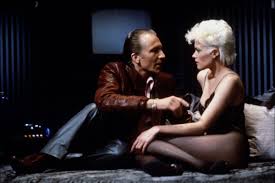
“Body Double” is an exhilarating exercise in pure filmmaking, a thriller in the             Hitchcock tradition in which there’s no particular point except that the hero is flawed and we identify with him completely.  The film gives more emphasis on visual storytelling rather than dialogue. Jake Scully (Craig Wasson) is a struggling actor who has lost his role as a vampire in a low-budget horror film.  At a method acting class, he meets Sam (Gregg Henry) who offers Scully a place to stay.  Sam points out all the sights including a shapely neighbor (Deborah Shelton) who does a nightly striptease dance in front of her open window.  For two nights, he uses a telescope to watch the striptease.  He also begins to suspect that the woman may be in danger. Since the plot is so important in “Body Double,” I won’t reveal very much more of the story. It is a genuinely terrifying thriller. De Palma is at home in this genre. We see some fairly mild porno scenes in this film.  The film opens with a satire on vampire movies, includes a Hitchcockian cat-and-mouse sequence, and even borrows some of the clichés of 1940s film-noirs.   Technically, it’s a marvel of film technique.  Wasson’s claustrophobic attacks are effectively conveyed to the viewer. The infamous drill murder is a terrific setpiece.  Craig Wasson is good as confused and creepy Scully and Deborah Shelton has a remoteness that fits in well with the dreaminess of some of her scenes.

Othello

OTHELLO

Shakespeare wrote the 3 hour-long originals but Welles cut and pasted it together to create a 90-minute pastiche that is barbed, claustrophobic, and hallucinatory. Film was shot in bits and pieces between 1948 and 1951, with the actors sometimes languishing on location while Welles went to raise more money.   In his last completed feature, “Filming Othello,” from 1978, Welles unravels the strange story of the shoot, which involved an actor, say, entering a doorway filmed in Morocco in 1949 and emerging in the same scene from a doorway filmed in Italy in 1951.   The fragmentation of the shoot is reflected in the fragmentation of the images, which is no mere convenience but an aesthetic, a fragmentation as complex as that of an  expeditious montage by Eisenstein.  In the course of his production, he employed five cinematographers, but few films sustain such uncanny visual consistency.  If by “auteur” we mean a director who takes not just the filmmaking process but all the alternations of fate and finances as his medium, then Welles easily qualifies.  From the opening scene the sublime strangeness takes over; it is like entering a Cubist painting. The dead Othello’s face, upside down, fills the screen, with strange chanting on the soundtrack.  Beginning with the ending, the narrative then follows that of the original, but so curtailed and suddenly pieced together that it takes on an alien quality.  His “Othello” (Orson Welles) boils down to the title character, his wife( Suzanne Cloutier), Iago(Micheál MacLiammóir) and bit players (and impressive numbers of extras). Welles the actor gives an impassioned performance as the titular character, while MacLiammoir is equally stunning as his jealous adversary.

The Killers

the-killers

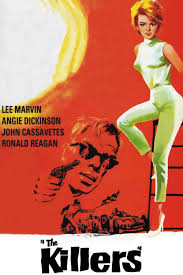
Adapted from the Ernest Hemingway short story, The Killers is the tale of two hitmen who pull a job that’s just a tad bit too easy. Their curiosity gets the best of them and they go searching for the truth in this Don Siegel directed gritty crime drama. The killers this time around are Lee Marvin and Clu Gallagher. John Cassavetes  plays the victim, a former race-car driver fallen on hard times since a bad accident. In the past he crossed tracks with the femme  fatale of the film, Angie Dickinson. But Dickinson’s heart belongs to daddy (Ronald Reagan). The strength of The Killers is the all-star cast led by Lee Marvin. Every time Lee and Clu Gulager are on the screen they shine as the hitmen searching for the truth. This film was released only two years before Ronald Reagan became the first of two actors to be elected governor of California as a Republican. He brings a natural air of authority and unspoken menace to every scene he has. Dickinson is a good femme fatale and does it in such a way that she doesn’t wear it on her sleeve. Overall this is an effective film. It lacks it’s own sense of style but is tough and enjoyable and it’s hard edge is still evident today.

The Big Steal

the-big-steal

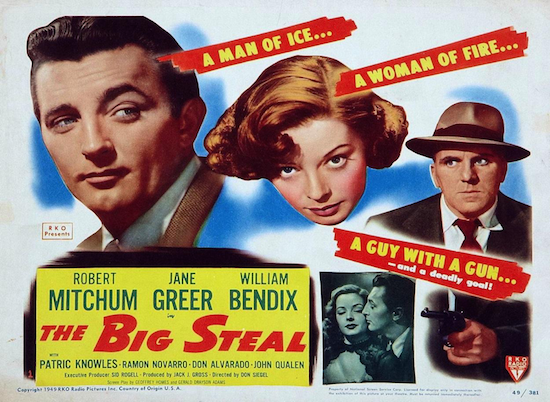
The Big Steal is an action-packed crime film starring Robert Mitchum and Jane Greer. Directed by Don Siegel, The Big Steal defies easy categorization. It’s not so much a film-noir as it is a hard-boiled crime film, loaded with crisp dialogue, witty and sarcastic banter between the leads.Duke Halliday (Mitchum) arrives in Mexico in search of army payroll cash that he alleges was stolen by Jim Fiske (Patric Knowles). He runs into Joan Graham (Greer), who is after the money she gave to her boyfriend, Fiske. The two attempt to track down Fiske, all the while being pursued by the U.S. Army Captain Vincent Blake (William Bendix). It may not be one of Mitchum’s iconic roles, but he’s really quite good here. As for Greer, she’s no femme fatale in this. She’s just a strong woman along for the ride. It was shot on location around Mexico City, which helps give it a more exotic look. This film is sort of like a mixture of film noir, and adventure film, a comedy and it’s all set in Mexico. Don Siegel masterfully directs this fast-paced, well-constructed and highly enjoyable road chase film noir that stretches the genre’s conventions.

Rebel Without A Cause

rebel-2

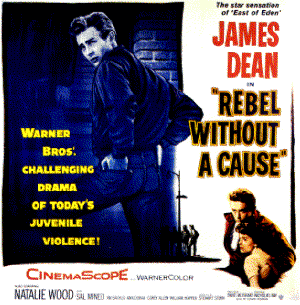
Directed by Nicholas Ray, it offers both social commentary and an alternative to previous films showing wrongdoers in urban rural locations. The title was taken from Robert M. Lindner’s  1944 book, Rebel Without a Cause: The Hypnoanalysis of a Criminal Psychopath. The film itself, however, does not reference  Lindner’s  book in any way.  Rebel Without a Cause is a look into the life of Jim Stark (James Dean) and his attempt to try and figure out what he wants to do with his life. After being taken to the police station his parents are brought in to help find out what he did. . His parents (Jim Backus and Ann Doran) are unsure what to do with him. Also at the station is Judy (Natalie Wood) and John “Plato” Crawford (Sal Mineo). Jim offers his coat to Plato but he refuses.  The next day is Jim’s first day at his high school. It is hear where he encounters Buzz, the leader of the “cool” crowd. Buzz and his gang slash the tires of Jim’s cars and a fight starts. The boys decide to settle their differences by having a ‘chicken run.’  During it, Buzz is killed when he is unable to escape from his car in time. Jim’s parents are kindly and liberal, but are too indulgent. Judy starts off as a member of the ‘ cool crowd’, as she is Buzz’s girlfriend, but after Buzz’s death a romance develops between Jim and herself.

The main theme of the film is the choice between the desire to conform to accepted values and the desire to rebel by finding one’s own individual ones, a choice that  seems legitimate in one’s teenage years. The film suggests that this choice is more complex than might be thought. Throughout the film there is an atmosphere of heightened emotion. It is a film that needs fine acting, both to convey this emotional atmosphere and to do justice to its ambitious theme. Sal Mineo as Plato and Natalie Wood as Judy are both good, but James Dean is better than good, making the tormented figure of Jim come vividly alive.

Invasion of the body snatchers

invasion-of-the-body-snatchers


Invasion of the body snatchers is a 1978 science fiction horror film directed by Philip Kaufman. Released on December 1978, it is a remake of Invasion of the Body Snatchers (1956), which is based on the novel The Body Snatchers by Jack Finney. The film follows many of the same plot points as the original, save for it is two  decades later, and set in the big city of San Francisco, rather than a small town.  The film follows Matthew (Donald Sutherland) a San Francisco health inspector who soon finds out, along with his co-worker Elizabeth (Brooke Adams), that an alien plague of pods has descended, and that people are being replaced by duplicates grown from them. As the pods grow, they replace their victims as they sleep, and suck out their memories and bodily fluids, leaving the original person a dried shell. The first person, in the film, to be podded is Elizabeth’s boyfriend Dr. Howell, a dentist. When he seems distant, it leads Elizabeth to the conspiracy, and into the arms of Matthew, who is secretly in love with her. He suggests she see his friend, David Kibner (Leonard Nimoy), a famous psychiatrist with best selling helpful books.

This film works because of a constant sense of paranoia. This paranoia begins to spread like wildfire as several citizens notice a bit of the same. Where the protagonists in Siegel’s film  were well-to-do and crisply dressed, the characters in the 78 version are engagingly odd.  Unlike the original, the film’s memorable for its use of outlandish special effects. In one startling scene, Brooke Adams is menaced by a dog with the head of a man. The 1978 Body Snatchers is most memorable, however, for the pod people’s habit of pointing and screaming at human escapees. It’s a trait that wasn’t exhibited by the eerily calm invaders of the earlier film, and its use here is absolutely terrifying. The typical unusual ’70’s cinematography is from Michael Chapman. There are some really exciting chase scenes at the end of the film. One of the greatest aspects of this film is its socio-political resonance. It can be interpreted as a state of minority versus majority, us versus them and individualism versus social conformity. The film has a dark brooding atmosphere throughout and there is a sense of realism in this film.

Inherit The Wind

inherit-the-wind

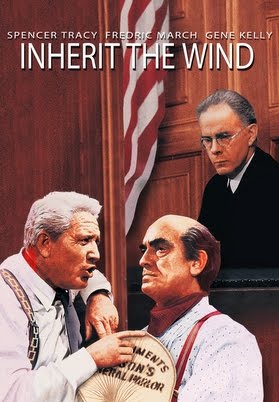
Inherit the wind is a fictionalized story of the 1925 famous “Monkey” trial. The trial took place in Dayton, Tennessee, in 1925. The trial did put a young high school teacher named John T. Scopes prohibiting the teaching of any theory that denied the biblical account of divine creation. Scopes was defended by the legendary Clarence Darrow, and the prosecution was led by three-time presidential candidate William Jennings Bryan. Darrow’s expenses were paid by the Baltimore Sun papers, home of the famous journalist H.L. Mencken. In Stanley Kramer’s film, Darrow becomes Henry Drummond (Spencer Tracy), Bryan is Matthew Harrison Brady (Fredric March), Mencken is E.K. Hornbeck (Gene Kelly), and Scopes is Bertram T. Cates (Dick York). Certainly most of the citizens in the film’s fictional town of Hillsboro, Tenn, believe in the literal truth of Genesis. “There’s only one man in this town who thinks at all,” Drummond roars, “and he’s in jail. ” The judge clearly admires Brady, even addressing him as “Colonel” in court. Drummond objects to this, so, as a result, the mayor reluctantly makes him a “temporary” colonel just for these proceedings. March and Tracy bring the full force of their talents to their roles as opposing lawyers (and one time friends) who face off on the issue of evolution vs. creation.The film features an iconic performance by Spencer Tracy. Florence Eldridge, March’s real life wife, is excellent as March’s film wife who recognizes the flaws in her husband, but loves and admires him anyways. March is at turns witty, cunning, over-the-top, hammy or contrite, depending upon the demands of the scene. His scenes on the witness stand with Tracy are among the best written and beautifully acted pieces in film history.What Kramer so effectively captured in the tightly shot film — was the intense claustrophobia and choking heat of the setting, the barely contained violence this conflict engendered.

Charley Varrick

Charley Varrick

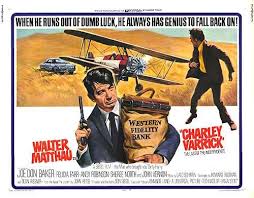
Charley Varrick is a 1973 crime film directed by Don Siegel. Things don’t go according to plan when a small-time robber, Charley (Walter Matthau), and his wife Nadine (Jacqueline Scott) accidentally rob a bank that belongs to a mafia gang. While Nadine waits outside in the getaway car, the heavily disguised Charley enters the bank, where his two partners are waiting. Outside, when two police officers approach Nadine to question her, she fires on them, killing one instantly and seriously wounding the other, but the second officer returns fire as he falls, wounding Nadine.  She ends up dying later. Charley and his partner Harman (Andy Robinson) set up an explosive charge to destroy the stolen car with Nadine in it. Charley later realises that the money they stole is actually mob money and the bank was a drop spot. Harman doesn’t care, but Charley knows they’ll have to lay low and not spend any of the money for at least 2 or 3 years.  Things begin to get really messy when the mob sends an eccentric hitman named Molly (Joe Don Baker) to the area to find out who stole the money. 

charley varrick 1

The fun in Charley Varrick is not sadistic, though there are cruel moments in it, but in watching Charley attempt to outwit both the cops and the Mafia. The casting of Matthau in this key role helps tremendously. Though Charley is tough enough to walk away from his wife’s death without showing much emotion, the character is inhabited—maybe even transformed—by Matthau’s wit and sensitivity as an actor.  But the film’s real revelation comes from Joe Don Baker,whose racist, sexist, ass-kicking brute of a henchman oozes malicious magnetism. Charley Varrick is informed by a quiet professionalism that suits a film about feds and criminals doing their jobs, whether that means laundering money, making fake passports, or robbing banks. Siegel’s direction–most of it permeated with a great, gritty, early 1970s “feel”–is impeccable, and ranges from a series of beautiful shots of the countryside during the opening credits to elaborately staged, underhanded “clues” as to the “plot beneath the plot”–during most of the middle section.


Steve Jobs

Steve Jobs

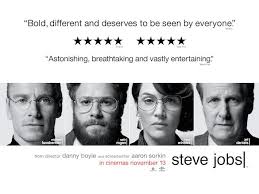
Steve Jobs is a 2015 American biographical drama film directed by Danny Boyle and written by Aaron Sorkin. The script, by Aaron Sorkin, an Oscar winner for The Social Network, is sheer brilliance. Sorkin divides the film into three time frames, each filmed in different formats and each involving the launch of a new Jobs product. The first part is set in 1984 in Cupertino, California, where Jobs, 29, debuts the Macintosh. The second part is set in 1988 when Jobs, axed by Apple, presents his Next cube to mass indifference. The final part, utilizing high-def digital, takes place in 1998 at San Francisco’s Davies Symphony Hall, where Jobs, back calling the shots at Apple, gives the iMac its famed send-off. Sorkin works wonders in this film revealing the man behind the machine rather than the machine behind the man. Without any scenes of failure or success, Sorkin forces his audience to understand the complex and often times revolting central Character. With extremely well written confrontations between Jobs and Wozniak ( Seth Rogen) or Jobs and his Daughter or even Jobs and his Boss (Jeff Daniels), Sorkin relentlessly demonstrates the true nature behind the tech giant. 
Steve jobs 2
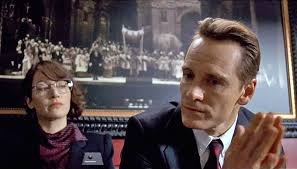
“Who are you? What do you do?”- Those questions, put to Steve Jobs by his partner Steve Wozniak in the middle of a heated argument, are both practical and rhetorical. Jobs is not a designer, an engineer or a coder — he relies on other people to do all of that, but he has somehow risen to the top of the computer business.  The sound scape is something that one should pay attention to. There’s no musical score at all only the voices the characters hear, the voices of an industrial town – ambiance. In the end the industrial voices just keep going on as the credits come on the screen. Polish-born marketing chief Joanna Hoffman (Kate Winslet) is ready to give shit to her boss. She rebukes him for letting his former lover  Brennan (Katherine Waterston) live on welfare and for denying paternity of their five-year-old daughter, Lisa (Makenzie Moss). What we don’t see is the older, even richer Jobs who married Laurene Powell, had three children, created more Apple miracles. Kate Winslet portrayal of real life Johanna Hoffman was as beautiful as it was naive . She brought the character alive in full force and truly demonstrated she is one of the best actresses working.  Seth Rogan gives the single best dramatic performance of his career. As Steve Wozniak, the literal opposite of Jobs, Rogan played the role with elegance and brilliance. Filled to the brim with nuance Fassbender offers a cold, intelligent, manipulative, calculating, and over all disturbingly convincing portrayal of Steve Jobs.
As calm as he is devilish, Fassbender plays this egotistical narcissist with such precision its close to horrifying to watch. Though calm through most of the movie Fassbender understands when to unleash the monster which lays in Jobs and is absolutely hysterical while doing so. The best thing about “Steve Jobs,” the thing that makes it work as both tribute and critique, is how messy it is. “Steve Jobs” is a creation myth written by a skeptic. 
Quills

Quills

Quills is a 2000 period film directed by Philip Kaufman and adapted from the Obie award-winning play by Doug Wright, who also wrote the original screenplay. Inspired by the life and work of the Marquis de Sade, Quills re-imagines the last years of the Marquis’ incarceration in the insane asylum at Charenton. Quills is a delightfully unsettling account of the demise of the Marquis de Sade and those he brings down with him. The film presents viewers with all the evidence they need to identify the illusions of society’s separation of “good” from “evil” and “moralists” from “sinners”. A dark look at an insane erotic  writer named Marquis De Sade (Rush) and his stay an asylum run by religious priest Abbe Du Coulmier (Phoenix).  While there he befriends a laundrette named Madeleine ( Kate Winslet). The Marquis dips into the extensive world of the forbidden sexual taboos of the 18th and 19th centuries, writing extensively about them without a care in the world for decorum. There is a curious relationship between the Marquis and a physician named  Royer-Collard, played by Michael Caine, who is assigned to prevent him from writing anymore. Geoffrey Rush is hilariously charismatic as The Marquis de Sade, a man who lives by glorifying the raunchiest sex acts he can imagine, but is at a loss when he finds himself falling in love.  Rush goes to all necessary lengths and doesn’t hold back whatsoever in his brilliant portrayal. Kate Winslet is charmingly enchanting as Medeleine LeClerc, a woman who was raised to be proper and distinguished and is able to let out her darker side through The Marquis’ writing.  Joaquin Phoenix is convincing in his portrayal of The Abbe du Coulmier, a man of God who is forced to confront his own demons of wrath and sexual desire constantly throughout the picture. Caine does a brilliant job of making the audience become absolutely disgusted by every one of his actions. In terms of art direction, costume design and cinematography, the filmmakers do a fantastic job in recreating this strange world of the past. The writing of the film is very good in that the film remains interesting throughout. Kaufman succeeded not only in bringing the spirit of the time but also the essence of the Marquis de Sade to the screen and he did that splendidly.