Midnight Cowboy

midnight cowboy 1


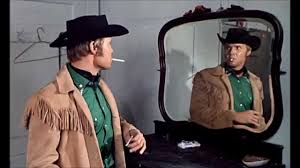
Joe Buck (Jon Voight), dresses in new cowboy clothing and quits his job. He wants to go to New York to work there as a male prostitute. Through broken flashbacks, we get to know that his mother and grandmother both used to be hookers.  He had an affair with an unstable girl and that ended in a tragic note. His flamboyant grandmother often let him share her bed or become acquainted with her lovers. In Newyork, he had sex with a rich woman but when he asks for money, she takes advantage of him. Instead, she gets paid for her sexual favors. Quickly, he becomes disillusioned, down on his luck, and low on money after being conned. Back on the street and at a tacky bar, he meets another hustler named Enrico “Ratso” Rizzo (Dustin Hoffman). The Party sequence will be much discussed. It is openly a burlesque Andy Warhol who, of course, is burlesque to start with. It is more like a secret society where closet homosexuals come to have sex, housewives come to have casual sex with male hustlers. The narrative of this film is very interesting. It uses broken flashbacks to depict the past of Joe and at-times flashbacks happen too fast.
The whole film is well photographed in DeLuxe Color by Adam Holender and professionalism in all technical areas is obvious. There are electronic, harmonica and a lot of country type of music. Dustin Hoffman delivered a fabulous performance as a crippled man. We don’t know much about his past but it is evident from his actions that he didn’t lead a happy life.  Jon Voight was no less as well. He imagined himself as a cowboy and he did dream of a great life in a big city only to see that his hopes were shattered. Voight captures all of those little details through his eyes. It is an outstanding film and it is a must-watch for any film lovers.

The Border

jack 5


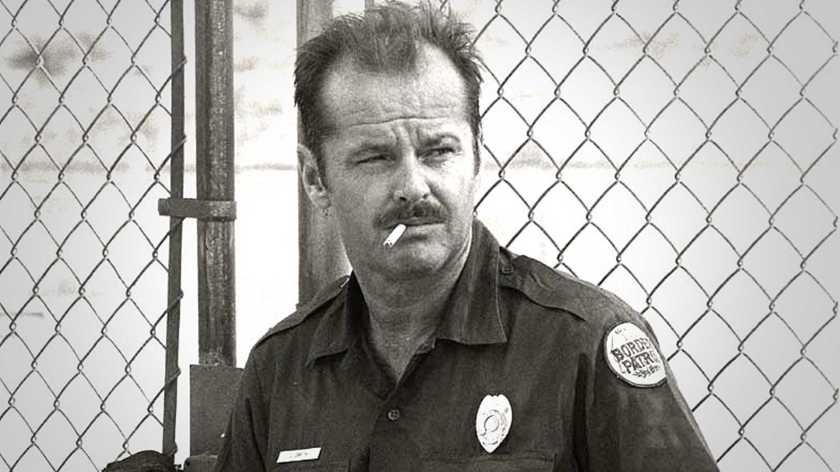
Immigration enforcement agent Charlie Smith (Jack Nicholson) lives with his wife in California in a small house. She forces him to move to a duplex in El Paso shared by border agent Cat (Harvey Keitel). Marcy wants to live a rich life and Charlie’s current wages won’t cover it. Cat gives him an offer to join him in a shady business. He introduces Charlie to the human smuggling operation he runs with their supervisor Red.
He uses this partnership to help a young Mexican woman, Maria, get across the Tex-Mex border along with her younger brother and her baby. Nicholson is constantly at odds with his bimbo wife (Perrine, perfectly annoying) and his morally corrupt partner (Keitel as always menacing). This is one of the few films which dealt with the issue of the USA-Mexican border. It handles the human smuggling issue in detail. After Charlie decides to join hands with Cat, the drama increases. While Cat is a perfect bad guy, Charlie still has some morals. It was never clear if Charlie loved his wife or not.
But the kind of guy is , he will never cheat her. With time, he develops a special feeling towards Maria but that is only limited to feelings. Jack Nicholson here plays a totally subdued character and he plays it with elan. Valerie Perrine is superb as the annoying wife while  Elpidia Carrillo does her job by slightly changing her facial expressions.
Harvey Keitel is always dependable. The direction by Tony Richardson, is at times inspired and artistic, and at other times as ordinary as dishwater. Still, as a snapshot of poor Mexican immigrants (and would-be immigrants) as they clash with the border patrol culture twenty-some years ago, The Border is definitely worth a look.

Get Out

get out

Jordan Peele’s directorial debut will make you think about your own privileges. In the opening sequence, we see a young black guy walking down a suburban street. While talking on his phone, he gets attacked by some random white people. White Rose Armitage (Allison Williams) wants to take her black boyfriend, Chris (Daniel Kaluuya), to meet her parents. While Chris was initially anxious, later he agrees to meet her parents. Her parents, Dean (Bradley Whitford) and Missy (Catherine Keener), welcome him in grand fashion. They were very supportive of him initially. At times, it seems that they are behaving too well. The body language all seems perfectly above board. Why is their basement locked? Why are their two black employees – a housemaid and groundsman – both black appear to be controlled by some unseen force?
 What’s the deal with old white people showing up to a party scheduled for his visit? Get Out is tense, thrilling, and gorgeous. If anything, the film becomes darker and more soul-chilling once the secret is revealed. Get Out is very direct and unapologetic about what it wants to convey.  There was an unsettling vibe throughout the film. Chris’s friend Rod warned him not to visit white people’s houses. While all this was going on, his girlfriend Rose was completely supportive of him. One can find references to many films here, starting from Halloween to Rosemary’s Baby.  Peele has effectively kept audiences on edge from the beginning, sending occasional jolts through the crowd. During Obama’s era, racism was under the carpet. White people were happy to pretend as liberals. In Trump’s era, white people are concerned about racism again. Get out shows racism within progressive whites and it is done by genre-mixing.  Daniel Kaluuya was very good as the main protagonist, but the surprise came from Allison Williams. Watch the film to get to know the reason.

Lady Bird

lady bird


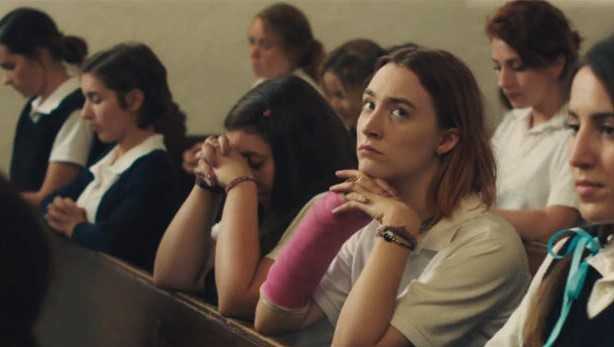
“Anybody who talks about California hedonism has never spent a Christmas in Sacramento.”- Joan Didion. Hedonism refers to the idea that pleasure is the ultimate aim of human life. Sacramento has a charm of old world Americana. It is very much different from rest of California. Interestingly the director of Lady Bird, Greta Gerwig was born in the same place.  The film starts with the famous quote made by Didion. It centers on Christine McPherson ( Saoirse Ronan), a high-schooler who likes to live life on her own terms and conditions. She insists that she be called by her “given” name of  Lady Bird . She wants to spread her wings. She dreams of bigger things and feels weighed down by her circumstances.  More than anything, she wants to break free from Sacramento . She wants to go to a place where culture is omnipresent. Its not that she has great idea about culture itself. She is an average student in school. She doesn’t seem to be an intellectual from any angle. She wants to go to New York as it is famous for culture. Her mother strongly disagrees. Her mother is pragmatic while her daughter likes to live in her own world.
Her father is jobless. They don’t have enough money to recruit her in any college of New York. So, Lady Bird decides to apply for scholarships to east coast colleges with the help from her father. New York is at the core of Lady Bird. New York is the city of Lady Bird’s dreams, but her reality is Sacramento. The film, loosely inspired by Gerwig’s formative years, is a love letter to the city of her childhood. That is why the film is set in 2002-2003. Lady bird not only wants her mother to love her, she also expects that her mother likes her. Lady bird thinks that her mother doesn’t care for her. While her mother thinks that her daughter doesn’t love her. In reality,both of them love each other. Some of the sequences are extremely funny while some are very serious. Calling it a coming-of-age story doesn’t do much justice to the film.  The film also questions parenthood as much as it does on adolescence. While her mother fails to understand her daughter well-enough, her father is over-protective of her daughter. Lady bird thinks that she is an atheist. In reality,it seems that she is confused. It doesn’t glorify or condemn religion. In one of the most important scenes,it acted as a trigger which connects Lady bird to her mother as well as to her hometown. Saoirse Ronan is fantastic in the film and brings such heart to the character of Lady Bird. Metcalf is brilliant as the constrained mother that’s trying her best to keep the family afloat during tough times.


Phantom Thread

Phantom Thread

“I can’t begin my day with a confrontation.” So says Reynolds Woodcock (Daniel Day-Lewis), a celebrated fashion designer, who lives and works in a quiet London square, and who despises any threat to his lifestyle. His sister Cyril ( Lesley Manville) helps him to run his business.  One day, Reynolds drives to the coast and arrives at a hotel restaurant. A waitress named Alma (Vicky Krieps) takes his order, which goes on forever. Alma blushes easily, yet there is no twitch of shyness; she bears herself with confidence, and, when Reynolds invites her to dine with him that night, she accepts the offer.  Thus she enters into the life of an elite fashion designer. We are back in London. With time, Alma has become his favorite model and muse. At the breakfast table, Reynolds sits with his sister. Alma is buttering toast, with firm swipes of the knife but the sound disturbs Reynolds’s attention. An argument takes place between them.
They bicker constantly and one night when Alma attempts to make him a romantic dinner, Reynolds lashes it out over how the meal is prepared. Alma decides to poison his tea with some wild mushroom she has gathered outside the house. It makes him terminally ill and with Alma’s care, he gets cured. That helps Alma to regain her control in the relationship.  Were they in love? its not sure. There are implications though. However, the woman had an agency of her own. The style and manner in which Paul Thomas Anderson uses silence and long takes is ingenious, and it was most likely inspired by Kubrick’s Barry Lyndon. Jonny Greenwood’s music adds another dimension to dramatic moments. The setting has similarities with Daphne du Maurier’s Rebecca.  Unlike Rebecca, here the woman is much stronger. She is well aware of her own position. DDL has always been a good actor but he was never among the best actors as he was made out to be (Something similar to Naseeruddin Shah in Hindi cinema). But with Paul Thomas Anderson, he gave his best performances. Here he repeats the same thing. But Vicky Krieps stole the show. She was successful in portraying all the vulnerable sides of her character.

Alice doesn’t live here anymore

Alice doesn't live here anymore

It starts with a scene where kid Alice is shown playing with her doll while her mother shouts at her to come back in home. Moving to the next scene,it shows a middle-aged woman named Alice (Ellen Burstyn) shouting at her son to lower the volume of music while her husband keeps shouting at his wife and son both. During this scene, it also shows Alice having fun with her son in a mischievous manner.  During the first 10 minutes, it was clear that Alice lives in a loveless marriage. Her husband is a weird person who neither cares for his wife, nor for his son. But Alice loves her son but the kid naturally doesn’t realise her position in the marriage. When her husband Donald dies unexpectedly, Alice decides to pack up and head out from New Mexico with her son Tommy and restart her singing career .
Alice and her son share an interesting relationship throughout. The kid is naughty and Alice is not uncomfortable while hurling abuses at him. Yet both of them love each other deeply. Along the way, she meets some genuinely good people who help her.  She also meets one psychopath called Ben (played amazingly by Harvey Keitel) . Later, she takes job of a waitress in a restaurant where she runs into a divorced young farmer (played by Kris  Kristofferson).  The death of her husband enables Alice toward some kind of self-awareness and self-sufficiency. The spectacular thing was the way Scorsese created the character called Alice.  I don’t know if  Scorsese was conscious of  it or not but he created a character who is flawed yet she searches for her own identity.  She is like any other regular woman who wants to settle with her partner.  She goes through a lot of struggle in her own life just like many women do in their own way.   Alice is not fiercely independent . She doesn’t understand deep politics of feminism yet her struggle can be linked with feminism.  So here Scorsese consciously or unconsciously creates a character who doesn’t wear the “badge” of feminism on her sleeve. Yet this is a feminist film and that is where lies the beauty and uniqueness of this film.  Ellen  Burstyn has been a spectacular actress . She was fully believable while showcasing vulnerability of her character.  Kris Kristofferson was dependable.

Far From Heaven


far from heaven


Like Sirk before him, Todd Haynes is fascinated with the thin lines that separate the world from a perceived version of reality and the paths of resistance that lie therein. Cathy (Julianne Moore) is a mother of two, married to a rich businessman Frank (Dennis Quaid) who works for a powerful television sales company.  The couple embody everything that is seemingly “perfect” about upper middle-class suburbia. A reporter does a story on Cathy for the local paper and claims that Cathy is “kind to the Negroes”. One day Cathy finds Frank doing sex with another man. She becomes so isolated that her most comforting moments are conversations with their gardener Raymond.  But Raymond is black and that was 1957. Everything about Far from Heaven playfully yet reverently implies to the 1950s as a movie genre.  Mark Friedberg’s production design is outstanding, surpassing his previous works. Sandy Powell’s costumes are superb, especially for Moore herself who is allowed noticeably fuller skirts to wear. As Cathy, Julianne Moore gives a performance that can be called nothing less than outstanding. She is utterly heartbreaking as a good-natured woman, totally bewildered by the curves life is throwing at her while trying to maintain a façade of normalcy. As Frank, Dennis Quaid gives a controlled and restrained performance. Todd Haynes’s film is not socially progressive film. It doesn’t take any specific stand on homosexuality. It is a tribute to 1950s melodramatic films and it is made exactly the way it should have been made during that period.


Carrie (1976)

Carrie 4
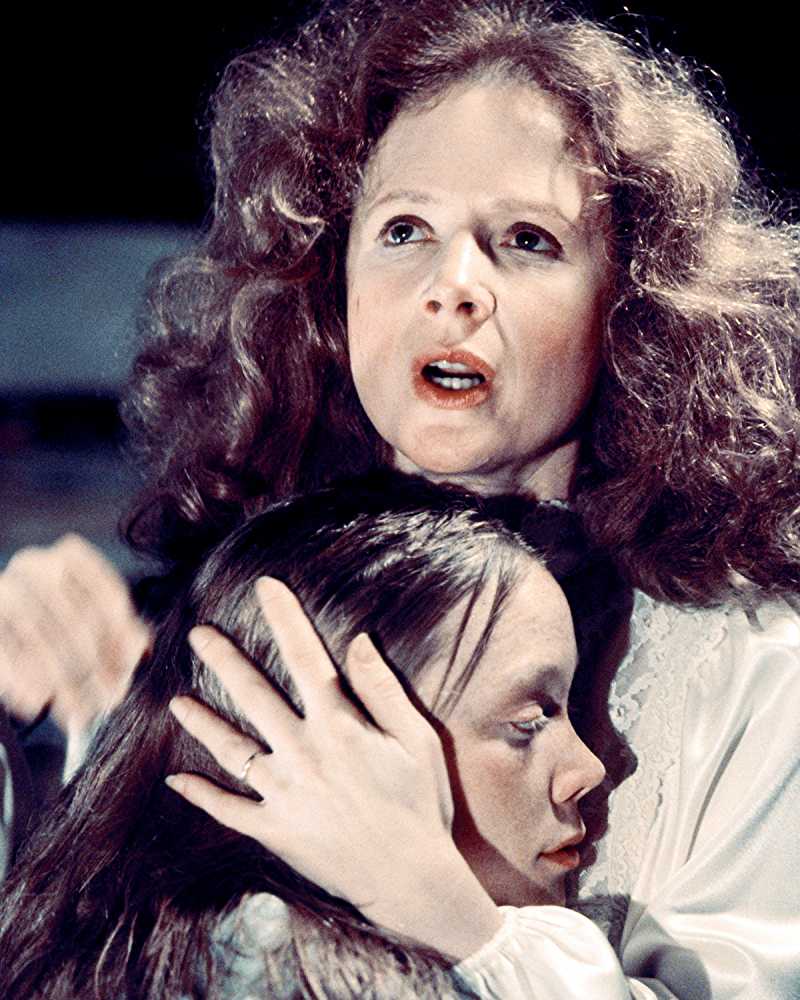
Telekinesis means the ability to move objects at a distance by mental power, or by other non-physical means. When high school girl Carrie White (Sissy Spacek)  experiences her first period in the gym at school, the other girls make fun of the young woman’s fear and ridicule her.  She lives in a gloomy ruinous house where she is dominated by her mother (Piper Laurie), a sexually repressed religious fanatic.  She has the power to move objects.  Her mother has left Carrie unprepared for a harsh world constantly being pelted with religious fanatical teachings. When Sue (Amy Irving) convinces her boyfriend Tommy Ross to take Carrie to the prom to make up for her part in the showers, disgraced popular girl Chris (Nancy Allen) and her abusive boyfriend Billy (John Travolta) take it upon themselves to teach Carrie a lesson. Sissy Spacek’s performance is easily a standout in the cast rivaled only by Piper Laurie, but the entire cast seems eerily aware that they are in a horror film masquerading as a dark fairy tale – and it works. In this film, De Palma discovered that his destructive sense of humor could be synthesized with his graceful visual sensibilities in a manner that would highlight both. She is not allowed to go outside of the house other than to go to school, she is not allowed to date boys, and she certainly is not allowed to question anything that has to do with her coming maturation into womanhood. As is the case in most De Palma films, the technical credits are superb. The cinematography (by Mario Tosi) is extremely effective; colors and shadows have been shot effectively here. Carrie was also very creepy. The scenes with her mother was really scary.

The man who knew too much (1956)

The man who knew too much 1956

The original “The Man Who Knew Too Much” brought Alfred Hitchcock acclaim for the first time outside of the United Kingdom.  Of course part of the reason for the acclaim was that people marveled at how Hitchcock on such a medium budget as compared to lavish Hollywood products was able to provide so much on the screen.  The original film was shot inside a studio. Hitchcock now with an international reputation and a big Hollywood studio behind him (Paramount) decided to see what The Man Who Knew Too Much would be like with a lavish budget. This is shot on location in Marrakesh and London and has two big international names for the box office. This was James Stewart’s third of four Hitchcock films and his only teaming with Doris Day. Day and Stewart are on vacation with their son Christopher Olsen in Morocco and they make the acquaintance of Frenchman Daniel Gelin and the aforementioned English couple, Bernard Miles and Brenda DaBanzie. Gelin is stabbed in the back at a market place and just before dying he whispers some words to Stewart about an assassination to take place in Albert Hall in London.
The original film had Peter Lorre playing the villain. This film doesn’t benefit from his presence, unfortunately, but that is made up of by performances from the fantastic James Stewart, and Doris Day.  Stewart conveys all the courage, conviction and heartbreak of a man that has lost his child and would do anything to get him back brilliantly. Doris Day was as good as Jimmy Stewart.  I’m enthralled by the enthusiasm and the energy that she puts behind her performance. Hitch mounted an elaborate remake that lacks the original’s crisp pace but makes up for it with star value, sumptuous color, and sustained suspense.

Hell or High Water

Hell or High water 1

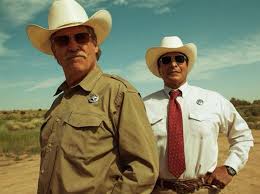
The 2016 feature by David Mackenzie tells the story of 2 brothers who will stop at nothing to save the land of their deceased mother, the last link to their childhood, and the riches that the oil under her land will promise. Marcus (Jeff Bridges) is a Texas lawman weeks before a forced retirement, training Alberto (Gil Birmingham) to be able to take his place. Just when it seems like it will be a quiet couple of weeks before his retirement, a rash of bank robberies occur and Marcus and Alberto take the responsibility to solve the case.  After their mother passed away, Tanner (Ben Foster) and Toby (Chris Pine) were faced with the realization that the land on which she lived was being seized by the bank. Toby has a former wife and a child to think about while Tanner is constantly on the run, in and out of jail. All of the performers in this film, right down to the bit players, are quite good, but Bridges shows yet again that he is one of the finest actors in America.
Bridges takes over the film every time he’s on-screen. He doesn’t want to give up his job because, we feel, he wants to hold on to a West that no longer exists. Pine, who usually chooses action hero type roles, makes us question whether he might not be a better character actor. He’s excellent here in part because the weight of the movie isn’t resting on his back.  Ben Foster does a pretty mean impression of a man who looks like he’s spent a week living in a gutter.  One character, a half-Comanche, puts it in perspective when he matter-of-fact observes that, 150 years ago, all this land belonged to his people. Hell or High Water is more of a drama than a thriller, although there are “thriller-type” elements in place. Mackenzie prefers extended takes and tracking shots that lift the film to great cinematic heights. Mackenzie takes great pains to provide a compelling, credible motive for Toby and Tanner and to illustrate the strengths and weaknesses of the men pursuing them. In the superbly tense Hell or High Water, New Mexico stands in for Texas and the heist film stands in for a bleak present-day western.