El abrazo de la serpiente (Embrace of the Serpent )

embrace-1

Embrace of the Serpent (Spanish: El abrazo de la serpiente) is a 2015 internationally co-produced adventure drama film directed by Ciro Guerra. A young shaman named Karamakate (Nilbio Torres) squats beside a river, waiting and watchful, as two other men approach in a boat: Theo (Jan Bijvoet), a German explorer, and Manduca (Miguel Dionisio Ramos), his local guide. It’s sometime during the early 1900s, and Theo, severely and mysteriously ill, is searching for the yakuna, an exceedingly rare flower that could heal him of his sickness.  When Theo offers to help Karamakate find the surviving remnant of his tribe, the wary shaman agrees to help, initiating a hazardous journey that will take the three men ever deeper into the wilderness while throwing their personal and cultural differences into sharp relief. In Karamakate’s eyes, the European and American marauders who enslaved and destroyed his tribe are agents of an insane culture devoted to genocidal conquest and avaricious destruction. Later American Botanist Evan makes the same journey with the older, weakened Karamakate (Antonio Bolívar Salvador), whose tribe is now extinct.
The film jumps between the two journeys, which follow roughly identical routes. Guerra has a great ear for the self-justifying and delusional presentations of both Theo and Evan. He shows us how their politeness and curiosity—compared to that of other Europeans, anyway—keep even the most skeptical natives from rejecting them out-of-hand. Filmed in black and white by cinematographer David Gallego, it is the first film to be shot on location in the Amazon in thirty years and its gorgeous kaleidoscope of rivers and forests, and the blending of time creates a surreal, dreamlike atmosphere.  David Gallego’s cinematography is absolutely gorgeous throughout, and adds a dimension to the journeys as we see first-hand the sociological and biological destruction caused by colonialism and the rubber barons. The forgotten cultures are reason enough for the natives to distrust white men, yet the mysticism and pride of the indigenous tribes are fascinating. The film doesn’t beat around the bush. As it progresses, it becomes evident that the plot is about the devastation of colonialism and what it had done to the land & its people. Everything from spreading Catholicism to Rubber Farming, more and more they see the land changing for the worse.
Laitakaupungin valot (Lights in the Dusk)

lights-in-the-dusk

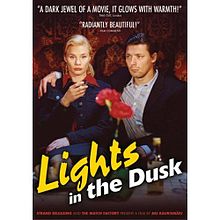
Lights in the Dusk (Finnish: Laitakaupungin valot) is a 2006 Finnish comedy-drama film starring Janne Hyytiäinen, Ilkka Koivula, and Maria Järvenhelmi. It is the last installment in Kaurismäki’s “Finland” trilogy after Drifting Clouds (1996) and The Man Without a Past (2002).  Koistinen (Janne Hyytiäinen) is a lonely security guard who is ignored by his co-workers; that is, when he’s not being teased by them. He attempts to socialize, but is treated coldly by his manager. His life is soon turned upside down by a femme fatale (Maria Järvenhelmi),with heartbreaking results. Koistinen’s only human contact is the vendor Aila (Maria Heiskanen) to whom he outlines his plans of starting his own company. This nobody suggests a contemporary version of Chaplin’s Little Tramp. Koistinen accepts the cruelties dished out by life with reticence  almost as if they were his due. On the rare occasions that he ineptly lashes back, he is immediately slapped down, and several times he is beaten up. The music of “Laitakaupungin valot” deserves a special mention, since with it the aesthetic style of Kaurismäki really flowers. There is a plenty of Kaurismäki’s trade-mark dry humor at the beginning of the movie, especially at the coffee shop scene, but when the film goes on its comedic currents almost totally vanish and the dramatic values take over. Another notable feature of this work is its exceptional amount of smoking  (even for Kaurismäki), which is possibly caused by the director’s own agenda of opposing the ban of smoking in restaurants.  Kaurismäki’s sequences of scenes are as bold and assured as they are ironic. This is a pessimistic, but curiously vibrant view of life.

Charley Varrick

Charley Varrick

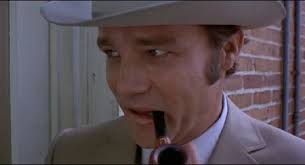
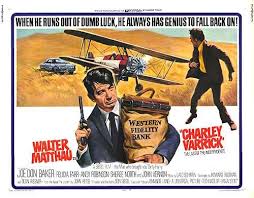
Charley Varrick is a 1973 crime film directed by Don Siegel. Things don’t go according to plan when a small-time robber, Charley (Walter Matthau), and his wife Nadine (Jacqueline Scott) accidentally rob a bank that belongs to a mafia gang. While Nadine waits outside in the getaway car, the heavily disguised Charley enters the bank, where his two partners are waiting. Outside, when two police officers approach Nadine to question her, she fires on them, killing one instantly and seriously wounding the other, but the second officer returns fire as he falls, wounding Nadine.  She ends up dying later. Charley and his partner Harman (Andy Robinson) set up an explosive charge to destroy the stolen car with Nadine in it. Charley later realises that the money they stole is actually mob money and the bank was a drop spot. Harman doesn’t care, but Charley knows they’ll have to lay low and not spend any of the money for at least 2 or 3 years.  Things begin to get really messy when the mob sends an eccentric hitman named Molly (Joe Don Baker) to the area to find out who stole the money. 

charley varrick 1

The fun in Charley Varrick is not sadistic, though there are cruel moments in it, but in watching Charley attempt to outwit both the cops and the Mafia. The casting of Matthau in this key role helps tremendously. Though Charley is tough enough to walk away from his wife’s death without showing much emotion, the character is inhabited—maybe even transformed—by Matthau’s wit and sensitivity as an actor.  But the film’s real revelation comes from Joe Don Baker,whose racist, sexist, ass-kicking brute of a henchman oozes malicious magnetism. Charley Varrick is informed by a quiet professionalism that suits a film about feds and criminals doing their jobs, whether that means laundering money, making fake passports, or robbing banks. Siegel’s direction–most of it permeated with a great, gritty, early 1970s “feel”–is impeccable, and ranges from a series of beautiful shots of the countryside during the opening credits to elaborately staged, underhanded “clues” as to the “plot beneath the plot”–during most of the middle section.


Gumrah

Gumrah

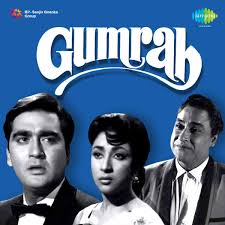
Gumrah is a 1963 Hindi film produced and directed by B.R.Chopra. Meena (Mala Sinha) and Kamla (Nirupa Roy) are two daughters of a wealthy Nainital resident. Meena is in love with artist-singer Rajendra (Sunil Dutt). Things take a turn when Kamla and her two kids come to visit them from Bombay.  Meena’s father (Nana Palsikar) suggests Meena marry her sister’s husband Barrister Ashok (Ashok Kumar) since a new woman might not take to the kids. Meena ultimately agrees to marry Ashok and then moves down with him to Bombay. All this happens without her even informing Rajendra.  After some time, she meets Rajendra again, and this brings to a renewed relationship. Gumrah was one of the earliest hindi films which tackle the issue of extra-marital affair. B.R. Chopra’s Gumrah must have been perceived then as a bold and forward film of the times. But then again,some aspects of this film can be regarded as sexist. The film makes the point of the woman being the moral centre point of the family. It treats extra-marital affair as crime especially when it is done by women.  Beside that ,the film is well-made. The music was composed by Ravi while the lyrics were by Sahir Ludhianvi.  All the songs are hauntingly beautiful, ‘chalo ek baar phir se’, the beautiful arrangements and melodies in ‘aap aaye’ the haunting ‘aa bhi ja’ wonderful kiddies song ‘Ek thi Ladki and my favourite one ‘tujhko mera pyar pukare’ where we’re treated to lovely shots of Nainital. Gumrah is overall Mala Sinha’s show, and she is plain excellent in a demanding part which requires her to work a lot with her inner self.  Ashok Kumar is competent in the role of the happy-go-lucky husband who is far more sophisticated than it seems to be. Sunil Dutt was strictly average as tormented lover.  Gumrah is overall an enjoyable film. It could have been a great film if it was devoid of apparent sexism.

Kasba

Kasba

Kasba is a 1991 Indian drama film written and directed by Kumar Shahani. It is based on the short story  “In the Ravine” by the famous Russian Writer Anton Chekov.  Maniram (Manohar Singh) an entrepreneur, makes huge profits by cheating people. His business is run by his daughter-in-law Tejo (Mita vasisht), who is married to Maniram’s mentally challenged younger son (Raghuvir Yadav).  When Maniram’s elder son Dhani (Shatrughan Sinha) comes back into town to get married, things start changing. He runs away from his wife next day and later ends up being arrested in Delhi. The police starts cracking down on Maniram’s corrupt business while Tejo takes control of the power. Kasba was shot in the Kangra Valley- a tourist spot that is framed by the snow capped Himalayan mountains. One of the most impressive aesthetic elements of Kasba is the positioning of the camera, moving only to parallel the psychological and emotional mood of the characters. Shahani’s observation of life in the Kangra Valley is measured in the vivid use of natural sounds to which the ambitious and ruthless Tejo becomes impenetrable.  The naturalism of the soundtrack that is used in opposition to the destruction of the family and Tejo’s desire to inherit the family wealth including the land leads to the excluding of Tara (sister in law) and the death of her child. Thematically, Shahani’s interest is with the passing of a feudal system in which patriarchy is represented as inadequate to deal with and respond to modernity. Shahani carefully distances the spectator from raw human emotions s by introducing allusions to miniature art found in the Kangra Valley. The film shows Shahani’s complete mastery of the narrative mode and goes into the depths of human nature and its worst impulses – ambition and greed.

Steve Jobs

Steve Jobs

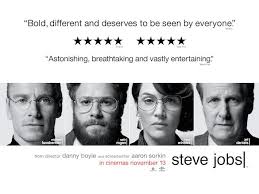
Steve Jobs is a 2015 American biographical drama film directed by Danny Boyle and written by Aaron Sorkin. The script, by Aaron Sorkin, an Oscar winner for The Social Network, is sheer brilliance. Sorkin divides the film into three time frames, each filmed in different formats and each involving the launch of a new Jobs product. The first part is set in 1984 in Cupertino, California, where Jobs, 29, debuts the Macintosh. The second part is set in 1988 when Jobs, axed by Apple, presents his Next cube to mass indifference. The final part, utilizing high-def digital, takes place in 1998 at San Francisco’s Davies Symphony Hall, where Jobs, back calling the shots at Apple, gives the iMac its famed send-off. Sorkin works wonders in this film revealing the man behind the machine rather than the machine behind the man. Without any scenes of failure or success, Sorkin forces his audience to understand the complex and often times revolting central Character. With extremely well written confrontations between Jobs and Wozniak ( Seth Rogen) or Jobs and his Daughter or even Jobs and his Boss (Jeff Daniels), Sorkin relentlessly demonstrates the true nature behind the tech giant. 

Steve jobs 2
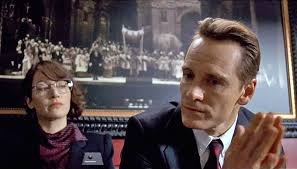
“Who are you? What do you do?”- Those questions, put to Steve Jobs by his partner Steve Wozniak in the middle of a heated argument, are both practical and rhetorical. Jobs is not a designer, an engineer or a coder — he relies on other people to do all of that, but he has somehow risen to the top of the computer business.  The sound scape is something that one should pay attention to. There’s no musical score at all only the voices the characters hear, the voices of an industrial town – ambiance. In the end the industrial voices just keep going on as the credits come on the screen. Polish-born marketing chief Joanna Hoffman (Kate Winslet) is ready to give shit to her boss. She rebukes him for letting his former lover  Brennan (Katherine Waterston) live on welfare and for denying paternity of their five-year-old daughter, Lisa (Makenzie Moss). What we don’t see is the older, even richer Jobs who married Laurene Powell, had three children, created more Apple miracles. Kate Winslet portrayal of real life Johanna Hoffman was as beautiful as it was naive . She brought the character alive in full force and truly demonstrated she is one of the best actresses working.  Seth Rogan gives the single best dramatic performance of his career. As Steve Wozniak, the literal opposite of Jobs, Rogan played the role with elegance and brilliance. Filled to the brim with nuance Fassbender offers a cold, intelligent, manipulative, calculating, and over all disturbingly convincing portrayal of Steve Jobs.
As calm as he is devilish, Fassbender plays this egotistical narcissist with such precision its close to horrifying to watch. Though calm through most of the movie Fassbender understands when to unleash the monster which lays in Jobs and is absolutely hysterical while doing so. The best thing about “Steve Jobs,” the thing that makes it work as both tribute and critique, is how messy it is. “Steve Jobs” is a creation myth written by a skeptic. 

La Promesse

la promesse

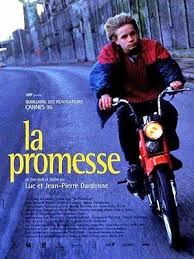
La Promesse, as the title suggests, is about the effort of keeping a promise, though it isn’t quite as simple as all that. At the age of fifteen, Igor has left school, works as an apprentice at a service station, and assists his father, Roger (Olivier Gourmet), in running an illegal immigrant smuggling, housing, and construction racket. They bring them back to a block of flats they live in and start charging them for money. One of the immigrants is Assita who has come to Belgium with her husband Amidou to find a better future for them and their baby. One day when immigrant-inspectors pay a visit, events start to have strange consequences. Igor leaves the service station in order to outrun the authorities and send the workers away.  In his haste, Amidou is critically injured when he falls from the arena, and, in his final words to Igor, asks the young man to look after his wife and child. Fearing prosecution, Roger ignores Igor’s pleas to take Amidou to the hospital for proper medical attention and instead, covers his body with canvas and leaves him to die. An important point of the film is the relationship between Igor and his father. The starting of the film presents a relationship between a father and his son that we could describe as complicity.  At this moment, the film becomes tinged with tenderness. But throughout this film, this complicity gradually turns into an open opposition and the consequences of Igor’s promise open his eyes on his father’s cruelty.

Jean-Pierre and Luc Dardenne create a scathing, poignant, and troubling  portrait of maturity, accountability, and sense of duty in La Promesse. Set in Liege, which is situated in Wallonia, a French-speaking portion of Belgium (where the Dardennes live), La Promesse is a study of native hustlers who exploit illegal West African immigrants, paying them little for hard labor. The sound scape is something that one should pay attention to. There’s no musical score at all only the voices the characters hear, the voices of an industrial town – ambiance. In the end the industrial voices just keep going on as the credits come on the screen.

Chopper

Chopper

Nabyendu Chatterjee made his directorial debut with an experimental Hindi film, followed by a hit Bengali film and continued directing in that language. Shubhra Ray ( Pradip Mukherjee), a dedicated worker of a left-wing party, is organising a strike to extract better wages for its workers. The morning on which the strikers are holding a meeting, Shubhra is shot dead. His family was entirely dependent on him.  His family consists of his father, mother, younger brother Rajat (Joy Banerjee) and sister Anjali. His death drives them to starvation and desperation. In the meantime, Rajat continues to apply for jobs but does not succeed in getting one. He has been immensely affected by the death of his brother and thinks of taking revenge on the killers. He becomes helpless in the face of the grave injustice done to the common people by the bourgeois social system. His girlfriend Reena ( Sreela Majumdar) also becomes a helpless victim of the evil forces which exploit the common people in name of democracy. Rajat ends up buying a chopper from a shop. Performance wise Joy Banerjee and Sreela Majumdar did make mark in their respective roles. Nabyendu Chatterjee depicts a thought-evoking portrayal of the lives of the members of a lower-middle class family in Kolkata. It is also one of the very few films which captured the dark side of Kolkata so acutely. It also shows the middle-class sense of disorientation which turns economically weak men into violent oppressors of women.

Damul

damul

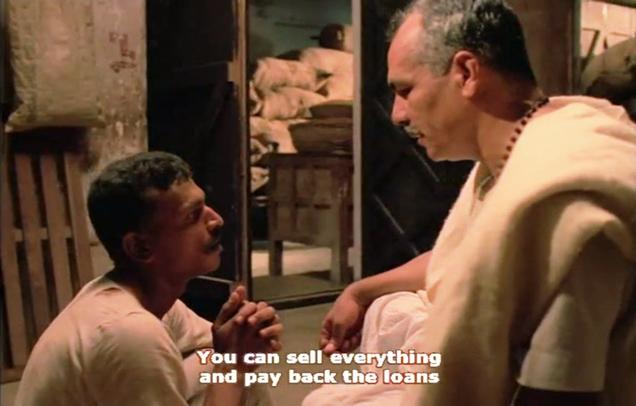
Damul is a 1985 Hindi film directed by Prakash Jha, based on the story Kaalsootra by Shaiwal, a native of Gaya district of Bihar. The story is about a bonded labourer Sanjeevan (Annu Kapoor) who is forced to steal for his  landlord Madho (Manohar Singh), to whom he is bonded until death. In a parallel development the landlord’s younger brother kills his labourers who try to flee from his construction site due to low wages.  Finally, the landlord’s mistress Mahatmain (Deepti Naval) decides to come out and make a statement before the authorities.  Madho keeps the debt-ridden and illiterate lower castes in eternal bondage, using their labour to win elections.  There is rivalry between Madho Pande and Bachcha Singh (Pyare Mohan Sahay), a Rajput, who is waiting for an opportunity to settle scores with the former. 

damul 1   damul 2

Damul makes links between caste, politics, the rural economy and migration. Rajen Kothari’s textured cinematography and mobile camera create just the right setting for a timeless tale of modern-day slavery. Through the unfolding of Damul, the viewer is almost continuously exposed to a series of audiovisual shocks. There is murder in cold blood, there are mass killings of defenseless people, sexual blackmail of a helpless young widow of high caste. The camera captures the subtle nuances of the facial expressions in close-up. The light in the Harijan basti is muted and natural- a glow here, a soft light there, the fiery flames heightening the credibility of the event or scene. The editing is slick without any jerks and jars that the violence could have justified. Manohar Singh is outstanding as Madho Pande. Annu Kapoor as Sanjeevan is very impressive while Sreela Majumder as his wife attracts notice. Deepti Naval’s brief stint as Mahatmain is adequately enacted. Damul remains Prakash Jha’s best film till date. 


Ek Ghar

Ek Ghar

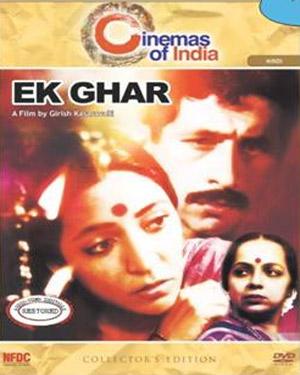
Ek Ghar (The House) is a 1991 hindi psychological drama directed by Girish Kasaravalli. Rajanna (Naseeruddin Shah) and Geeta (Deepti Naval) arrive in the city in the fond hope of building a little home.  He works as a supervisor in a MNC which manufactures bulldozers. Rajanna finally manages to find a house. However, when a workshop opens up next door, they are troubled by the noise and find ways to attain peace.  He has been helped in securing the house with the influence of his aunt (Rohini Hattagandi). She is old,attractive and has been deserted by her husband long ago. Rajanna uses her but wants his wife to stay away from her as she may be a bad influence. The contradictions are clear both within Rajanna and in the city. Nothing is what it appears to be. In 1991, India was on the point of an economic and consequently a social revolution which must have made most men and women anxious. The film is carefully constructed and crafted.  It follows a dual colour pattern of mostly blue intersected with yellow. When he and his wife decide to take a walk, it is at night and trees appear more like concrete pillars, lit by street light. The background score by L. Vaidyanathan mixed with the noise of the city creates a perfect mood of peace lost forever.Naseeruddin Shah is convincing as the confused, disoriented immigrant while Deepti Naval and Rohini Hattagandi stole the show by their power-packed performances.