Othello

OTHELLO

Shakespeare wrote the 3 hour-long originals but Welles cut and pasted it together to create a 90-minute pastiche that is barbed, claustrophobic, and hallucinatory. Film was shot in bits and pieces between 1948 and 1951, with the actors sometimes languishing on location while Welles went to raise more money.   In his last completed feature, “Filming Othello,” from 1978, Welles unravels the strange story of the shoot, which involved an actor, say, entering a doorway filmed in Morocco in 1949 and emerging in the same scene from a doorway filmed in Italy in 1951.   The fragmentation of the shoot is reflected in the fragmentation of the images, which is no mere convenience but an aesthetic, a fragmentation as complex as that of an  expeditious montage by Eisenstein.  In the course of his production, he employed five cinematographers, but few films sustain such uncanny visual consistency.  If by “auteur” we mean a director who takes not just the filmmaking process but all the alternations of fate and finances as his medium, then Welles easily qualifies.  From the opening scene the sublime strangeness takes over; it is like entering a Cubist painting. The dead Othello’s face, upside down, fills the screen, with strange chanting on the soundtrack.  Beginning with the ending, the narrative then follows that of the original, but so curtailed and suddenly pieced together that it takes on an alien quality.  His “Othello” (Orson Welles) boils down to the title character, his wife( Suzanne Cloutier), Iago(Micheál MacLiammóir) and bit players (and impressive numbers of extras). Welles the actor gives an impassioned performance as the titular character, while MacLiammoir is equally stunning as his jealous adversary.
Aar Paar

Aar Paar

I noticed that I had not reviewed a single film of Guru Dutt on my blog. In order to make amends, I decided to review one of his films. Kalu (Guru Dutt), a taxi driver who was sentenced to prison for speeding, is released two months before his term for good conduct. Wandering the streets, Kalu helps a young woman Nikki (Shyama) to fix her car.  He gets a job at Nikki’s father’s garage and love blossoms between Nikki and him.  When her father finds out, he kicks Kalu out.  An encounter with the mysterious Captain results in a brand new job for Kalu. Captain is planning a Bank robbery and thinks Kalu would be useful in driving the car.  Kalu joins with the captain’s gang which includes a dancer (Shakila) and a guy named Rustom (Johnny Walker).  In Aar Paar, Guru Dutt took his talent for song picturization to several notches above the commonplace.  Songs in his films often take place in locations occupied by the characters in his films. A fine example here is the romantic duet Sun Sun Sun Sun Zalima. The song is set in the stark and unromantic atmosphere of a garage with a car providing the center-piece but the way two lovers circle around each other within this space is a brilliant piece of choreography.

The other song whose picturisation deserves a special mention is- “babuji dheere chalna pyaar mein zara sambhalna” (Shakila’s great entry).  Aar Paar was a significant turning point in the life of composer OP Nayyar who went on to become an extremely successful music director.  Songs like Babuji Dheere Chalna, Yeh lo Main Hari Piya, Mohabbat Karlo, Ja Ja Ja Ja Bewafa, all sung brilliantly by Geeta Dutt, are remembered and hummed to this day. The plot of Aar Paar may now seem formulaic but scores in its treatment.  The narrative flow is pacy and engaging, merging the elements of thrills, romance, action, and comedy rightly. Aar Paar is a noir film that is infused with humor. Dutt’s friend and collaborator, VK Murthy, was behind the camera as usual, and the Dutt-Murthy combination’s play with light and shade was nothing short of magical. Guru Dutt plays his part of the streetsmart driver with ease.  Shyama was ok.  Shakila is excellent as a femme fatale.

IL Divo

il divo

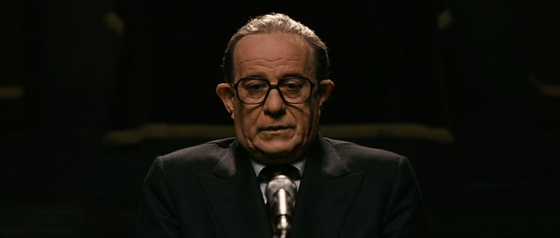
Paolo Sorrentino’s terrific Il Divo presents an extraordinarily sinister portrait of Giulio Andreotti, Italy’s most significant politician of the post-war era.  Between 1972 and 1992, he faced numerous trials on conspiracy and corruption charges and always escaped.   It begins as a collection of arresting images and concludes two hours later in the same fashion.  Throughout the film, the camera loops, and dances.  There is pop music on the soundtrack, low-impact electronica, and opera, too.  The film focuses squarely on the ending of his government service in the 1990s, during and after the seventh term as prime minister.  The trial surrounded his alleged involvement in the murder of Mino Pecorelli, a journalist who accused him of Mafia ties and to the kidnapping of Prime Minister Aldo Moro.  Toni Servillo gives an intricate portrayal of the man. Assisted by magnificent makeup work, he embodies the bent-eared, hunchback former Prime Minister.  His upper body seems to move as a single unit.
In the film, Andreotti is most haunted by the Red Brigades’ murder of the kidnapped of Aldo Moro, which he might have prevented.   Sorrentino tags Andreotti as the ultimate power-hungry; in one scene, he explains that the reason he confides in a priest instead of praying directly to God is because priests vote.   Il Divo tarnishes his legacy but not clearly, which is probably appropriate for a politician renowned for his opacity.

Pitfall (Otoshiana )

PITFALL.jpg

Pitfall is set against the background of labor relations in the Japanese mining industry.  It’s the first collaboration between Teshigahara, writer Kodo Abe.  A miner and his son travel the countryside searching for work.  Stalked by an unnerving, immaculately suited assassin he is killed brutally and left for dead.  It is also a ghost story, as miner rises from the dead and wanders the camp looking for answers to his murder. The child hides and avoids contact with the human beings around him.  Tesigahara builds a fascinating film by using a number of different tools-cinematography, numerous themes and a range of genre and stylistic conventions.  The film is not only an unsettling ghost story but also a murder mystery, a tragic tale of human desperation.  Meanwhile, the music is creepily effective in making you very aware of the characters’ every move and keeping you on edge.  Teshigahara’s visual flair, evident in his sculptural use of wastelands and remarkable superimpositions, is matched by  Takemitsu’s unorthodox score.

Elle

elle

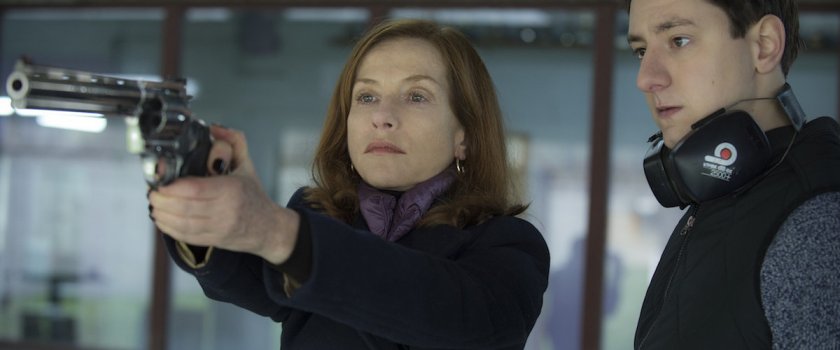
Michèle Leblanc (Isabelle Huppert) is raped in her home by an assailant in a mask, then promptly cleans up the mess and resumes her life. The only witness to the attack is a black cat, which sits watching silently. This is the first image, the cat’s stare, a touch that’s grotesque and mysterious, like everything that follows in this subversive black humor.  Later, at dinner with friends, she offhandedly remarks, “I suppose I was raped.”  Michèle is the CEO of a video game company.  Her ex-husband, Richard (Charles Berling), is an obscure novelist who is trying to pitch her an idea for a game about a post-apocalyptic revolt of cyborg dog slaves. Her mother lives with a gigolo. And there are the violent fantasies that Michèle initially entertains about getting back at her rapist, whose identity she discovers later.  Elle is at least three films at once: First, there’s the comedy of manners involving Michele’s adult son, mother, ex-husband and their respective other halves. At other moments, Elle plays like a sophisticated thriller. But it’s the third film, a complex psychological portrait of an unusual woman, that might be the most alluring (and these are the things u can never find in Indian cinema). As it progresses, Elle takes a deep dive into dangerous territory that could be misinterpreted as misogyny.  Huppert gives a performance of imperious fury, holding the audience at bay, almost provoking us to disown her. Paul Verhoeven’s long-awaited return to genre filmmaking pulls off a breathtaking film.

The Killers

the-killers

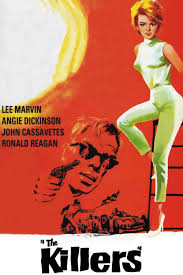
Adapted from the Ernest Hemingway short story, The Killers is the tale of two hitmen who pull a job that’s just a tad bit too easy. Their curiosity gets the best of them and they go searching for the truth in this Don Siegel directed gritty crime drama. The killers this time around are Lee Marvin and Clu Gallagher. John Cassavetes  plays the victim, a former race-car driver fallen on hard times since a bad accident. In the past he crossed tracks with the femme  fatale of the film, Angie Dickinson. But Dickinson’s heart belongs to daddy (Ronald Reagan). The strength of The Killers is the all-star cast led by Lee Marvin. Every time Lee and Clu Gulager are on the screen they shine as the hitmen searching for the truth. This film was released only two years before Ronald Reagan became the first of two actors to be elected governor of California as a Republican. He brings a natural air of authority and unspoken menace to every scene he has. Dickinson is a good femme fatale and does it in such a way that she doesn’t wear it on her sleeve. Overall this is an effective film. It lacks it’s own sense of style but is tough and enjoyable and it’s hard edge is still evident today.

Kids Return

kids-return

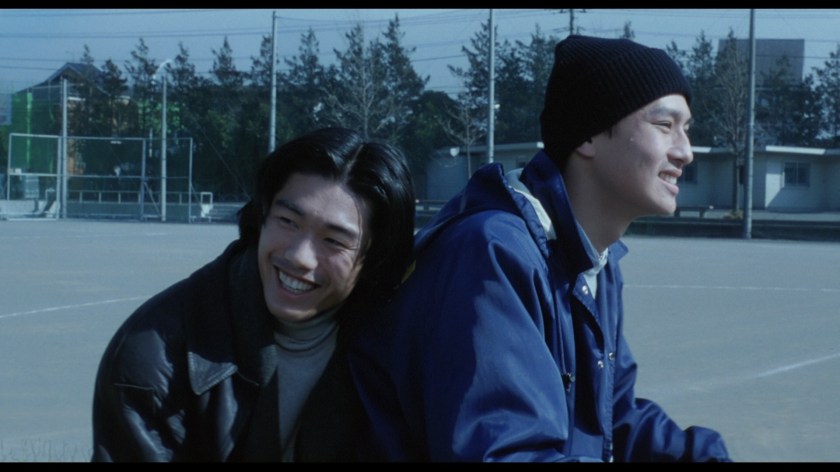
Kids Return is a 1996 Japanese film written, edited and directed by Takeshi Kitano. The film was made directly after Kitano recovered from a motorcycle accident that left one side of his body paralyzed. After extensive surgery and physical therapy he quickly went on making Kids Return. The film focuses on a group of high school students as they prepare to enter into the adult world. The two lead characters are Shinji and Masaru, delinquent losers who are looked down upon by their teachers, and feared by their classmates. After they’re thrown out of school, they fall into amateur boxing and go into different paths. Unfortunately, Shinji is the only one who shows any talent for boxing. Masura, on the other hand, gives up and joins a menacing Yazuka gang. The relationship between the two friends really works. We see their dynamic and when they drift apart, you believe it. You also grow to like the characters, and kinda root for one. Kids Return’ is seen as  Kitano’s most autobiographical work, set in the part of Tokyo where he grew up and featuring events and job roles that he himself experienced while growing up. The two friends, Masaru and Shinji drift through school, seen as the ultimate prodigal sons by their teachers. Even at it’s darkest, Kids Return remains optimistic for Shinji and Masaru’s future. For Kitano, life is not an unbroken journey towards an inevitable conclusion, but a series of moments, each significant in their own right. Kitano interweaves different narrative levels combining flash backs with snippets of the past and present and placing high demands on the audience.

Chokh (The Eyes)

chokh1

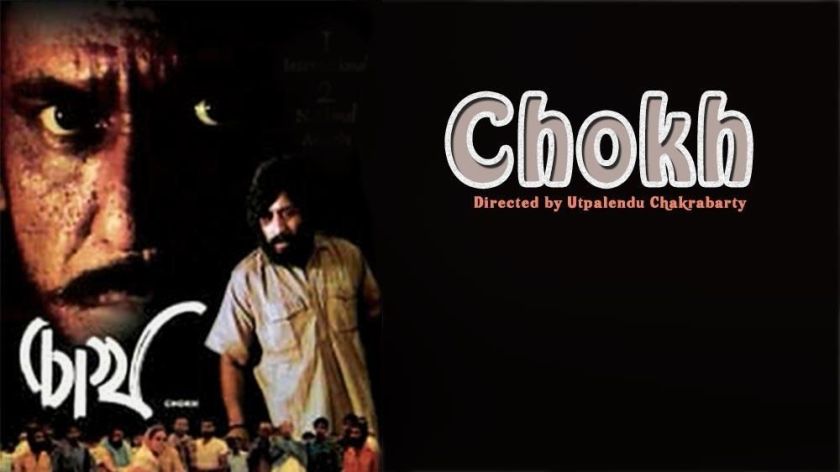
Chokh (The Eyes) is a 1982 Indian Bengali film directed by Utpalendu Chakrabarty. The film was set in during the Emergency period in December 1975. Jadunath (Om Puri) a labour union leader, of Jethia Jute Mill in Kolkata has been given death sentence, for the murders of Jethia’s (Shyamanand Jalan) brother and another worker even though Jadunath was innocent. He wants that his eyes should be given to a worker who has never seen the world. Jethia influenced the government to get the eyes for his son who lost his eyes due to an accident. But Ghanshyam, the hospital driver and few other workers demand that eyes be given to a blind worker.  When Dr. Mukherjee (Anil Chatterjee) before the operation tries to trace the papers recording  Jadunath’s donation, the superintendent orders Dr. Mukherjee to carry out his duty as there are instructions from the highest quarters. Dr. Mukherjee sticks to his point and is ready to face the consequences. Om Puri and Anil chatterjee both did justice to their parts though  Chatterjee was bit mannered. Shyamanand  Jalan was convincing as villain. Set in the era of mid  70s, depicting the exploitive state of Calcutta (Kolkata) mill workers, it’s the story of an honest union leader, who is being hanged for getting wrongly framed in the cold blooded murder of the mill owner’s brother. With an use of the ‘Eye Donation’ plot, Chokh showcases an accepted truth that eyes are in fact the mirror of a man’s real inner personality .

The Long Memory

the-long-memory

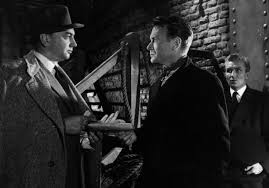
The Long Memory is a black and white 1953 British noir film directed by Robert Hamer. John Mills plays Philip Davidson, just released from an eight-year stretch in prison for murder. But Philip has a mission. He wants to track down the people responsible for his imprisonment—Captain Driver (Fred Johnson), his daughter Fay (Elizabeth Sellers), and Tim Pewsie (John Slater)—who stitched him up for the murder of the criminal Boyd (John Chandos) to hide their own involvement in Boyd’s crimes. Boyd had actually clubbed one of his customers over the head in a fight over payment, and then seemed to drown when Driver’s boat caught fire and sank. After his release, Phillip finds that Captain Driver drank himself to death, Fay has married the detective on the case, Bob Lowther (John McCallum), and become a middle-class housewife, and Pewsey, a middle-aged man, has recently left his own wife (Thora Hird) for a younger mistress (Mary Mackenzie).

Mills is excellent as an ordinary, decent man who’s life is turned upside down and because of that becomes frustrated and obsessed. Eva Bergh is excellent as a young waitress at a café who befriends Davidson and ends up falling in love with him. Sellars is good as the woman who only cares about herself and doesn’t realise until much later just what her accusations cost Davidson. The great works of British film noir are far less well known than the American, but it was one of the few genres that thrived for the British film industry after World war 2. Like many true noir films, The Long Memory is about people trying to cling to existence and their humanity; crime is a negative expression of their desires. The Long Memory portrays Britain as it was then—depressed, hungry, worn out by war, and full of the poor, deprived, transient, and criminal.

Sieranevada

sieranevada-1

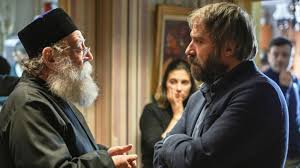
Fundamentally, it is a conventional family drama in which emotions and secrets boil to the surface in the usual way. Forty days after the death of his father, Lary (Mimu Branescu), a doctor in his forties, is about to spend the Saturday at a family gathering to pay tribute to his father. He turns up for the party after having a huge row with his wife Laura about getting his daughter the wrong  disney costume for her school play. Laura is super-informed about everything and thinks a lot before she decides, while her other half, who relies more on gut feelings and improvisation, is the kind of person who listens to her with a bewildered smirk if he disagrees but then still wants to win the argument. The dialogue is sharp, funny and full of unexpected twists that are logical yet often turn things on their heads. Relatives and spouses are gathered, tensely. But through a strange series of events, they are prevented from eating. The event takes place just around the Charlie  Hebdo shooting, which sets the stage for a prolonged conspiracy theory discussion about 9/11. But seemingly countless topics are brought in, whether in the bedroom (the story of an abusive husband), in the kitchen (communism versus monarchy ), in the small office (the memorial service traditions), the dining room or even the tight hallway, from where we constantly revolve.  Cristi Puiu creates a claustrophobic atmosphere within an oppressive, environment, whether inside or outside the apartment. The proceedings are intense and alienated – often brilliant, sometimes slightly redundant. There are many long shots of 20-25 minutes where we are observing actions within two-rooms from outside. Here camera creates a third-person audience.