Ganga Jamuna

Ganga Jamuna

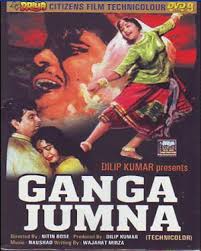
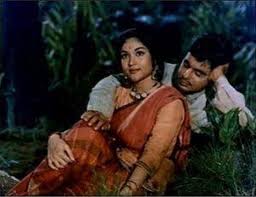
Ganga Jamuna released in 1961 was one of the first films to popularize the theme of two brothers on opposite side of law . It was produced by Dilip Kumar and directed by Nitin Bose.  A religious, principled widow (Leela Chitnis) struggles to raise her two sons Ganga and Jamuna. Devastated when she is framed for a theft, the frail woman passes away. Ganga pledges himself to support his younger brother as they grow to adulthood. He enjoys the endless squabbles with his childhood friend Dhanno (Vyjayanthimala). The sombre Jamuna (Nasir Khan), is in love with the zamindar’s daughter (Azra). Meanwhile, the zamindar’s brother-in-law (Anwar Hussain) has his eyes on Dhanno.  Ganga saves her from the zamindar’s lecherous assault. The zamindar (Anwar Hussain) gets his revenge by upstaging a robbery charge against Ganga. The supreme irony is that his best intentions for his loved ones are ill-fated. Ganga gets an empty jewel box home probably for his beloved mother but this gets her framed. 
Ganga jamuna 1

The money he steals doesn’t reach Jamuna. Of all the human relationships that Ganga Jamuna explores, the most affecting is the one between Ganga and Dhanno- an outstanding love story between two ordinary people handled with great care. Dilip kumar is too good and plays the role of Ganga very convincingly. Vyjayanthimala is a revelation as Dhanno.  Nasir Khan (real life brother of Dilip Kumar) manages to lend a quiet dignity to his role. Directed by New Theatres old-timer Nitin Bose, Ganga Jamuna is a well-structured and briskly paced film and was notable of the use of Bhojpuri dialect. This former cinematographer also frames some excellent shots even while keeping a tight check on the narrative.

The Ballad of Cable Hogue

The Ballad of Cable Hogue

Sam Peckinpah’s “The Ballad of Cable Hogue” is a splendid example of the New Western. The New Western is usually set at the moment when civilization reached the West. Largely ignored upon its release, The Ballad of Cable Hogue has been rediscovered in recent years and is often held by critics as an example of the breadth of Peckinpah’s talent.

Betrayed by his partners Bowen (Strother Martin) and Taggart (L.Q. Jones), Cable Hogue (Jason Robards) is left for dead in the desert. Miraculously, he finds water.
It turns out that the hole is 40 yards from the stage coach route between the towns of Deaddog and Lizard. Cable obtains claim to the land and convinces the stage-line to sign a contract with him to set up a way station for travellers. On his occasional trips to the closet town, he meets cheerful prostitute  Hildy (Stella Stevens), who joins him in his oasis. He meets Joshua (David Warner), a wandering preacher who applies a liberal interpretation of the bible to suit his own needs.  The old fellow’s project prospers; the sympathetic prostitute pays him a brief but fulfilling visit; he eventually gets revenge on one of the partners who left him to die. The cast are great, Jason Robards is wonderful in the title role, Stella Stevens as Hildy shows a fine actress at work.  David Warner is particularly fine as the raunchy priest and in his relationship to Jason Robards strike real sparks.

It contains an emotive score by the master Jerry Goldsmith, adding various sensitive country-western songs. The film is filled with scenes to cherish . Hildy takes a bath and Cable rubs her in one of the tenderest of moments, and the preacher conducts over one of the sincerest of funerals you can imagine. It’s a stunningly different and more positive film from the director of the nihilistic “Wild Bunch”. At the same time, it works as a reverse examination of his earlier film’s major themes. If “Bunch” is about damnation, “Cable Hogue” is about preservation, and redemption.  A twilight story ,¨Ballad of Cable Hogue¨ is a director Sam Peckinpah’s lovely effort, feeling look at the world of the Western.  


Imdb link :-   http://www.imdb.com/title/tt0065446/

The Beguiled

The Beguiled
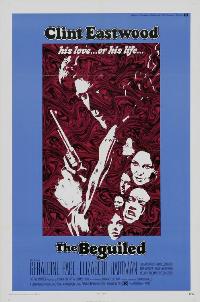
Directed by Don Siegel, with whom Eastwood collaborated on several films, it was made a year before Eastwood’s directorial debut with “Play Misty For Me”.  Eastwood and Siegel had to battle with Universal Pictures to keep the original ending, and they won out; and, the film was promoted as a standard Eastwood western, which it certainly is not. The Beguiled did poorly in its theatrical release.  Nobody was quite sure what to make of it, and some of its content raised a few eyebrows in 1971.  The film received major recognition in France and was proposed by Pierre Rissient to the Cannes Film Festival. “The Beguiled” is Mr. Siegel’s 26th film, as well as his most ambitious and elaborate. 

In the closing years of the American civil war, a severely injured Union soldier finds himself in the care of an all-girl boarding school. He is found by 12-year-old Amy, who takes him to the school run by Martha Farnsworth (Geraldine Page). Five other girls also attend the school, including the romantic and responsible Edwina (Elizabeth Hartman) and the desirous Carol (Jo Ann Harris).  The virginal teacher Edwins falls in love with him, and the sensual teen Carol wants to sleep with him.  Mcburney begins an erotic chess game, secretly telling each woman exactly what she wants to hear, hoping to gain a foothold of power in the house. Martha reveals herself to be a wounded, sexually confused character who has very personal reasons for not turning Mcburney over to the troops when she has the chance.  The Beguiled is entirely interested in what makes its characters tick. Sexual tension is visible in nearly every scene, even uncomfortably between Eastwood and 12-year old girls who share a kiss early on. The scene where Geraldine Page, armed with only a medical book as guide and brandy as anesthetic, removes Clint Eastwood’s leg with a hacksaw, is truly gruesome. The sexual politics are impenetrable. 

Mcburney is a hero whose stories of wartime heroics are a lie. Representing the union, he promises slave Halie (Mae Mercer) freedom before threatening to rape her. When his masculinity’s challenged he resorts to threats, threatening to loose Union soldiers on the school. If Mcburney’s a chauvinist pig, the women are stock archetypes. Martha’s rigid demeanor hides shameful secrets and unacknowledged longings. She falls for John after noticing his resemblance to her brother.  Geraldine Page (Miss Martha) was very convincing in her role; bringing lots of duality to it. Elizabeth Hartman (Edwina) was eerily convincing in her emotionally unbalanced part. Eastwood seems to be having a blast with the role until things turn really ugly, then he turns mean and ugly. it’s quite an impressive achievement overall and must be counted as one of Don Siegel’s finest films. The period details are richly, even obsessively designed and the acting is top-notch from everyone. The crisp cinematography by Bruce Surtees adds enormously to Siegel’s carefully wrought atmosphere of sexual repression.

The Man Without a Past (Mies vailla menneisyyttä )

The man without a past
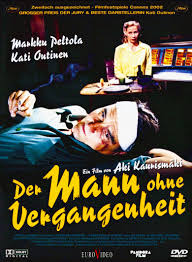
A welder M, played by Markku Peltola, turns up in Helsinki looking for work, dies in hospital after getting beaten by muggers but is then reborn as a man with no memory and joins a community of homeless folk living in polished contentment in empty container units. But this is not a film of a man trying to find out who he is (or was) but rather of a man trying to make a future for himself.  He finds friendship among the homeless and destitute and love with a melancholy Salvation Army worker, Irma (Kati Outinen). The government won’t help him because he has no name and no papers, so he helps himself. From the start, he continuously improves his condition. He plants potatoes next to his container and prepares for the winter. He also teaches the Salvation Army band to play spirited tunes (along the lines of “Sister Act”). “M” plays with the interesting theme of getting another chance to begin life again. We gradually see him going from a loner to becoming a part of the community.

It is the second installment in Kaurismäki’s Finland trilogy, the other two films being Drifting Clouds (1996) and Lights in the Dusk (2006). What we have here is a political allegory for our times, in which big business and the equipment of capitalism are shown as dehumanising forces of evil. The film can best be appreciated when its sly humor is at work without inhibitions. It’s a quirky film that will not suit every one’s taste, but should please those who can live with the droll acting and the Charlie Chaplin ‘silent film’ humor. What sets this film apart from other idiosyncratic adventures is its internal coherence (both in terms of storytelling and visual style) as well as the humanity of its characters.

Imdb link :     http://www.imdb.com/title/tt0311519/

Theeb

Theeb

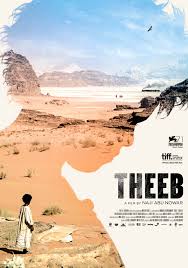
The film is set in a period known as Arab Revolt, when Arab nationalists sought independence from the Ottoman Turks. Events are seen through the eyes of Theeb (Jacir Eid), a Bedouin child who has had no contact with the world outside his desert community.  Theeb whose father has recently died, is the youngest of three sons in a family of guide. The story begins in traditional Bedouin desert community where a blond British army officer, Edward (Jack Fox), and his Arab sidekick, Marji (Marji Audeh), appear out of nowhere, seeking a well near the Ottoman train tracks. Hussein (Hussein Salameh), the second-oldest among brothers, agrees to lead the party and instructs Theeb to remain behind.   Theeb, whose name means wolf, disobeys his brother and follows the men to the well. When the Englishman goes for a drink, he finds only blood. There are bodies in the well. After a series of bandit attacks, Theeb is the only one left alive. Help does come, but in the badly wounded form of one of the bandits who attacked them.

The director was Naji Abu Nowar, who wrote the screenplay with Bassel Ghandour, and the stunning cinematography was done by Wolfgang Thaler.  Theeb is a bright kid who is consumed with curiosity.  Nowar has described Theeb as an “Arabic western” and the film has been compared to Sergio Leone’s westerns, in addition to Lawrence of Arabia. Throughout the film’s 100 mins, there is a significant shift between the film’s two major plotlines. However the latter half of the film is a much more compelling tale of survival against all odds, dissecting ideas about trust as the human element.  Theeb possesses some impeccable staging of cinematography as the harshness of the desert landscape is captured elegantly. In particular, Theeb possesses a beautiful sequence involving the starry night sky that is not to be missed.  Theeb deals with is nothing less grand than survival; survival on an individual level for the protagonist but also the survival of a culture .


Imdb link : http://www.imdb.com/title/tt3170902/


Mustang

Mustang images

The trouble begins at the beginning of the film, when some nasty gossip and a misunderstanding turns innocent fun into a minor sexual scandal, leading the girls’ relatives to increasingly shut down their access to the outside world.  The grandmother brings suitors to the house, determined to marry the older girls off as soon as possible. The film tells the tale about five young sisters living in a conservative Turkish society and the friction regarding the relationship between them and their uncle and grandmother.  Writer/director Deniz Gamze Erguven and writer Alice Winocour have crafted a story for the ages about how women continue to suffer at the hands of patriarchs. Lale (Gunes Sensoy) is the youngest of the sisters and in the end, proves to be the toughest.  As Lale witnesses what her older sisters are subjected to, she becomes more determined to avoid such destiny. One of the strengths of the screenplay, co-written by the film’s Turkish-born, French-raised director Deniz Gamze Erguven, is that it suggests but neatly avoids direct mention of any specific religion.

Deniz Gamze Ergüven makes a remarkably assured debut as writer/director here, aided by a terrific ensemble cast, especially the five young actresses playing the sisters. The aforementioned Sensoy is the central character amongst the five, and is probably the standout, though all have their moments.  It is a coming-of-age drama, which reflects upon its five central protagonists as well as the society that so decisively influences their lives.

Blue Collar

Blue Collar

Paul Schrader tells the story of three workers, who are all more or less in the same boat. Three leads- Keitel, Pryor and Yaphet Kotto- play laborers on the Checker cab assembly line in Detroit.  Richard Pryor, in easily his best performance, plays a man in trouble with the IRS. At work, he has a defective locker that continually cuts his hand when he fights with it.  Yaphet Kotto is in debt to a loan shark, Keitel works a second job to get by and finds himself unable to pay for the dental treatment that his daughter needs. Pryor, Keitel and Kotto hated each other during the making of the film, so much so that many of their scenes play out in long master shots only.  But when their money troubles pile up, they make a desperate plan to steal cash from their local union office. When they put their plans to work ,things eventually go from bad to worse. Richard Pryor shines in a performance that is both funny and heartbreaking. Harvey Keitel is in his usual magnetic self and Kotto is understated yet electric at the same time.

Schrader, who was at the time a renowned screenwriter for his work on Taxi Driver (1976), made his directorial debut with this film. The choice to go with a blue score is inspired in itself, as the nature of the music so perfectly captures what these characters are going through. There are several scenes that don’t feature any music at all, these being some of the most important scenes. Schrader made an impressive debut as director with this film. It is very rare to find an American film tackling issues like corruption in organised labour.


La isla mínima(Marshland)

Marshland

Set in 1980, it follows two cops, Juan (Javier Gutiérrez) and Pedro (Raúl Arévalo), investigating the disappearance of teenage girls in a remote part of rural Andalusia. While investigating the death and mutilation of two girls found in a swamp, they find out that they are dealing with a serial killer.  Two other girls were murdered in similar ways, on almost the same dates, in both 1978 and 1979.  Juan and Pedro, who have never met until now , don’t like each other.  Pedro has disdain for the older Juan’s boozing, womanizing ways. However, their differences make each encounter with suspects interesting, as we see how each man handles certain situations.  Directed by Alberto Rodriguez, the film was intentionally set in 1980, when the country was reeling from the end of Franco’s undemocratic rule and learning to adapt to a more liberal society. Pedro is more methodical and observant, while Juan is impulsive and prone to using his fists to get answers while questioning the witnesses. Pedro despises Franco’s regime and its legacy, while Juan didn’t seem to care much about that. 

There are a couple of symbol-heavy scenes that include Juan and a bird seemingly staring at each other, one might claim that the bird represents a new era for the country, while Juan is a man tormented by a dark past he can’t escape. The political climate of the region is what separates this film from many murder mystery films. Also worth mentioning is the sublime photography.  The top-down aerial photography is most prevalent during the starting credits of the film. Good performances from Javier Gutiérrez as a tough, arrogant cop abusing the suspects’ civil rights and Raul Arevalo as an ethical Inspector who displays his worried look to everybody. Support cast is pretty good such as Antonio De la Torre , Nerea Barros. The setting is well-structured, as the cars, haircuts and mustaches certainly point to the late 70’s.  This thriller is gripping, well-structured and entertaining throughout.

http://www.imdb.com/title/tt3253930/

Ratcatcher

ratcatcher 2

It begins with a boy named Ryan spinning while wrapped in his mother’s curtains, and the scene shifts from slow motion to real time as his mother pulls him out of the fabric. Ryan meets James at the canal and suddenly he is drowned, clearly with James bearing much of the blame for not having raised the alarm. The film follows the sensitive James (William Eadie) as he tries to come to terms with his guilt.

Ratcatcher, written and directed by Lynne Ramsay, is a really stunning feature debut.  It takes place during the Glasgow garbage strike of 1973.  James lives with his father (Tommy Flanagan), mother (Mandy Matthews) and two sisters in a poor neighborhood in Glasgow 1973 where the working class is influenced by the garbage streak that over-floods the streets with trash and rats. James isolates himself from his family and makes friendship with the weird neighbor boy Kenny and with the slightly older unrestrained Margaret Anne. Ramsey evokes some breathtaking images and poetry with her incredible editing. Her film is mainly concerned with the subjective experience of childhood and its relation to death.  
 

Sicario

Sicario

Written by Taylor Sheridan , the film is about an idealist FBI agent (Emily Blunt) who is enlisted by a government task force to bring down the leader of a powerful and brutal Mexican drug cartel.  While tracking leads in a kidnapping case , FBI agent Kate ( Emily Blunt) and her team make the shocking discovery of a mundane Arizona home that has been serving as a cartel graveyard.

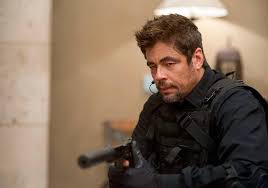
During the raid, a bomb goes off in the yard, killing two of the officers involved. Shortly after, she is recommended by her boss to join a special team headed by Matt Graver ( Josh Brolin), a team that would try to catch the men responsible. Kate is surprised to find out one of the members of the team is a Mexican, Alejandro (Benicio Del Toro) , which seems to be against the law.  They are going to Juarez; Mexico for their mission, another violation. They are successful, but not without incident.

The new film from director Dennis Villeneuve, Sicario captures the tension and horror of the modern war on drugs like few films before it have.  Graphic scenes are avoided by having them take place just off camera. The film’s real thrill do not come from violence and blood on the screen but from intelligent and unsettling dialog.  It is beautifully shot by Roger Deakins, one of the great film cinematographers. There is also plenty to like about the performances here, including a fine turn from Emily Blunt as the agent who wants revenge but not by violating the law. Josh Brolin also turns in a decent performance as the mysterious leader of this team. The role is ideal for Benicio Del Toro, who always gets scarier when his gestures outnumber his lines. He dramatically underacts.