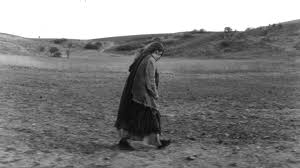
After making this film, Bela Tarr announced that he was retiring from making films. Though after 8 years, he is making a comeback with a documentary titled “Missing People”. Turin Horse begins with an unseen narrator telling us, that in 1889 Friedrich Nietzsche went suddenly insane after throwing his arms around an abused horse in Turin. After this incident, the philosopher remained in such a state until his death. Nobody knows what happened to the horse. Next, we see a monochrome film about six chapters of life on a remote, impoverished farm occupied by an elderly man, his daughter, and their unfit horse. In one sequence, we get to know that the name of the old man is Ohlsdorfer. Every day, the daughter goes to the well and brings the water. She dresses her father as his right arm is paralyzed. But each day things get worse. The wind doesn’t decline, the horse won’t drink or pull a cart. One day, a man comes to their house to get some amount of brandy. He tells the old man humans and God are responsible for suffering in the world. The old man ignores his vision, saying that all of those are rubbish. There lies the point of the film. It is about the “heaviness of human existence”. The film is in black and white and consists of merely thirty long takes. As it is with Tarr’s films, he uses the environment as the main ‘characters’ – the buildings, the landscape. This gives a tremendous sense of grandeur to simple images. Mihaly Vig once again delivers an incredible score, a funereal song that shares the soundtrack with the endless howling wind. Previously in Tarr’s films, we have seen that people do always suffer. But we have also found a glimmer of hope in Werckmeister Harmonies. There was a particular scene where a mob would attack the hospital, but they would stop vandalizing once they find a helpless person inside a bathroom. But in “Turin Horse”, it seems that he feels that there is only a horse to human suffering.

 debarshithecinemaniac