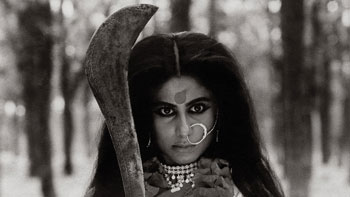
In the 70s and 80s, plenty of Indian directors made socially-realistic films. Some of the notable directors were Shyam Benegal, Govind Nihalani, Nabyendu Chatterjee and Utpalendu Chakraborty. Utpalendu Chakrabarty made very few films in his career. His last film was 25 years ago. Even then, not all of his films are available. But if one watches Chokh and Debshishu, he/she will be convinced of his great skills and mastery over the medium. In the opening scene, we see a middle-aged guy announcing the arrival of a debshishu (child god) in a remote village. The child god fulfills the wishes of people. A couple, Raghubir and Seeta (Sadhu Meher and Smita Patil), arrive in the village with their only child. They have lost everything in the flood. Seeta came to stay at her brother’s house for a few days. However, the brother’s wife (Rohini Hattagandi) turns out to be very cruel and insensitive towards them. Still, they manage to get a room in their house. Raghubir realizes that he can’t stay here for long. Soon, he has to find a job and a house of his own. One day, while going to the market, he hears about debshishu (child-god). He visits there hoping that his wishes will be fulfilled. There he sees a magician (Om Puri). He remembers him showing magic in his village. When Raghubir and Seeta’s deformed baby was born, he went to his house to ask for help. The villagers warn Raghubir that if his baby is not killed, they will force them to leave the village. According to them, the baby would bring bad luck to the village. The magician told him to sell the baby to them, and he would compensate for that by giving him good money in return. Raghubir follows his orders. Raghubir realizes that the child god is his deformed baby.
Let me tell you, this film is much different in content and form than other good social-realist films belonging to that particular period. The cast system, poverty, religion are all mixed here in a bizarre (important word) way. While I do like most social-realist films of that period, very few of them did display the complexity of oppression. It isn’t just limited to homeowners or wealthy, powerful people oppressing others. The reality is bizarre and that is what this film is. The film highlighted how gods are born and how poor people are forced to believe in their existence more. Sadhu Meher has been exceptional. Smita Patil and Om Puri are dependable. Utpalendu was a gem of a director and to me one of the most important ones, along with Shyam Benegal and Govind Nihalani. He used two flashbacks in the film. One of them was done in black and white to capture the image of the rain more realistically. Another one was in color when Sadhu Meher visited Om Puri’s house.

 debarshithecinemaniac