The Border

jack 5


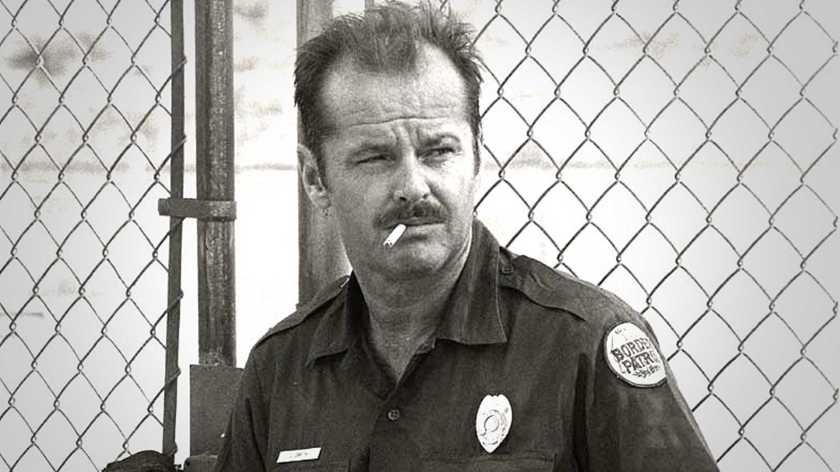
Immigration enforcement agent Charlie Smith (Jack Nicholson) lives with his wife in California in a small house. She forces him to move to a duplex in El Paso shared by border agent Cat (Harvey Keitel). Marcy wants to live a rich life and Charlie’s current wages won’t cover it. Cat gives him an offer to join him in a shady business. He introduces Charlie to the human smuggling operation he runs with their supervisor Red.
He uses this partnership to help a young Mexican woman, Maria, get across the Tex-Mex border along with her younger brother and her baby. Nicholson is constantly at odds with his bimbo wife (Perrine, perfectly annoying) and his morally corrupt partner (Keitel as always menacing). This is one of the few films which dealt with the issue of the USA-Mexican border. It handles the human smuggling issue in detail. After Charlie decides to join hands with Cat, the drama increases. While Cat is a perfect bad guy, Charlie still has some morals. It was never clear if Charlie loved his wife or not.
But the kind of guy is , he will never cheat her. With time, he develops a special feeling towards Maria but that is only limited to feelings. Jack Nicholson here plays a totally subdued character and he plays it with elan. Valerie Perrine is superb as the annoying wife while  Elpidia Carrillo does her job by slightly changing her facial expressions.
Harvey Keitel is always dependable. The direction by Tony Richardson, is at times inspired and artistic, and at other times as ordinary as dishwater. Still, as a snapshot of poor Mexican immigrants (and would-be immigrants) as they clash with the border patrol culture twenty-some years ago, The Border is definitely worth a look.

Debshishu

debsishu

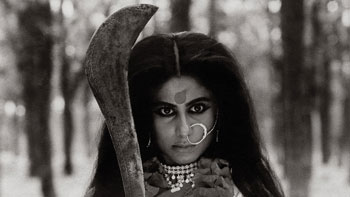
In the 70s and 80s, plenty of Indian directors made socially-realistic films. Some of the notable directors were Shyam Benegal, Govind Nihalani, Nabyendu Chatterjee and Utpalendu Chakraborty.  Utpalendu Chakrabarty made very few films in his career. His last film was 25 years ago.  Even then, not all of his films are available. But if one watches Chokh and Debshishu, he/she will be convinced of his great skills and mastery over the medium. In the opening scene, we see a middle-aged guy announcing the arrival of a debshishu (child god) in a remote village.  The child god fulfills the wishes of people. A couple, Raghubir and Seeta (Sadhu Meher and Smita Patil), arrive in the village with their only child. They have lost everything in the flood. Seeta came to stay at her brother’s house for a few days. However, the brother’s wife (Rohini Hattagandi) turns out to be very cruel and insensitive towards them. Still, they manage to get a room in their house.  Raghubir realizes that he can’t stay here for long. Soon, he has to find a job and a house of his own. One day, while going to the market, he hears about debshishu (child-god). He visits there hoping that his wishes will be fulfilled. There he sees a magician (Om Puri). He remembers him showing magic in his village. When Raghubir and Seeta’s deformed baby was born, he went to his house to ask for help. The villagers warn Raghubir that if his baby is not killed, they will force them to leave the village. According to them, the baby would bring bad luck to the village. The magician told him to sell the baby to them, and he would compensate for that by giving him good money in return.  Raghubir follows his orders.  Raghubir realizes that the child god is his deformed baby. 

Let me tell you, this film is much different in content and form than other good social-realist films belonging to that particular period. The cast system, poverty, religion are all mixed here in a bizarre (important word) way. While I do like most social-realist films of that period, very few of them did display the complexity of oppression. It isn’t just limited to homeowners or wealthy, powerful people oppressing others. The reality is bizarre and that is what this film is. The film highlighted how gods are born and how poor people are forced to believe in their existence more. Sadhu Meher has been exceptional. Smita Patil and Om Puri are dependable.  Utpalendu was a gem of a director and to me one of the most important ones, along with Shyam Benegal and Govind Nihalani. He used two flashbacks in the film. One of them was done in black and white to capture the image of the rain more realistically. Another one was in color when Sadhu Meher visited Om Puri’s house.


Jiban Trishna

Jiban Trishna 1


Sophisticated millionaire Rajnath Samanta (Uttam Kumar) tries to woo the self-respecting, independent artist Shakuntala (Suchitra Sen). At first, she avoids him, but slowly she develops a feeling towards him. The relationship between Rajnath’s parents, Dr Samanta (Pahari Sanyal), and his second wife, the ethical Sudeshna (Chandravati Devi), is based on the need for care and understanding.  Sudeshna keeps her real identity hidden from Rajanth to maintain the prestige of the family. The third relationship is the most interesting one. It develops between the dignified widow Sabita (Deepti Roy) and her neighbor Debkamal (Bikash Roy). Debkamal has a hidden past.  Asit Sen, with complete mastery over his medium, could handle a six-edged storyline with such finesse. All the characters are equally powerful and all of them get equal space.  It is no mean task. The forte of Asit Sen lay in his ability to balance the script and handle complex characters in such a manner that makes them connect with the audience.  Asit Sen was a cameraperson himself, so cinematography used to be a highlight in all of his films.  Each camera angle is well-thought-out and the low-angle shots of Uttam Kumar and Suchitra sen were excellent. Uttam Kumar delivers a very good performance. This is not one of his best performances, but in certain scenes, he shows his spark. Especially during the scene where he confronts Suchitra in his room. Suchitra mostly matches Uttam, though in certain sequences, she goes overboard. Overall, she still does a very good job.  In Asit Sen and Ajoy Kar’s films, Suchitra really did a good job as an actor. The best performances came from Bikash Roy and Deepti Roy.  Bikash Roy masterfully portrayed vulnerable shades of his character. Deepti Roy was attracted to Bikash, but she never expressed it in an explicit manner. Her nuanced acting did manage to maintain the balance. One of Bhupen Hazarika’s earliest hits, “Sagar sangame’, is featured in this film. Unfortunately, in Angle’s video, the song is cut from the film. However, one can watch this song on YouTube. It is a brilliant depiction of murmuring to oneself as one gets ready for the day.

Colo

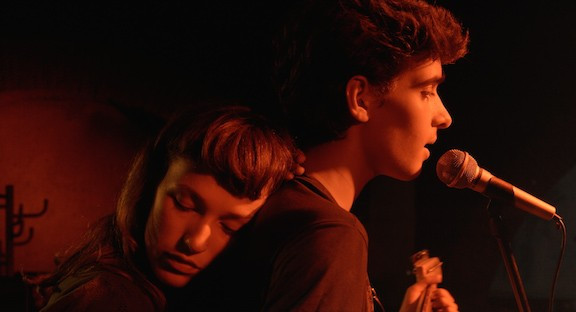
One evening, teenager Martha (Alice Albergaria Borges) asks her unemployed father (João Pedro Vaz) where her mother (Beatriz Batarda) is, and dad replies that she will probably never return. Her father goes outside. But after a while, her mother does return, explaining that she has got an additional job. They are going through an economic crisis. Her father is jobless, and her mother takes multiple small jobs to run the family.  But even that is not sufficient for them to pay electric bills. At times, her father disappears without saying anything. Martha makes friends with a pregnant girl in high school. She observes the outside world through her window. She spends time wandering at a beach. Her mother is so occupied with many jobs that we can’t get a look at her psyche. The first hour consists mostly of mundane routines and interactions between these three. All of them try to understand each other but, in the end, they don’t quite understand.  Random incidents are described without much context. Characters drift along, showing little certainty in what they do. Whether young or old, the people in Colorado don’t quite understand what’s happening to them. The most attractive aspect of the film is its striking visual design. Both indoor and outdoor spaces, as well as the characters’ relation to them, are presented with great care. The natural world offers little solace in Colo, but it does suggest a yearning for a simpler, easier state of things. Despite suffering from economic crises, the characters maintain their humanity. 
 Mother appears to be a male of the family while her father doesn’t shy away from crying. Mother acts as a protector of the family. Artificial and natural lighting helps to create an impressive visual control of mood. Other strengths include a delicate, sparing, use of classical pieces by Schumann and Shostakovich. This is my first film by Teresa Villaverde. She showed immense control throughout the film. I would like to explore all of her works.