Phantom Thread

Phantom Thread

“I can’t begin my day with a confrontation.” So says Reynolds Woodcock (Daniel Day-Lewis), a celebrated fashion designer, who lives and works in a quiet London square, and who despises any threat to his lifestyle. His sister Cyril ( Lesley Manville) helps him to run his business.  One day, Reynolds drives to the coast and arrives at a hotel restaurant. A waitress named Alma (Vicky Krieps) takes his order, which goes on forever. Alma blushes easily, yet there is no twitch of shyness; she bears herself with confidence, and, when Reynolds invites her to dine with him that night, she accepts the offer.  Thus she enters into the life of an elite fashion designer. We are back in London. With time, Alma has become his favorite model and muse. At the breakfast table, Reynolds sits with his sister. Alma is buttering toast, with firm swipes of the knife but the sound disturbs Reynolds’s attention. An argument takes place between them.
They bicker constantly and one night when Alma attempts to make him a romantic dinner, Reynolds lashes it out over how the meal is prepared. Alma decides to poison his tea with some wild mushroom she has gathered outside the house. It makes him terminally ill and with Alma’s care, he gets cured. That helps Alma to regain her control in the relationship.  Were they in love? its not sure. There are implications though. However, the woman had an agency of her own. The style and manner in which Paul Thomas Anderson uses silence and long takes is ingenious, and it was most likely inspired by Kubrick’s Barry Lyndon. Jonny Greenwood’s music adds another dimension to dramatic moments. The setting has similarities with Daphne du Maurier’s Rebecca.  Unlike Rebecca, here the woman is much stronger. She is well aware of her own position. DDL has always been a good actor but he was never among the best actors as he was made out to be (Something similar to Naseeruddin Shah in Hindi cinema). But with Paul Thomas Anderson, he gave his best performances. Here he repeats the same thing. But Vicky Krieps stole the show. She was successful in portraying all the vulnerable sides of her character.

Ramybė mūsų sapnuose (Peace to us in our dreams)

peace to us in our dreams 1

A woman violinist suddenly stops performing at middle of her program. Returning home, when she was asked about the event, she replied by saying “shitty”.  Bartas casts himself in the lead, a father who is distant from his daughter.  He shows her an old video where she can be seen with her mother in a happy mood. The girl is played by Ina Marija Bartaite (Bartas’ actual daughter), and the mother by Katia Golubeva. The father ,his daughter and his partner violinist go to a trip to country side.
Most of the action is set in a small country home not far from Vilnius, where Bartas has actually spent a lot of time. His violinist partner seems to be in depression. Neither she is being able to perform, nor she is being able to communicate well with her partner.
There they find a neighbour who is supposed to take care of the house but spends most of the time fishing. He lives with his wife and their only son is in search of his own identity and desires. None of the film’s characters has a name, just to indicate how symbolic they are supposed to be. All of them are in a state of personal crisis but none of them are aware about their problems. The daughter yearns for the guidance of a mother she no longer has. A lady friend suddenly arrives at his house. She asks him “are you happy to see me? “. She tells him that she likes to be child at-times.  Children knows how to be happy at-times. But in the next scene,we see his daughter being unhappy. Father tells her that human spend their lives trying to understand reality. He adds that most of their perceptions are limited in nature. He tells her that it is best to have doubts as doubts help people to grow.
Much of the dialogue, which Bartas says was largely created through improvisations, has a similar ring of undigested philosophy and symbolism. Locked in tight close-ups, Bartas’s characters are constantly trying to reach out to each other in their own ways. All of them are finding it difficult to express their own feelings and desires. Brief, close-up shots of the characters and minimal dialogue, representing their extreme incomprehension and solitude , are contrasted with wide shots of Lithuanian scenery, remarkably photographed by Eityydas  Doshkus.

Teströl és lélekröl (On Body and Soul)

On Body and Soul

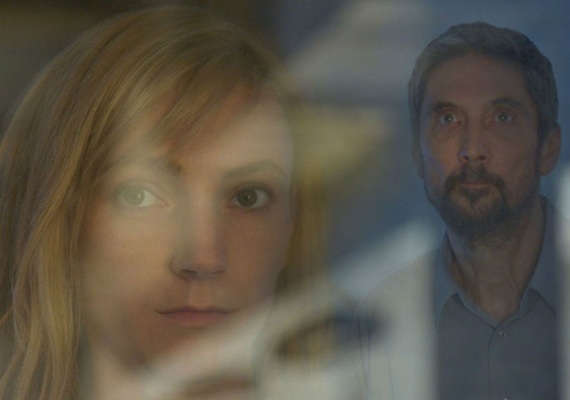
Ildikó Enyedi’s “On Body and Soul” opens on a buck and a doe going through snowy woods, in a fantasy that climaxes with the buck placing it’s head on the doe’s neck in a haunting gesture of relationship. Endre (Géza Morcsányi) and Maria (Alexandra Borbély) both see the same dream at night.  Both of them work in a slaughterhouse. Endre is the manager, a middle aged man with a disabled arm. Maria is the new hygiene inspector in the farm. She examines the slaughtered beasts for signs of disease or excess fat. She finds difficult to interact with human beings. In this film,we see some explicit shots of animals being chopped up. Such scenes might give an eerie feeling to the film throughout. Endre and Maria begin to fall in love. Both do share the same dream but when it comes to real life,both of them struggle to continue the relationship. Endre has a disabled arm while Maria finds it tough to communicate with him. Maria watches pornography to know about sex in details.  Both are lonely in their own lives. Just like the cows of the slaughterhouse, both of them are imprisoned in their worlds. Endre mostly talks to Jenö (Zoltán Schneider) but he is far from being his friend. One of the most interesting aspect of the film is the way window is used to separate them. At-times, Endre watches Maria through the windows of his office.
At canteen,he watches her through windows. They are so close yet so far. One day, both of them try to sleep in one room together. While doing so,they can’t sleep at all. The film is extremely well-shot. A lot of the imagery is splendidly unsettling. The music is hauntingly beautiful and Ildiko Enyedi’s direction is controlled and intelligent. She succeeds in connecting between human and animal behaviour and depiction of the alienation of modern human being.  Géza Morcsányi gives a stunning performance as Endre . He successfully conveys all the emotions with a bit of sophistication. Alexandra Borbély is even better than him. Some actresses perform so wonderfully that it stays in your mind forever. She is beautiful but in most part of the film she acts as if she suffers from inferiority complex. She hardly looks confident. The script is nuanced, poignant and thought-provoking, with some pertinent points made about the subjects it explores.