Antikörper (Antibodies)

Antibodies


Written and directed by Christian Alvart, the film begins with two German police offers on a call in which a woman has been hearing screams from an upper floor of an apartment. Upon investigating, the two officers are caught off guard and blasted by an alleged serial killer Gabriel Engel (Andre Hennicke), the man who has killed and sexually assaulted 13 young boys.  Soon Engel is caught and taken into custody. But he keeps mum about what he has done. Meanwhile, in a small country village, local farmer and town constable Michael Martens (Wotan Wilke Mohring) has been trying to solve the brutal murder case of a local 12-year-old girl.  Hearing the news of Engel’s capture, the villagers believe that cops finally managed to catch the killer. But Michael is not convinced. Michael goes to the big city in hopes to find out the truth directly from the killer, himself. As he begins a deadly mind game with the madman, he gets more questions than answers. There have been a lot of comparisons between this film and Jonathan Demme’s Silence of the Lambs.  However, this film differs by directly referring to Silence of the Lambs in the very first meeting between Michael and serial killer Engel.
As the two meet for the first time, Engel says, “What did you expect? Hannibal Lecter? ” By doing this, the film is clearly able to take a stand different from Silence of the Lambs. Both the lead actors  (Hennicke and Mohring) do a superb job in their respective roles. Hennicke’s character is much more vicious than Hannibal Lecter.  Hennicke’s performance is incredibly effective and, in a way, much more terrifying than Hannibal Lecter. The cinematography of this film is stunning.  Hagen Bogdanski did an incredible job here. The grey and blue-tinted color is used to depict the big city while the warm picture gives the feel of the countryside. From the beginning, the film is imaginative, brave and unpredictable.

 

Black Narcissus

Black Narcissus

British nun sister Clodagh (Deborah Kerr) is chosen by her superior to establish a school and dispensary in the Himalayas. Her companions being Sister Briony (Judith Furse), Sister Phillipa (Flora Robson) and Sister Ruth ( Kathleen Byron). Her superior believes that she is too young to take such responsibility in a strange place still she wishes her well.  When they arrive in the place, they are stunned to discover that the wind is blowing hard all the time and their building used to be a harem. Mr Dean (David Farrar), an Englishman who serves as the ruler’s agent warns the sisters that it will be difficult for them to have much impact on local people who have their own traditions and customs. His confidence and charm are noted by both sister Clodgah and sister Ruth.  The exotic place and the constant wind lead Sister Clodagh to remember her past as a young woman of privilege in Ireland. Meanwhile, Sister Ruth plunges even further into her sexual fantasy by convincing herself that she loves Mr. Dean, even though he has barely talked to her. Black Narcissus is a digitally restored 1947 classic English film directed by Michael Powell and Emeric Pressburger. Powell called it an erotic film, and so it is on many levels. There is the sexual arousal of Sister Ruth who gets rid of her habit and puts on a red dress and thick red lipstick in her bid for Mr. Dean’s affections.
There is little surface action in Pressburger’s script. Characters come and go, including an impossibly beautiful Jean Simmons, as a 17-year-old bride who has been rejected by her husband. Despite its dazzling visual sweep, not one frame of Black Narcissus was filmed on location. The shots were taken inside studio. The mountains and the castle are the creations of production designer Alfred Junge, and the magnificent color photography, surely among the finest work ever produced for the medium, is the contribution of Jack Cardiff.  Powell builds Black Narcissus as a series of moods created through space and color. He contrasts the boxy interiors and blank walls of the British colonial offices with the curved, multi-leveled chambers of the old palace. Deborah Kerr gave a stunning performance and Kathleen Byron was convincing as crazy, possessive woman.

Alice doesn’t live here anymore

Alice doesn't live here anymore

It starts with a scene where kid Alice is shown playing with her doll while her mother shouts at her to come back in home. Moving to the next scene,it shows a middle-aged woman named Alice (Ellen Burstyn) shouting at her son to lower the volume of music while her husband keeps shouting at his wife and son both. During this scene, it also shows Alice having fun with her son in a mischievous manner.  During the first 10 minutes, it was clear that Alice lives in a loveless marriage. Her husband is a weird person who neither cares for his wife, nor for his son. But Alice loves her son but the kid naturally doesn’t realise her position in the marriage. When her husband Donald dies unexpectedly, Alice decides to pack up and head out from New Mexico with her son Tommy and restart her singing career .
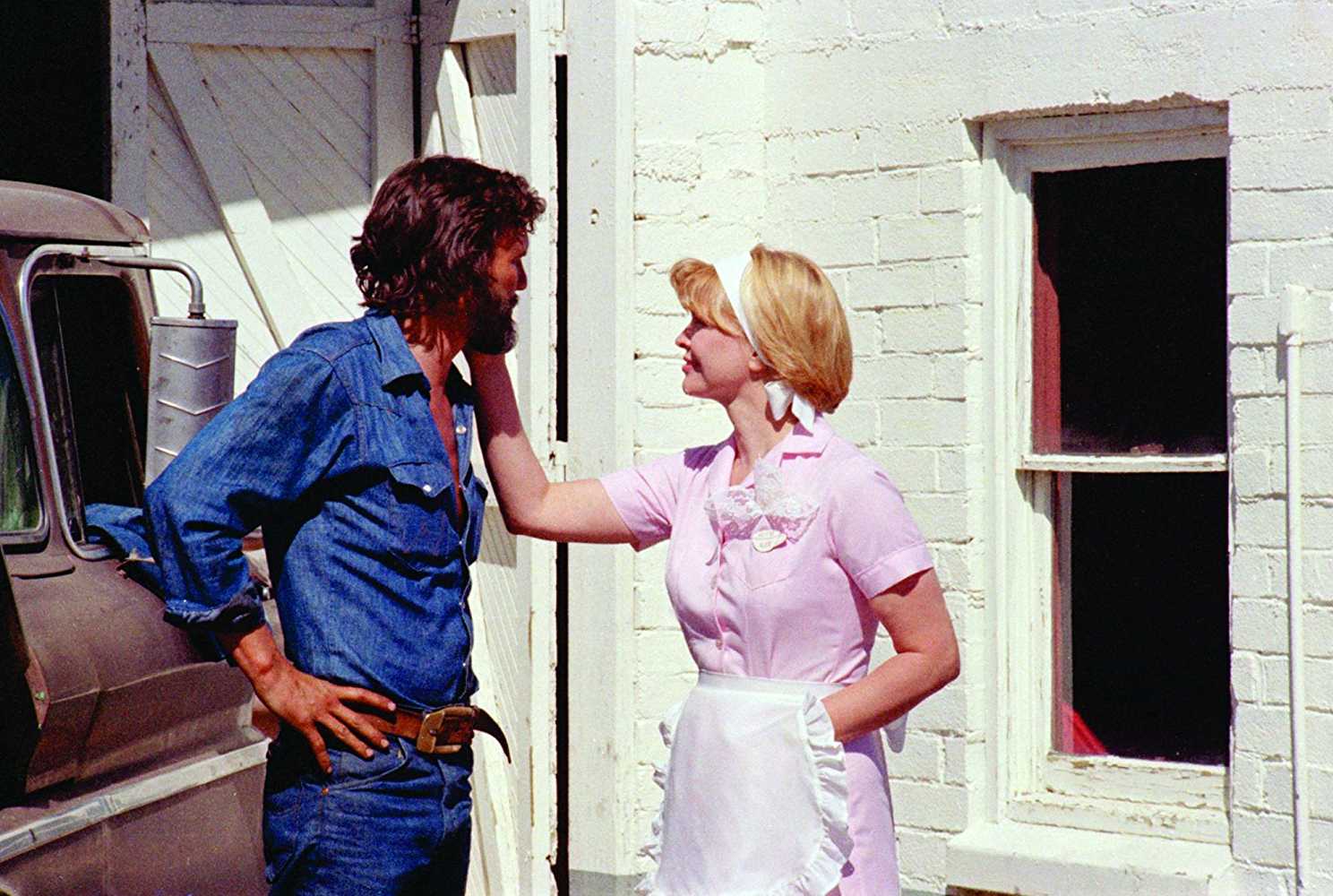
Alice and her son share an interesting relationship throughout. The kid is naughty and Alice is not uncomfortable while hurling abuses at him. Yet both of them love each other deeply. Along the way, she meets some genuinely good people who help her.  She also meets one psychopath called Ben (played amazingly by Harvey Keitel) . Later, she takes job of a waitress in a restaurant where she runs into a divorced young farmer (played by Kris  Kristofferson).  The death of her husband enables Alice toward some kind of self-awareness and self-sufficiency. The spectacular thing was the way Scorsese created the character called Alice.  I don’t know if  Scorsese was conscious of  it or not but he created a character who is flawed yet she searches for her own identity.  She is like any other regular woman who wants to settle with her partner.  She goes through a lot of struggle in her own life just like many women do in their own way.   Alice is not fiercely independent . She doesn’t understand deep politics of feminism yet her struggle can be linked with feminism.  So here Scorsese consciously or unconsciously creates a character who doesn’t wear the “badge” of feminism on her sleeve. Yet this is a feminist film and that is where lies the beauty and uniqueness of this film.  Ellen  Burstyn has been a spectacular actress . She was fully believable while showcasing vulnerability of her character.  Kris Kristofferson was dependable.

Far From Heaven


far from heaven


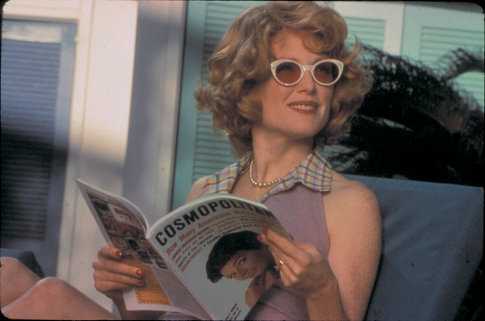
Like Sirk before him, Todd Haynes is fascinated with the thin lines that separate the world from a perceived version of reality and the paths of resistance that lie therein. Cathy (Julianne Moore) is a mother of two, married to a rich businessman Frank (Dennis Quaid) who works for a powerful television sales company.  The couple embody everything that is seemingly “perfect” about upper middle-class suburbia. A reporter does a story on Cathy for the local paper and claims that Cathy is “kind to the Negroes”. One day Cathy finds Frank doing sex with another man. She becomes so isolated that her most comforting moments are conversations with their gardener Raymond.  But Raymond is black and that was 1957. Everything about Far from Heaven playfully yet reverently implies to the 1950s as a movie genre.  Mark Friedberg’s production design is outstanding, surpassing his previous works. Sandy Powell’s costumes are superb, especially for Moore herself who is allowed noticeably fuller skirts to wear. As Cathy, Julianne Moore gives a performance that can be called nothing less than outstanding. She is utterly heartbreaking as a good-natured woman, totally bewildered by the curves life is throwing at her while trying to maintain a façade of normalcy. As Frank, Dennis Quaid gives a controlled and restrained performance. Todd Haynes’s film is not socially progressive film. It doesn’t take any specific stand on homosexuality. It is a tribute to 1950s melodramatic films and it is made exactly the way it should have been made during that period.