
Aar Paar

Aar Paar

I noticed that I had not reviewed a single film of Guru Dutt on my blog. In order to make amends, I decided to review one of his films. Kalu (Guru Dutt), a taxi driver who was sentenced to prison for speeding, is released two months before his term for good conduct. Wandering the streets, Kalu helps a young woman Nikki (Shyama) to fix her car.  He gets a job at Nikki’s father’s garage and love blossoms between Nikki and him.  When her father finds out, he kicks Kalu out.  An encounter with the mysterious Captain results in a brand new job for Kalu. Captain is planning a Bank robbery and thinks Kalu would be useful in driving the car.  Kalu joins with the captain’s gang which includes a dancer (Shakila) and a guy named Rustom (Johnny Walker).  In Aar Paar, Guru Dutt took his talent for song picturization to several notches above the commonplace.  Songs in his films often take place in locations occupied by the characters in his films. A fine example here is the romantic duet Sun Sun Sun Sun Zalima. The song is set in the stark and unromantic atmosphere of a garage with a car providing the center-piece but the way two lovers circle around each other within this space is a brilliant piece of choreography.

The other song whose picturisation deserves a special mention is- “babuji dheere chalna pyaar mein zara sambhalna” (Shakila’s great entry).  Aar Paar was a significant turning point in the life of composer OP Nayyar who went on to become an extremely successful music director.  Songs like Babuji Dheere Chalna, Yeh lo Main Hari Piya, Mohabbat Karlo, Ja Ja Ja Ja Bewafa, all sung brilliantly by Geeta Dutt, are remembered and hummed to this day. The plot of Aar Paar may now seem formulaic but scores in its treatment.  The narrative flow is pacy and engaging, merging the elements of thrills, romance, action, and comedy rightly. Aar Paar is a noir film that is infused with humor. Dutt’s friend and collaborator, VK Murthy, was behind the camera as usual, and the Dutt-Murthy combination’s play with light and shade was nothing short of magical. Guru Dutt plays his part of the streetsmart driver with ease.  Shyama was ok.  Shakila is excellent as a femme fatale.
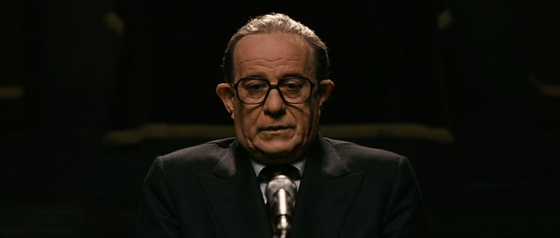
IL Divo

il divo

Paolo Sorrentino’s terrific Il Divo presents an extraordinarily sinister portrait of Giulio Andreotti, Italy’s most significant politician of the post-war era.  Between 1972 and 1992, he faced numerous trials on conspiracy and corruption charges and always escaped.   It begins as a collection of arresting images and concludes two hours later in the same fashion.  Throughout the film, the camera loops, and dances.  There is pop music on the soundtrack, low-impact electronica, and opera, too.  The film focuses squarely on the ending of his government service in the 1990s, during and after the seventh term as prime minister.  The trial surrounded his alleged involvement in the murder of Mino Pecorelli, a journalist who accused him of Mafia ties and to the kidnapping of Prime Minister Aldo Moro.  Toni Servillo gives an intricate portrayal of the man. Assisted by magnificent makeup work, he embodies the bent-eared, hunchback former Prime Minister.  His upper body seems to move as a single unit.
In the film, Andreotti is most haunted by the Red Brigades’ murder of the kidnapped of Aldo Moro, which he might have prevented.   Sorrentino tags Andreotti as the ultimate power-hungry; in one scene, he explains that the reason he confides in a priest instead of praying directly to God is because priests vote.   Il Divo tarnishes his legacy but not clearly, which is probably appropriate for a politician renowned for his opacity.

Pitfall (Otoshiana )

PITFALL.jpg

Pitfall is set against the background of labor relations in the Japanese mining industry.  It’s the first collaboration between Teshigahara, writer Kodo Abe.  A miner and his son travel the countryside searching for work.  Stalked by an unnerving, immaculately suited assassin he is killed brutally and left for dead.  It is also a ghost story, as miner rises from the dead and wanders the camp looking for answers to his murder. The child hides and avoids contact with the human beings around him.  Tesigahara builds a fascinating film by using a number of different tools-cinematography, numerous themes and a range of genre and stylistic conventions.  The film is not only an unsettling ghost story but also a murder mystery, a tragic tale of human desperation.  Meanwhile, the music is creepily effective in making you very aware of the characters’ every move and keeping you on edge.  Teshigahara’s visual flair, evident in his sculptural use of wastelands and remarkable superimpositions, is matched by  Takemitsu’s unorthodox score.