The Big Steal

the-big-steal

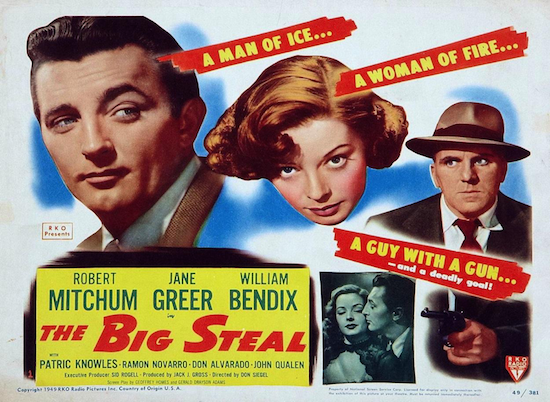
The Big Steal is an action-packed crime film starring Robert Mitchum and Jane Greer. Directed by Don Siegel, The Big Steal defies easy categorization. It’s not so much a film-noir as it is a hard-boiled crime film, loaded with crisp dialogue, witty and sarcastic banter between the leads.Duke Halliday (Mitchum) arrives in Mexico in search of army payroll cash that he alleges was stolen by Jim Fiske (Patric Knowles). He runs into Joan Graham (Greer), who is after the money she gave to her boyfriend, Fiske. The two attempt to track down Fiske, all the while being pursued by the U.S. Army Captain Vincent Blake (William Bendix). It may not be one of Mitchum’s iconic roles, but he’s really quite good here. As for Greer, she’s no femme fatale in this. She’s just a strong woman along for the ride. It was shot on location around Mexico City, which helps give it a more exotic look. This film is sort of like a mixture of film noir, and adventure film, a comedy and it’s all set in Mexico. Don Siegel masterfully directs this fast-paced, well-constructed and highly enjoyable road chase film noir that stretches the genre’s conventions.


Glory (Slava)

glory-slava-locarno

Glory is a 2016 Bulgarian drama film written and directed by Kristina Grozeva and Petar Valchanov. The film plays like a parable that keeps expanding its themes. Solitary railway worker Tsanko (Stefan Denolyubov) discovers a pile of cash in the middle of the tracks, but instead of taking the cash, he informs the authorities. Workaholic publicity executive Julia (Margita Gosheva), takes the oppurtunity to hide a corruption scandal by holding a ceremony to hail Tsanko as a hero. At the conference, she bullies him to remove his watch, to put on the crappy digital one he’s awarded for being an honest citizen. At the conference, when Petrov insists that he knows why the national company is suffering huge financial losses,the minister ignores him. When he wakes up the next morning, the gift no longer works. When Tsanko calls the administration to get it back, Julia tries to shrug him off. Hailed as a hero by the government, the bewildered Tsanko’s experience becomes the pawn of a bureaucratic agenda. Dashing between meetings and phone calls, Julia tries to satisfy her husband attempting embryonic fertilization therapy, even as she remains uncertain about motherhood. Gosheva’s performance brilliantly conveys that divided state. Gosheva plays the part to the hilt, never seeking to soften the character. Glory displays the distance between the corrupt authorities and the hardworking employees of the state superbly. The screenplay written by the two directors together with Decho Taralezhkov finds an interesting way of making the two worlds collide.


Mother (Ema)

ema

Smartly crafted mystery film set in a small town of Estonia where everyone is thinking of something big. Elsa (Tina Malberg), the mother forced to give up her job to care for her unconscious teacher son Lauri (Slim Maten). Stuck in a dull marriage with Arvo (Andres Tabun), she’s been having an affair with Aarne (Andres Noormets).  In between confessions and tears, Lauri’s friends, girlfriend, admirers and the town’s local policemen all ask the same questions: who shot him and why? And where is that money he withdrew shortly before his attack? Elsa’s life is, in short, not her own. It is claustrophobic, suffocated, and determined by the demands of the men around her. One by one, people knock on the door to come visit him. Each character sits by his bed,talking to him. This includes Lauri’s friend Andres (Jaak Prints), whose failing company needed a cash influx; girlfriend Liina (Katrin Kalma); and his student lover Riin (Rea Lest), perhaps the only person not interested in the missing money. But as the police inquiry into the crime progresses, some of his closest ties are interrogated. Unfolding at a rapid pace, Mother is structured as an episodic series of house visits to the unconscious Lauri, and mostly played for deadpan comedy with lightly noir-ish touches that darken as the plot grows thick. Director Kadri Kõusaar carefully wrote a script that slowly pieces together the truth behind Lauri’s shooting through his visitors’ confessionals to the comatose protagonist.

Rebel Without A Cause

rebel-2

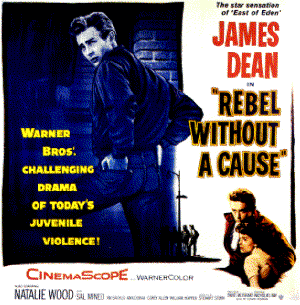
Directed by Nicholas Ray, it offers both social commentary and an alternative to previous films showing wrongdoers in urban rural locations. The title was taken from Robert M. Lindner’s  1944 book, Rebel Without a Cause: The Hypnoanalysis of a Criminal Psychopath. The film itself, however, does not reference  Lindner’s  book in any way.  Rebel Without a Cause is a look into the life of Jim Stark (James Dean) and his attempt to try and figure out what he wants to do with his life. After being taken to the police station his parents are brought in to help find out what he did. . His parents (Jim Backus and Ann Doran) are unsure what to do with him. Also at the station is Judy (Natalie Wood) and John “Plato” Crawford (Sal Mineo). Jim offers his coat to Plato but he refuses.  The next day is Jim’s first day at his high school. It is hear where he encounters Buzz, the leader of the “cool” crowd. Buzz and his gang slash the tires of Jim’s cars and a fight starts. The boys decide to settle their differences by having a ‘chicken run.’  During it, Buzz is killed when he is unable to escape from his car in time. Jim’s parents are kindly and liberal, but are too indulgent. Judy starts off as a member of the ‘ cool crowd’, as she is Buzz’s girlfriend, but after Buzz’s death a romance develops between Jim and herself.

The main theme of the film is the choice between the desire to conform to accepted values and the desire to rebel by finding one’s own individual ones, a choice that  seems legitimate in one’s teenage years. The film suggests that this choice is more complex than might be thought. Throughout the film there is an atmosphere of heightened emotion. It is a film that needs fine acting, both to convey this emotional atmosphere and to do justice to its ambitious theme. Sal Mineo as Plato and Natalie Wood as Judy are both good, but James Dean is better than good, making the tormented figure of Jim come vividly alive.

Ma nuit chez maud (My Night at Maud’s)

ma-nuit-chez-med

My night at maud’s is a 1969 French film directed by Eric Rohmer. It is the third film in his series of six moral tales. In this film, an introverted Catholic enginner (Jean-Louis Trintignant) is introduced by his Marxist friend Vidal (Antoine Vitez) to Maud (Francoise Fabian), a charming middle-aged woman and ends up staying the night in her apartment. They spend the evening talking about philosophy and religion, particularly about their different views on Pascal and his wager.  Pascal offered a pragmatic reason for believing in god : even under the assumption that god’s existence is unlikely, the benefits of believing are so vast as to make betting on theism rational. If god does exist, then our lives gain meaning and our reward is eternal. The three main characters are an interesting study in contrast. Vidal sees the wager as a logical tool for explaining everything, from religion to politics. For Jean-Louis, Pascal is too strict, a man who has sacrificed sensual pleasure.
Maud believes in the supremacy of love. After Vidal leaves, Maud tells Jean-Louis about her marriage, her ex-husband’s Catholic mistress, and the tragic end to her affair with the only man she loved. The girl that Jean-Louis is currently chasing is 22 year old Francoise ((Maire-Christine Barrault) a blonde,catholic girl that he has seen at church. They too fence with words as they try to mislead and reveal at the same time, and the audience is intrigued. Jean-louis is conflicted between his Catholic principles and his love of sensual pleasure.  He lives in a world centered on himself, involving in much philosophizing about choice but never choosing. Once Vidal leaves, Jean-Louis stays the night. Maud effortlessly engages Jean-Louis in a game of intellectual chess, provoking him with his own illusions about love. On the surface, the film appears very simple but underneath there is much complexity. Rohmer’s approach has often been called literary. He combines his intellectual interests with an intense examination of everyday life.