Confessions

confessions-2010


Confessions is a 2010 Japanese revenge drama directed by Tetsuya Nakashima, based on housewife-turned-author Kanae Minato’s 2008 mystery novel. High school teacher Moriguchi (Takato Matsu) announces in her class that she will resign shortly. Her young daughter was murdered by students identified in her class. She not only reveals the murderers’ identity but also explains how she plans to take revenge on those students. This leads to serious repercussions for some of the pupils. Twists and turns in the story then unfold for the viewer as we are retold further confessions to piece it all together. The story is told through confessions of various characters in the film, sometimes repeating the same event from different perspectives. Everyone expresses their own hopes and despair,sadness and hatred. The fast narratives combined with hauntingly beautiful slow motion imagery and mesmerizing background music gave this film an eerie atmosphere. The “blue” look and the ominous, monotonous soundtrack just adds to the film’s darkness.  Matsu Takako gave a superb performance in the lead role. Her control of emotion was perfect in the first half as a ruthless teacher who suffers from tremendous pain. In the second half, her character breaks down a couple of times. Confessions is a dark revenge drama that works quite well because of how the director structures the story. The film does falter slightly, though, from some overdone and contorted scenes drawing dangerously close to being gimmicky.


Invasion of the body snatchers

invasion-of-the-body-snatchers


Invasion of the body snatchers is a 1978 science fiction horror film directed by Philip Kaufman. Released on December 1978, it is a remake of Invasion of the Body Snatchers (1956), which is based on the novel The Body Snatchers by Jack Finney. The film follows many of the same plot points as the original, save for it is two  decades later, and set in the big city of San Francisco, rather than a small town.  The film follows Matthew (Donald Sutherland) a San Francisco health inspector who soon finds out, along with his co-worker Elizabeth (Brooke Adams), that an alien plague of pods has descended, and that people are being replaced by duplicates grown from them. As the pods grow, they replace their victims as they sleep, and suck out their memories and bodily fluids, leaving the original person a dried shell. The first person, in the film, to be podded is Elizabeth’s boyfriend Dr. Howell, a dentist. When he seems distant, it leads Elizabeth to the conspiracy, and into the arms of Matthew, who is secretly in love with her. He suggests she see his friend, David Kibner (Leonard Nimoy), a famous psychiatrist with best selling helpful books.

This film works because of a constant sense of paranoia. This paranoia begins to spread like wildfire as several citizens notice a bit of the same. Where the protagonists in Siegel’s film  were well-to-do and crisply dressed, the characters in the 78 version are engagingly odd.  Unlike the original, the film’s memorable for its use of outlandish special effects. In one startling scene, Brooke Adams is menaced by a dog with the head of a man. The 1978 Body Snatchers is most memorable, however, for the pod people’s habit of pointing and screaming at human escapees. It’s a trait that wasn’t exhibited by the eerily calm invaders of the earlier film, and its use here is absolutely terrifying. The typical unusual ’70’s cinematography is from Michael Chapman. There are some really exciting chase scenes at the end of the film. One of the greatest aspects of this film is its socio-political resonance. It can be interpreted as a state of minority versus majority, us versus them and individualism versus social conformity. The film has a dark brooding atmosphere throughout and there is a sense of realism in this film.

Raman Raghav 2.0

raman-raghav-2-0

Raman Raghav was a psychopathic serial killer who operated in the city of Mumbai in the mid 1960s. His real name was Sindhi Dalwai. All the murders took place at night and were committed using a hard object. He also raped his sister before killing her.  This film is not about him. The electrifying atmosphere at the night club that follows instantly takes the audiences in the trance for a gut wrenching, dark, intense thriller about a killer and a policeman that brings in different shades of evil and inhumanity.  Nawaz, who plays the notorious serial-killer Raman, is inspired by the real-life serial-killer, Raman Raghav. The screenplay follows his exploits as he steers the bylanes, slums, and rundown apartments of Mumbai, piling on the bodies and indulging his dark fantasies.  Vicky Kaushal (Raghav) plays the DCP of the Mumbai Police Force . Kaushal is as emotionally bare as Nawaz, with the only difference being that they emotional voids are targeted at the opposite spectrums of the law. He’s an addict to the core, and has no apologies about being one just like Nawaz has none about his murderous wrongdoings.

Raman calls himself Sindhi Dalwai and finds a partner in Raghav. Through eight chapters- Locked Man, The Sister, The Policeman, The Hunter, The Hunted, The Son, The Fallen and Soulmates – Kashyap builds his characters to a tall dark shadow that scares us out of our wits.  Nowhere does the camera focus on a smashed, bloodied head yet the way with which Nawaz carries out each murder is gory and makes you want shut your eyes. The camera work is also crisp as  it travels to murky bylanes of Mumbai with as much ease as it captures the city’s impressive skyline at night. Siddiqiui is appropriately creepy as Raman, a long scar running down his forehead, an unmistakable glitter in his eyes. While not as spine-chilling as his more counterpart, Kaushal holds up his end impressively.  Both Ramanna and Raghav are also creatures bred and brought up in patriarchy, are victims of it ( Raghav’s submissive equation with his dad for instance) yet preserving its deep misogyny. Some sequences stand out. Ramanna holding his sister’s family hostage brings out his sick mind in an anxious  way possible. Raman Raghav 2.0 is a taut thriller, full of energy and overflowing with tension.

The 39 Steps

the-39-steps

The 39 Steps has the classic Hitchcockian theme of an average, innocent man caught up in extraordinary events which are quite beyond his control. Over a span of four days, the smart and unflappable protagonist, Richard Hannay (Robert Donat) is involved in a circular journey to prove his innocence and expose the hive of intrigue. The opening of the film, the first three shots do not show him above his neck. With his back to the camera, he is followed down the aisle to his seat. He is then assumed to be lost in the crowd. This gives the audience the feeling that he could be anybody. During a music hall brawl, Hannay agrees when a mysterious woman asks if she can go home with him. He takes her to his flat.   There, she tells him that she is a spy, being chased by assassins. Later that night she gets murdered and the man stands accused. En route, he has many adventures as he flees across the South Scotland landscapes, including being handcuffed to a woman (Madeline Carroll) who happens to think he is guilty of the murder. Donat is a charming lead and he plays it well. Carroll is well used as the traditional blonde cast by Hitchcock, she is a little disorganized but she is a match for Donat in early scenes. The 39 Steps stands out because it was one of the Master of Suspense’s first “talkies”; like any artist trying something new, his strokes are at once nervous and brash, and his motifs wonderfully contradictory.  It was made at a time when film-makers were experimenting with sound, yet Hitchcock uses silence to heighten the tension.


Inherit The Wind

inherit-the-wind

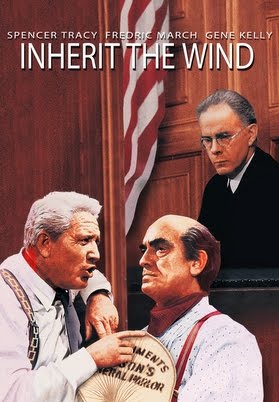
Inherit the wind is a fictionalized story of the 1925 famous “Monkey” trial. The trial took place in Dayton, Tennessee, in 1925. The trial did put a young high school teacher named John T. Scopes prohibiting the teaching of any theory that denied the biblical account of divine creation. Scopes was defended by the legendary Clarence Darrow, and the prosecution was led by three-time presidential candidate William Jennings Bryan. Darrow’s expenses were paid by the Baltimore Sun papers, home of the famous journalist H.L. Mencken. In Stanley Kramer’s film, Darrow becomes Henry Drummond (Spencer Tracy), Bryan is Matthew Harrison Brady (Fredric March), Mencken is E.K. Hornbeck (Gene Kelly), and Scopes is Bertram T. Cates (Dick York). Certainly most of the citizens in the film’s fictional town of Hillsboro, Tenn, believe in the literal truth of Genesis. “There’s only one man in this town who thinks at all,” Drummond roars, “and he’s in jail. ” The judge clearly admires Brady, even addressing him as “Colonel” in court. Drummond objects to this, so, as a result, the mayor reluctantly makes him a “temporary” colonel just for these proceedings. March and Tracy bring the full force of their talents to their roles as opposing lawyers (and one time friends) who face off on the issue of evolution vs. creation.The film features an iconic performance by Spencer Tracy. Florence Eldridge, March’s real life wife, is excellent as March’s film wife who recognizes the flaws in her husband, but loves and admires him anyways. March is at turns witty, cunning, over-the-top, hammy or contrite, depending upon the demands of the scene. His scenes on the witness stand with Tracy are among the best written and beautifully acted pieces in film history.What Kramer so effectively captured in the tightly shot film — was the intense claustrophobia and choking heat of the setting, the barely contained violence this conflict engendered.