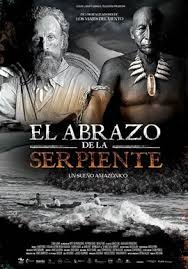
Embrace of the Serpent (Spanish: El abrazo de la serpiente) is a 2015 internationally co-produced adventure drama film directed by Ciro Guerra. A young shaman named Karamakate (Nilbio Torres) squats beside a river, waiting and watchful, as two other men approach in a boat: Theo (Jan Bijvoet), a German explorer, and Manduca (Miguel Dionisio Ramos), his local guide. It’s sometime during the early 1900s, and Theo, severely and mysteriously ill, is searching for the yakuna, an exceedingly rare flower that could heal him of his sickness. When Theo offers to help Karamakate find the surviving remnant of his tribe, the wary shaman agrees to help, initiating a hazardous journey that will take the three men ever deeper into the wilderness while throwing their personal and cultural differences into sharp relief. In Karamakate’s eyes, the European and American marauders who enslaved and destroyed his tribe are agents of an insane culture devoted to genocidal conquest and avaricious destruction. Later American Botanist Evan makes the same journey with the older, weakened Karamakate (Antonio Bolívar Salvador), whose tribe is now extinct.
The film jumps between the two journeys, which follow roughly identical routes. Guerra has a great ear for the self-justifying and delusional presentations of both Theo and Evan. He shows us how their politeness and curiosity—compared to that of other Europeans, anyway—keep even the most skeptical natives from rejecting them out-of-hand. Filmed in black and white by cinematographer David Gallego, it is the first film to be shot on location in the Amazon in thirty years and its gorgeous kaleidoscope of rivers and forests, and the blending of time creates a surreal, dreamlike atmosphere. David Gallego’s cinematography is absolutely gorgeous throughout, and adds a dimension to the journeys as we see first-hand the sociological and biological destruction caused by colonialism and the rubber barons. The forgotten cultures are reason enough for the natives to distrust white men, yet the mysticism and pride of the indigenous tribes are fascinating. The film doesn’t beat around the bush. As it progresses, it becomes evident that the plot is about the devastation of colonialism and what it had done to the land & its people. Everything from spreading Catholicism to Rubber Farming, more and more they see the land changing for the worse.

 debarshithecinemaniac