Damul

damul

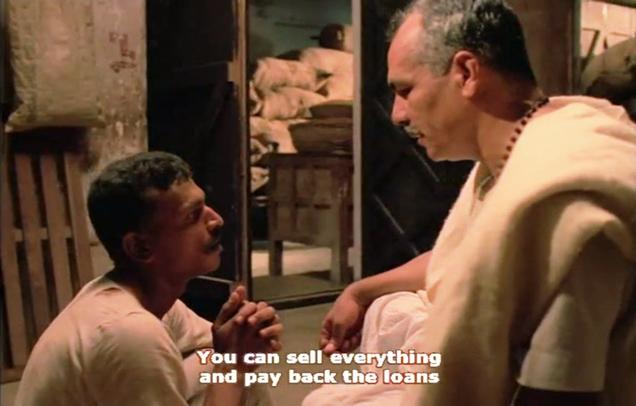
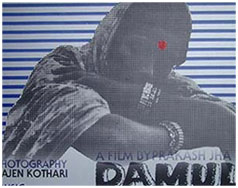
Damul is a 1985 Hindi film directed by Prakash Jha, based on the story Kaalsootra by Shaiwal, a native of Gaya district of Bihar. The story is about a bonded labourer Sanjeevan (Annu Kapoor) who is forced to steal for his  landlord Madho (Manohar Singh), to whom he is bonded until death. In a parallel development the landlord’s younger brother kills his labourers who try to flee from his construction site due to low wages.  Finally, the landlord’s mistress Mahatmain (Deepti Naval) decides to come out and make a statement before the authorities.  Madho keeps the debt-ridden and illiterate lower castes in eternal bondage, using their labour to win elections.  There is rivalry between Madho Pande and Bachcha Singh (Pyare Mohan Sahay), a Rajput, who is waiting for an opportunity to settle scores with the former. 

damul 1   damul 2

Damul makes links between caste, politics, the rural economy and migration. Rajen Kothari’s textured cinematography and mobile camera create just the right setting for a timeless tale of modern-day slavery. Through the unfolding of Damul, the viewer is almost continuously exposed to a series of audiovisual shocks. There is murder in cold blood, there are mass killings of defenseless people, sexual blackmail of a helpless young widow of high caste. The camera captures the subtle nuances of the facial expressions in close-up. The light in the Harijan basti is muted and natural- a glow here, a soft light there, the fiery flames heightening the credibility of the event or scene. The editing is slick without any jerks and jars that the violence could have justified. Manohar Singh is outstanding as Madho Pande. Annu Kapoor as Sanjeevan is very impressive while Sreela Majumder as his wife attracts notice. Deepti Naval’s brief stint as Mahatmain is adequately enacted. Damul remains Prakash Jha’s best film till date. 
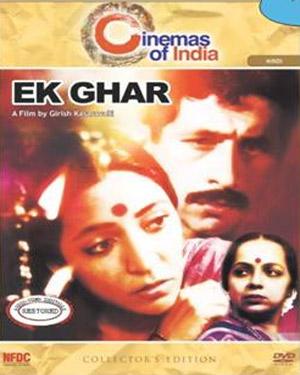
 

Ek Ghar

Ek Ghar

Ek Ghar (The House) is a 1991 hindi psychological drama directed by Girish Kasaravalli. Rajanna (Naseeruddin Shah) and Geeta (Deepti Naval) arrive in the city in the fond hope of building a little home.  He works as a supervisor in a MNC which manufactures bulldozers. Rajanna finally manages to find a house. However, when a workshop opens up next door, they are troubled by the noise and find ways to attain peace.  He has been helped in securing the house with the influence of his aunt (Rohini Hattagandi). She is old,attractive and has been deserted by her husband long ago. Rajanna uses her but wants his wife to stay away from her as she may be a bad influence. The contradictions are clear both within Rajanna and in the city. Nothing is what it appears to be. In 1991, India was on the point of an economic and consequently a social revolution which must have made most men and women anxious. The film is carefully constructed and crafted.  It follows a dual colour pattern of mostly blue intersected with yellow. When he and his wife decide to take a walk, it is at night and trees appear more like concrete pillars, lit by street light. The background score by L. Vaidyanathan mixed with the noise of the city creates a perfect mood of peace lost forever.Naseeruddin Shah is convincing as the confused, disoriented immigrant while Deepti Naval and Rohini Hattagandi stole the show by their power-packed performances.

Tarpan

Tarpan-film

Tarpan was a 1994 hindi dramatic film written and directed by K.Bikram.Singh. Joravar (Ravi Jhankal) and his wife (Mita Vasisht) live together in a small village of Rajasthan. Their first daughter inexplicably passed away , and both of them take special care of their second one.  Unfortunately, she too starts suffering inexplicably. The couple set out to speak to a village elder by the name of  Jasso (Om Puri). He guides them to Sukku baba (Veerendra Saxena) -a fakir who knows the cure. He tells them to travel to another village, and cleanse the well that the upper-caste thakurs used to draw their water from years ago. A village where no girl child survives beyond the age of seven. The well would have to be cleaned by the community as a whole, before its waters can be used. Nobody seems to know about the well. The village headman (Manohar Singh) and an old woman (Dina Pathak) help them to discover the well . An old well from which ghosts of the past emerge. A woman (Revathy) fighting for the rights of her child and taking revenge of her husband’s (Pavan Malhotra) murder even after her own death. A community confessing its crimes long forgotten. The film presents a series of inter-related events in the form of four stories, which initially appears as individual disputes between members of different communities. The four stories merge into the theme of caste conflict. The interesting film wonderfully depicts the reality of caste-ridden India, where humans are discriminated against on the basis of their birth. 

Quills

Quills

Quills is a 2000 period film directed by Philip Kaufman and adapted from the Obie award-winning play by Doug Wright, who also wrote the original screenplay. Inspired by the life and work of the Marquis de Sade, Quills re-imagines the last years of the Marquis’ incarceration in the insane asylum at Charenton. Quills is a delightfully unsettling account of the demise of the Marquis de Sade and those he brings down with him. The film presents viewers with all the evidence they need to identify the illusions of society’s separation of “good” from “evil” and “moralists” from “sinners”. A dark look at an insane erotic  writer named Marquis De Sade (Rush) and his stay an asylum run by religious priest Abbe Du Coulmier (Phoenix).  While there he befriends a laundrette named Madeleine ( Kate Winslet). The Marquis dips into the extensive world of the forbidden sexual taboos of the 18th and 19th centuries, writing extensively about them without a care in the world for decorum. There is a curious relationship between the Marquis and a physician named  Royer-Collard, played by Michael Caine, who is assigned to prevent him from writing anymore. Geoffrey Rush is hilariously charismatic as The Marquis de Sade, a man who lives by glorifying the raunchiest sex acts he can imagine, but is at a loss when he finds himself falling in love.  Rush goes to all necessary lengths and doesn’t hold back whatsoever in his brilliant portrayal. Kate Winslet is charmingly enchanting as Medeleine LeClerc, a woman who was raised to be proper and distinguished and is able to let out her darker side through The Marquis’ writing.  Joaquin Phoenix is convincing in his portrayal of The Abbe du Coulmier, a man of God who is forced to confront his own demons of wrath and sexual desire constantly throughout the picture. Caine does a brilliant job of making the audience become absolutely disgusted by every one of his actions. In terms of art direction, costume design and cinematography, the filmmakers do a fantastic job in recreating this strange world of the past. The writing of the film is very good in that the film remains interesting throughout. Kaufman succeeded not only in bringing the spirit of the time but also the essence of the Marquis de Sade to the screen and he did that splendidly.


Dobermann

Dobermann

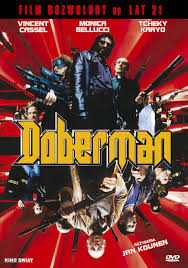
The charismatic criminal Dobermann (Vincent Cassel), who got his first gun when he was christened, leads a gang of brutal robbers with his deaf girlfriend Nat (Monica Bellucci). After a complex bank robbery, they are being hunted by the Paris police. The hunt is led by the sadistic cop Christini (Tchéky Karyo), who only has one goal: to catch Dobermann.  The cast is dominated by French superstars Cassel and Monica Bellucci (they married in 1999), playing the antihero and his ultra-loyal partner in crime, and they both manage to create a niche amidst the film’s visual excesses. But the film clearly belongs to Karyo as the deranged cop on Dobermann’s tail, an irredeemable psycho who’s prepared to break every rule – legal and moral – to bring his nemesis to book.  Dobermann not only set debut director Jan Kounen on the road to cinematic glory, it also helped to create an aggressive upsurge in ultra-commercial European cinema. This is 100 minutes of non-stop comic-book violence, a traditional cops and robbers scenario in which the police are no better than the crooks. All the thought behind this film was put into the style, and in that regard the film succeeds admirably for this is an incredibly stylish film made on a relatively small budget, the film was made for about 33 million Francs which is equivalent to about 5 million Euro’s. The directing was extremely fast paced and kinetic, full of stylish movements, rapid zooms to close ups and fast editing. The film consists of basically two sequences: a supposedly “genius” bank heist and a violent confrontation at a nightclub frequented by cross dressers.

Le scaphandre et le papillon (The Diving Bell and the Butterfly

The Diving Bell and The Butterfly

The Diving Bell and the Butterfly (French: Le scaphandre et le papillon) is a 2007 biographical drama film based on Jean-Dominique Bauby’s memoir of the same name. The film is based on a real man, and the book he somehow succeeded in writing although he could blink only his left eye. The man was Jean-Dominique Bauby (Mathieu Amalric), who was the editor of Elle, the French fashion magazine, when he had his paralyzing stroke.  A speech therapist (Marie-Josee Croze) suggests a mode of communication: They will arrange the alphabet in the order of most frequently used letters, and he will choose a letter by blinking. She passes the baton to Claude (Anne Consigny), who takes the dictation for his memoir. She makes the letters into sentences and paragraphs in a variety of different settings once Bauby is able to be moved around in a wheelchair.  The positive attitude of these women gives the patient the courage and confidence he needs to write his memoir. He also welcomes Laurent (Isaach de Bakole), a friend who reads books to him. He fondly remembers his last meeting with his forgetful father (Max Von Sydow), who loves him dearly. Later in a phone call, his dad breaks down when he realizes that he will never hear his son’s voice again. One of the most dramatic moments in the film occurs near the beginning when the first therapist thought Jean-Do communicates is that he wants to die.

the diving bell and the butterfly 1
Feeling rejected and angry, the therapist storms out of the room but apologizes and comes back shortly to resume the treatment. We do not actually see Jean-Do until about a third of the way through the film but we can hear his thoughts which are in turn angry, funny, and bitterly cynical. Much of the film vividly explores the editor’s imagination and the camera takes us on some wild rides that include images of Nijinsky, Empress Eugénie, Marlon Brando, and Jean-Do in his imagination skiing and surfing. Some of the most emotional moments occur when he greets his young children at the beach for the first time after his stroke, a telephone “conversation” with his 92-year old father (Max Von Sydow).  Mathieu Amalric has played the character of Jean with so authentication that it is hard to believe and separate his self from the real character. The most wonderful part that remains with you after the movie is the sense of humour with which Jean sees this world. He remains light hearted at times and thinks hilarious comments even in the most painful state of his being. I would also like to mention the two supporting characters who render Jean’s words on paper. Those roles are beautifully portrayed by two well known Canadian and French actresses – Marie Josee Croze (former writer) and Anne Consigny (latter writer) respectively. The Diving Bell and the Butterfly is a film of enormous power that shakes us and enables us to get in touch with the miracle of each moment.


New Delhi Times

New Delhi Times

New Delhi Times is 1986 Hindi film directed by Ramesh Sharma and written by Gulzar. The editor of the newspaper New Delhi Times, Vikas Pande (Shashi Kapoor) has to confront the politician Ajay Singh (Om Puri) who is associated with a powerful lobby of illegal liquor manufacturers.  Meanwhile, there is a power struggle going on between the existing chief minister Chaturvedi (Ram Gopal Bajaj) and the ambitious MLA Ajay Singh for the post of chief minister. On the other hand Vikas’s wife Nisha (Sharmila Tagore), who is a lawyer, is approached by an old man whose daughter is missing from her in-laws place.  Shashi Kapoor’s Pande is a man of the world, who nevertheless has not developed a cynical attitude despite the surrounding environment. Shashi has played the role with dignity and poise. Sharmila Tagore plays Pande’s supportive wife and though she does not get to do much in the film, her practical attitude comes across as a breath of fresh air after Pande’s burning idealism. The film also stars Om Puri, who is impeccable as ever,who becomes the focus of Vikas Pande’s investigations. Mk Raina, Kulbushan Kharbanda , Manohar Singh were convincing in their roles as well.

It is also one of the few movies made in India that looks at the difficulty and paradox inherent in a crime-journalist’s profession. New Delhi Times takes an in-depth look at the politically corrupt system that pervades the lives of ordinary people, who in many ways are unable to deal with it. But the film ran into all kinds of trouble. There was a lawsuit filed against it by someone who took offence to a dialogue where Vikas tells Nisha that all lawyers are liars; someone else tried to get the film banned for depicting a politician instigating communal riots. When New Delhi Times was scheduled to play on Doordarshan, it was pulled out at the last minute because of the legal battles that confronted it.  Over the years, New Delhi Times has gone on to receive largely positive reviews.

Pit and the Pendulum

Pit and the Pendulum


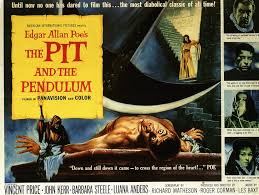
Following the sudden death of his sister, Francis Barnard (John Kerr) travels to Spain to question her husband, Don Nicholas Medina (Vincent Price), son of a notoriously barbaric Inquisitor. Medina openly mourns the death of his wife but Barnard is unconvinced by his story and is determined to discover the truth. “The Pit and the Pendulum” is the second of Roger Corman’s Edgar Allan Poe’s adaptations with a screenplay by Richard Matheson. Nicholas and his younger sister Catherine (Luana Anders) offer a vague explanation that Elizabeth died from a rare blood disorder six months earlier. During the dinner, the family’s friend Doctor Charles Leon (Antony Carbone) unexpectedly arrives and Francis discovers that his sister died of heart attack after visiting the torture chamber in the dungeons. Nicholas witnessed the murder of his uncle Bartolome (Charles Victor) and his adulterer mother Isabella (Mary Menzies) being tortured and killed by his father when he was a kid. Price himself is wonderful as usual as the tormented Don Medina. With ease he can go from melodrama to utter horror and his melancholic over-the-top melodrama was right at home in Poe’s adaptations. John Kerr makes a terrific counterpart and his performance is very believable. Steel’s aura of mystery suits perfectly the atmospheric horror of the film and Anders displays her talent for melodrama.
Pit and the Pendulum’ is a uniquely and profoundly visual experience. Richard Matheson’s screenplay is both intelligent and eloquent and Corman makes full use of what he is gifted here. The theme of being buried alive is something that appears to have fascinated Edgar Allen Poe as it appears in a number of his stories. It’s impossible to imagine the terror of being alone in an encircled space with nobody or nothing to help you escape and that’s what makes it so terrifying. Corman’s lavish, flavorful sets and unique use of color only add to the overall effect of the film.