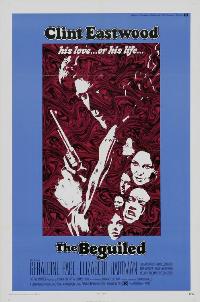
The Beguiled

The Beguiled
Directed by Don Siegel, with whom Eastwood collaborated on several films, it was made a year before Eastwood’s directorial debut with “Play Misty For Me”.  Eastwood and Siegel had to battle with Universal Pictures to keep the original ending, and they won out; and, the film was promoted as a standard Eastwood western, which it certainly is not. The Beguiled did poorly in its theatrical release.  Nobody was quite sure what to make of it, and some of its content raised a few eyebrows in 1971.  The film received major recognition in France and was proposed by Pierre Rissient to the Cannes Film Festival. “The Beguiled” is Mr. Siegel’s 26th film, as well as his most ambitious and elaborate. 

In the closing years of the American civil war, a severely injured Union soldier finds himself in the care of an all-girl boarding school. He is found by 12-year-old Amy, who takes him to the school run by Martha Farnsworth (Geraldine Page). Five other girls also attend the school, including the romantic and responsible Edwina (Elizabeth Hartman) and the desirous Carol (Jo Ann Harris).  The virginal teacher Edwins falls in love with him, and the sensual teen Carol wants to sleep with him.  Mcburney begins an erotic chess game, secretly telling each woman exactly what she wants to hear, hoping to gain a foothold of power in the house. Martha reveals herself to be a wounded, sexually confused character who has very personal reasons for not turning Mcburney over to the troops when she has the chance.  The Beguiled is entirely interested in what makes its characters tick. Sexual tension is visible in nearly every scene, even uncomfortably between Eastwood and 12-year old girls who share a kiss early on. The scene where Geraldine Page, armed with only a medical book as guide and brandy as anesthetic, removes Clint Eastwood’s leg with a hacksaw, is truly gruesome. The sexual politics are impenetrable. 

Mcburney is a hero whose stories of wartime heroics are a lie. Representing the union, he promises slave Halie (Mae Mercer) freedom before threatening to rape her. When his masculinity’s challenged he resorts to threats, threatening to loose Union soldiers on the school. If Mcburney’s a chauvinist pig, the women are stock archetypes. Martha’s rigid demeanor hides shameful secrets and unacknowledged longings. She falls for John after noticing his resemblance to her brother.  Geraldine Page (Miss Martha) was very convincing in her role; bringing lots of duality to it. Elizabeth Hartman (Edwina) was eerily convincing in her emotionally unbalanced part. Eastwood seems to be having a blast with the role until things turn really ugly, then he turns mean and ugly. it’s quite an impressive achievement overall and must be counted as one of Don Siegel’s finest films. The period details are richly, even obsessively designed and the acting is top-notch from everyone. The crisp cinematography by Bruce Surtees adds enormously to Siegel’s carefully wrought atmosphere of sexual repression.
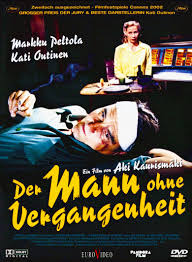
The Man Without a Past (Mies vailla menneisyyttä )

The man without a past
A welder M, played by Markku Peltola, turns up in Helsinki looking for work, dies in hospital after getting beaten by muggers but is then reborn as a man with no memory and joins a community of homeless folk living in polished contentment in empty container units. But this is not a film of a man trying to find out who he is (or was) but rather of a man trying to make a future for himself.  He finds friendship among the homeless and destitute and love with a melancholy Salvation Army worker, Irma (Kati Outinen). The government won’t help him because he has no name and no papers, so he helps himself. From the start, he continuously improves his condition. He plants potatoes next to his container and prepares for the winter. He also teaches the Salvation Army band to play spirited tunes (along the lines of “Sister Act”). “M” plays with the interesting theme of getting another chance to begin life again. We gradually see him going from a loner to becoming a part of the community.

It is the second installment in Kaurismäki’s Finland trilogy, the other two films being Drifting Clouds (1996) and Lights in the Dusk (2006). What we have here is a political allegory for our times, in which big business and the equipment of capitalism are shown as dehumanising forces of evil. The film can best be appreciated when its sly humor is at work without inhibitions. It’s a quirky film that will not suit every one’s taste, but should please those who can live with the droll acting and the Charlie Chaplin ‘silent film’ humor. What sets this film apart from other idiosyncratic adventures is its internal coherence (both in terms of storytelling and visual style) as well as the humanity of its characters.

Imdb link :     http://www.imdb.com/title/tt0311519/

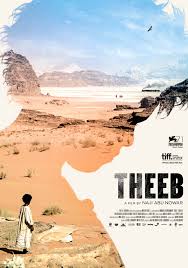
Theeb

Theeb

The film is set in a period known as Arab Revolt, when Arab nationalists sought independence from the Ottoman Turks. Events are seen through the eyes of Theeb (Jacir Eid), a Bedouin child who has had no contact with the world outside his desert community.  Theeb whose father has recently died, is the youngest of three sons in a family of guide. The story begins in traditional Bedouin desert community where a blond British army officer, Edward (Jack Fox), and his Arab sidekick, Marji (Marji Audeh), appear out of nowhere, seeking a well near the Ottoman train tracks. Hussein (Hussein Salameh), the second-oldest among brothers, agrees to lead the party and instructs Theeb to remain behind.   Theeb, whose name means wolf, disobeys his brother and follows the men to the well. When the Englishman goes for a drink, he finds only blood. There are bodies in the well. After a series of bandit attacks, Theeb is the only one left alive. Help does come, but in the badly wounded form of one of the bandits who attacked them.

The director was Naji Abu Nowar, who wrote the screenplay with Bassel Ghandour, and the stunning cinematography was done by Wolfgang Thaler.  Theeb is a bright kid who is consumed with curiosity.  Nowar has described Theeb as an “Arabic western” and the film has been compared to Sergio Leone’s westerns, in addition to Lawrence of Arabia. Throughout the film’s 100 mins, there is a significant shift between the film’s two major plotlines. However the latter half of the film is a much more compelling tale of survival against all odds, dissecting ideas about trust as the human element.  Theeb possesses some impeccable staging of cinematography as the harshness of the desert landscape is captured elegantly. In particular, Theeb possesses a beautiful sequence involving the starry night sky that is not to be missed.  Theeb deals with is nothing less grand than survival; survival on an individual level for the protagonist but also the survival of a culture .


Imdb link : http://www.imdb.com/title/tt3170902/