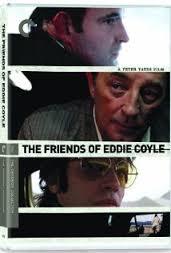
Eddie Coyle (Robert Mitchum) doesn’t want to serve a life sentence in prison, so he becomes an informant for both the police and the treasury department. The characters and dialogue are what drive this low key crime story. Eddie Coyle has no friends.
The life of a criminal is hard. Eddie Coyle is tough but wearing out. He doesn’t want to leave his wife and kids and see them go on welfare. It’s impossible to not feel for Eddie (because of Mitchum’s understated performance), who comes across as a mostly harmless man who got caught up in the wrong game and could never figure out how to unravel himself. The film’s other characters like Dilon, a hard-eyed bartender who acts as a liaison for those who are truly in power and thus don’t need to dirty their hands directly and Jackie Brown, a young gun dealer. Brown is cocky and in no way naive, but he also represents a generation that Coyle doesn’t understand. There is not a lot of physical violence in the film, with only a few gunshots being fired. Directed with a sharp eye for its gritty locales and an open heart for its less-than-heroic characters, this is one of the suspenseful crime drama of 1970s Hollywood.
Month: January 2014
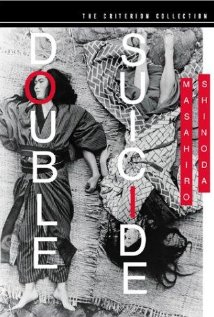
Double Suicide
Masahiro Shinoda directs this brilliant modernist reworking of a famous 1720 bunraku (puppet theatre ) play written by Chikamatsu Monzaemon. Set in Osaka , the film centers on the doomed romance between Jihei , a down and out married paper merchant passionately in love with courtesan Koharu whome he cannot afford to buy out of servitude. Their love is further hampered by Tahei , a rich ,obnoxious merchant who flaunts his ability to buy Koharu. Suicide is the only way for the two to be together. Shinoda begins the film in a modern day theater with puppeteers preparing for the show. When the story itself begins , Shinoda replaces the puppets with real actors but puppeteers’ presence remains. Figures dressed entirely in black move among the characters, helping to position them and manipulating the story. When the actual story begins, Shinoda constantly reminds the audience that they are watching a theatrical story with a predetermined outcome. Shinoda’s interiors are abstract and theatrical to the point of absurdity. Shinoda also cast his real-life wife Shima Iwashita as both the courtesan and the paper merchant’s wife. No matter where he turned ,he was stuck with the same woman. Double Suicide effectively combines the best of both worlds – the technical prowess of a master cinematician with a touching and tragic love story.

